THE CLASSIC COLLECTION✦The sprightly romance of MarsacCLASSIC FREE BOOKS
The sprightly romance of Marsac
Molly Elliot Seawell
THE CLASSIC COLLECTION · 1903
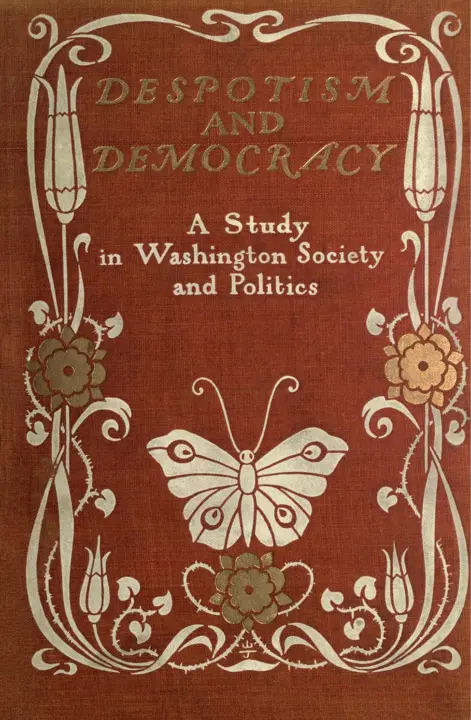
"Despotism and Democracy: A Study in Washington Society and Politics" by Seawell is a historical account written in the early 20th century. The work delves into the political and social intricacies of Washington, D.C., exploring the dynamics between different characters within the political sphere, particularly through the experiences of Geoffrey Thorndyke and Julian Crane. The themes of ambition, power dynamics, and societal expectations are likely central to the narrative. The opening of the book introduces us to two key characters, Thorndyke and Crane, as they engage in a conversation that signifies their differing perspectives on politics and ambition. Thorndyke, a seasoned member of Congress, reflects on the nature of political life and the limitations imposed by their respective bosses, while Crane, filled with youthful ambition, contemplates his recent political promotions. The setting captures the contrasts between Thorndyke's deeper understanding of political realities and Crane's naive enthusiasm for social acceptance and political success, hinting at the complexities of their characters and the unfolding drama of Washington society.
Introduction adapted from the source catalogue; source summaries may be automatically generated.
Free to read · English · 58,897 words · No account needed
MAKE TIME FOR A GOOD BOOK
On by default. Untick to stop anonymous reading totals. Each page counts after 10 seconds in view. How this works.
Anonymous counting is on unless you have switched it off.
It almost cured Crane of his infatuation for Washington society to see how little it was impressed by the large events waiting to burst from under the great white dome on the hill. Himself, in a fever heat of suppressed excitement, he felt aggrieved that dinners still went on unflaggingly, that the first long season of grand opera Washington had ever known was about to begin, and claimed much attention. None of these smart people seemed to care in the least that he was to present the report of the Committee on Foreign Affairs in an unprecedentedly short time--a report which might mean war or peace. He expressed his sense of personal injury to Thorndyke as the two sat hard at work in their committee-room one night a week after the meeting of Congress.
They were quite alone, and it might be said that the report was theirs alone. There were other strong men on the committee, but they had got used to the autocratic rule of Thorndyke, and rather liked it. He consulted them attentively, but he was always the man who acted. The new chairman recognised this, and being ambitious to rule as Thorndyke had ruled, he consulted his predecessor somewhat ostentatiously--at which his colleagues smiled and let him alone. Crane had just experienced an instance of Thorndyke’s goodwill, who was in the act of saving his chairman from making a ridiculous blunder which would have hindered his prospects very much as Oliver Goldsmith’s unlucky red coat did for him with the Bishop. The Secretary of State, a very long-headed person in a small way, had previously got the length of the Honourable Julian Crane’s foot, as the vulgar express it. He had asked Crane to play golf with him; he had invited the member from Circleville to little dinners with him. The Secretary’s wife had requested Crane as a great favour to assist her widowed daughter in chaperoning a party of débutantes and college youths to the theatre, and when a scurrilous journal had reflected grossly upon himself, a married man, and the young widow, Crane was in secret hugely flattered. To be linked, even remotely, in a scandal with the daughter of the Secretary of State was a social rise--although he happened to know that Cap’n Josh Slater, the father of the Secretary of State, had been engaged in steam-boating on the Ohio River in the wild forties with his own grandfather, Cap’n Ebenezer Crane. The Secretary’s father had made money, and his daughters were replicas of Lady Clara Vere de Vere. Of his sons, one, the present Secretary of State, had left the banks of the Ohio never to return, and by a steady evolution had passed from the Western Reserve College to Harvard, thence to Oxford for a post-graduate course, to Berlin as attaché to the then Legation, thence home to exercise a gift the politicians had found in him, viz., the power to form a silk-stocking contingent in the party to offset the silk stockings in the opposition. Being a man of some brains and much perseverance, he had reached the most highly ornamental position in the Government of the United States--the Secretaryship of State. He maintained it with dignity. He had, of course, long since, abjured the Methodist faith, in which he was reared, and was as uncompromising a Churchman as his brother, the Episcopal Bishop--for such had been the career of the steam-boat captain’s other son. Both had been brought up in an auriferous atmosphere totally denied the descendants of Cap’n Ebenezer Crane, who had lost his all in the steam-boat business, and spent his last years keeping the Circleville tavern. Crane knew all about this, one of his grandfather’s standing quarrels with Fate being that Josh Slater, a durned fool, and a rascal besides, in Cap’n Ebenezer’s opinion, had made so much, where a better man--that is, himself--couldn’t make a living. But Crane knew better than to refer to any of these matters before the Secretary, who was indeed only dimly acquainted with his father’s profession. The Secretary, a polished, scholarly man, was a very good imitation of a statesman. He liked to be called the Premier, prided himself on his resemblance to Lord Salisbury, and dressed the part to perfection. During Thorndyke’s chairmanship of the Committee on Foreign Affairs, when the present international complication had been brewing, the Secretary had been a good deal annoyed by being sent for to the Capitol on what he considered flimsy pretexts. He determined when Crane succeeded Thorndyke to make a bold stroke, and have the chairman come to him occasionally, on the sly, as it were. To this end he had written Crane a little note beginning, “My Dear Crane.” In it the Secretary spoke pathetically of his lumbago, also of his age--sixty-one--and would Crane, on the score of old friendship and the Secretary’s many infirmities, come to see him at a certain hour at the Department, and perhaps the necessity might be avoided of the Secretary taking a trip in the changeable weather to the Capitol, which otherwise would be inevitable.
Your reading position is saved on this browser. Take it to another device with a library code. Reading pages adapt to text, rather than matching a printed edition.
Molly Elliot Seawell
Molly Elliot Seawell
Molly Elliot Seawell
Molly Elliot Seawell
BEHIND THE BOOK
This eBook is for the use of anyone anywhere in the United States and most other parts of the world at no cost and with almost no restrictions whatsoever. You may copy it, give it away or re-use it under the terms of the Project Gutenberg License included with this eBook or online at www.gutenberg.org. If you are not located in the United States, you will have to check the laws of the country where you are located before using this eBook. Read the source licence.
The original source file, including credits and licence, is retained by this library. Request an original-format copy at no charge. Please include the book title and Project Gutenberg identifier #67721.
KEEP YOUR CURIOSITY GOING
Coulson Kernahan

Maurice Baring
Frances Wright
Cécile Tormay

Frederic Jesup Stimson

W. H. P. (William Henry Pope) Jarvis