THE CLASSIC COLLECTION✦The school and societyCLASSIC FREE BOOKS
The school and society
John Dewey
THE CLASSIC COLLECTION · 1916
"Democracy and Education: An Introduction to the Philosophy of Education" by John Dewey is a book published in 1916. Dewey argues that education bridges the gap between immature newcomers and mature members of society. Without deliberate instruction, each generation cannot inherit the knowledge, customs, and skills necessary to sustain civilization. As societies grow more complex, this educational challenge intensifies. Though influential, Dewey's ideas were never fully adopted in American schools, and critics question his emphasis on occupations over aesthetic origins of thought.
Introduction adapted from the source catalogue; source summaries may be automatically generated.
Free to read · English · 135,736 words · No account needed
MAKE TIME FOR A GOOD BOOK
On by default. Untick to stop anonymous reading totals. Each page counts after 10 seconds in view. How this works.
Anonymous counting is on unless you have switched it off.
To sum up: Science represents the office of intelligence, in projection and control of new experiences, pursued systematically, intentionally, and on a scale due to freedom from limitations of habit. It is the sole instrumentality of conscious, as distinct from accidental, progress. And if its generality, its remoteness from individual conditions, confer upon it a certain technicality and aloofness, these qualities are very different from those of merely speculative theorizing. The latter are in permanent dislocation from practice; the former are temporarily detached for the sake of wider and freer application in later concrete action. There is a kind of idle theory which is antithetical to practice; but genuinely scientific theory falls within practice as the agency of its expansion and its direction to new possibilities.
3. Naturalism and Humanism in Education. There exists an educational tradition which opposes science to literature and history in the curriculum. The quarrel between the representatives of the two interests is easily explicable historically. Literature and language and a literary philosophy were entrenched in all higher institutions of learning before experimental science came into being. The latter had naturally to win its way. No fortified and protected interest readily surrenders any monopoly it may possess. But the assumption, from whichever side, that language and literary products are exclusively humanistic in quality, and that science is purely physical in import, is a false notion which tends to cripple the educational use of both studies. Human life does not occur in a vacuum, nor is nature a mere stage setting for the enactment of its drama (ante, p. 211). Man's life is bound up in the processes of nature; his career, for success or defeat, depends upon the way in which nature enters it. Man's power of deliberate control of his own affairs depends upon ability to direct natural energies to use: an ability which is in turn dependent upon insight into nature's processes. Whatever natural science may be for the specialist, for educational purposes it is knowledge of the conditions of human action. To be aware of the medium in which social intercourse goes on, and of the means and obstacles to its progressive development is to be in command of a knowledge which is thoroughly humanistic in quality. One who is ignorant of the history of science is ignorant of the struggles by which mankind has passed from routine and caprice, from superstitious subjection to nature, from efforts to use it magically, to intellectual self-possession. That science may be taught as a set of formal and technical exercises is only too true. This happens whenever information about the world is made an end in itself. The failure of such instruction to procure culture is not, however, evidence of the antithesis of natural knowledge to humanistic concern, but evidence of a wrong educational attitude. Dislike to employ scientific knowledge as it functions in men's occupations is itself a survival of an aristocratic culture. The notion that "applied" knowledge is somehow less worthy than "pure" knowledge, was natural to a society in which all useful work was performed by slaves and serfs, and in which industry was controlled by the models set by custom rather than by intelligence. Science, or the highest knowing, was then identified with pure theorizing, apart from all application in the uses of life; and knowledge relating to useful arts suffered the stigma attaching to the classes who engaged in them (See below, Ch. XIX). The idea of science thus generated persisted after science had itself adopted the appliances of the arts, using them for the production of knowledge, and after the rise of democracy. Taking theory just as theory, however, that which concerns humanity is of more significance for man than that which concerns a merely physical world. In adopting the criterion of knowledge laid down by a literary culture, aloof from the practical needs of the mass of men, the educational advocates of scientific education put themselves at a strategic disadvantage. So far as they adopt the idea of science appropriate to its experimental method and to the movements of a democratic and industrial society, they have no difficulty in showing that natural science is more humanistic than an alleged humanism which bases its educational schemes upon the specialized interests of a leisure class. For, as we have already stated, humanistic studies when set in opposition to study of nature are hampered. They tend to reduce themselves to exclusively literary and linguistic studies, which in turn tend to shrink to "the classics," to languages no longer spoken. For modern languages may evidently be put to use, and hence fall under the ban. It would be hard to find anything in history more ironical than the educational practices which have identified the "humanities" exclusively with a knowledge of Greek and Latin. Greek and Roman art and institutions made such important contributions to our civilization that there should always be the amplest opportunities for making their acquaintance. But to regard them as par excellence the humane studies involves a deliberate neglect of the possibilities of the subject matter which is accessible in education to the masses, and tends to cultivate a narrow snobbery: that of a learned class whose insignia are the accidents of exclusive opportunity. Knowledge is humanistic in quality not because it is about human products in the past, but because of what it does in liberating human intelligence and human sympathy. Any subject matter which accomplishes this result is humane, and any subject matter which does not accomplish it is not even educational.
Your reading position is saved on this browser. Take it to another device with a library code. Reading pages adapt to text, rather than matching a printed edition.
John Dewey
John Dewey

John Dewey
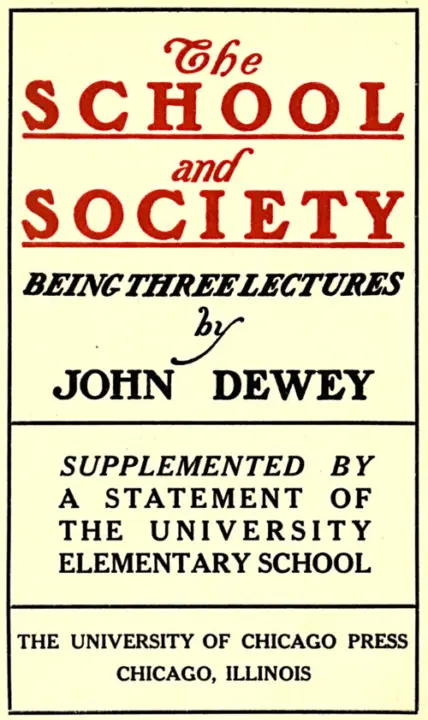
John Dewey
BEHIND THE BOOK
This eBook is for the use of anyone anywhere in the United States and most other parts of the world at no cost and with almost no restrictions whatsoever. You may copy it, give it away or re-use it under the terms of the Project Gutenberg License included with this eBook or online at www.gutenberg.org. If you are not located in the United States, you will have to check the laws of the country where you are located before using this eBook. Read the source licence.
The original source file, including credits and licence, is retained by this library. Request an original-format copy at no charge. Please include the book title and Project Gutenberg identifier #852.
KEEP YOUR CURIOSITY GOING

David Patterson (Spirit) Hatch
Coulson Kernahan

Ralph Waldo Emerson
Frances Wright

Edwin Abbott Abbott

Joseph Droz