
Recollections The Reminiscences of the Busy Life of One Who Has Played the Varied Parts of Sailor, Author & Lecturer
Frank Thomas Bullen
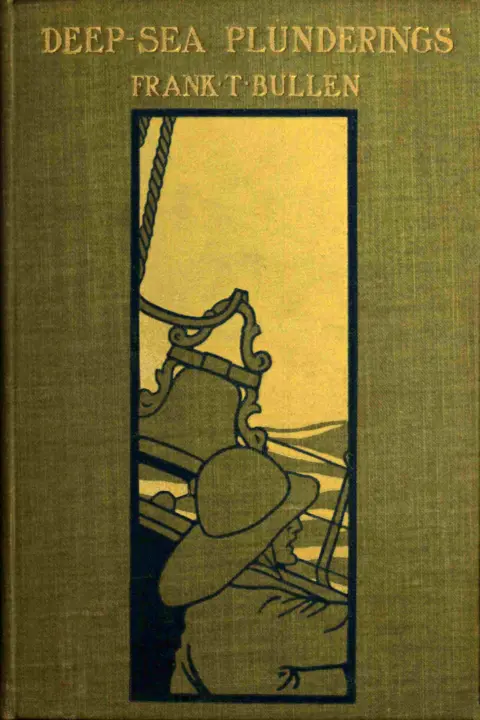
THE CLASSIC COLLECTION · 1901
"Deep-Sea Plunderings" by Frank Thomas Bullen is a collection of maritime adventures written in the late 19th century. The book explores the thrilling experiences of seafarers, particularly focusing on the world of whaling, ship life, and human encounters at sea, revealing the challenges and dangers faced by sailors in their pursuit of fortune. The opening of the novel introduces readers to the clipper ship Mirzapore, sailing toward Melbourne. As the elegant vessel glides through the sea, the chief officer, Mr. Curzon, disdainfully comments on an old whaling ship they encounter, showcasing the contrast between the gracefully designed Mirzapore and the antiquated vessel. As curiosity piques among the ship's passengers, they observe a whaling operation taking place, witnessing the perilous chase and harpooning of whales. The scene is charged with action and emotion as the crew members of the whaling ship demonstrate their skill, courage, and the brutal realities of their trade. The setting captures the essence of life at sea while foreshadowing the intricate human dramas and connections that will unfold throughout the stories in this collection.
Introduction adapted from the source catalogue; source summaries may be automatically generated.
Free to read · English · 97,853 words · No account needed
MAKE TIME FOR A GOOD BOOK
On by default. Untick to stop anonymous reading totals. Each page counts after 10 seconds in view. How this works.
Anonymous counting is on unless you have switched it off.
A fortnight later I was prowling up and down the cabin outside their closed state-room door, my fingers twitching with nervousness, and a lump continually rising in my throat that threatened to choke me; for within that tiny space, the captain, all unaided except by his great love and quiet common sense, was elbowing a grim shadow that seemed to envy him his treasure. Now and then a faint moan curdled round my heart, making it ache as if with cold. Beyond that there was no sign from within, and the suspense fretted me till I felt like a bundle of bare nerves. Overhead I could hear the barefooted step of the mate, as he wandered with uncertain gait about the lee side of the poop under the full glow of the passionless moon. At last, when I felt as worn as if I had been swimming for hours, there came a thin, gurgling little wail--a new voice that sent a thrill through the curves of my brain with a sharp pang. And then I felt the hot tears running down my face--why, I did not know. A minute later the door swung open, and the skipper said, in a thick, strange tone, “It’s all right, Peter; I’ve a son. And she’s grand, my boy, she’s grand.” I mumbled out something; I meant well, I’m sure, but no one could have understood me. He knew, and shook hands with me heartily. And presently I was nursing the bonny mite as if I had never done aught else--me that never had held a baby before. It was good, too; it lay in my arms on a pillow, and looked up at me with bright, unwinking eyes.
Then came three weeks of unalloyed delight. Overhead the skies were serene--that deep, fathomless blue, that belongs of right to the wide, shoreless seas of the tropics, where the constant winds blow unfalteringly to a mellow harmony of love. On board, every thought was drawn magnet-wise to the tiny babe who had come among us like a messenger from another sphere, and the glances cast at the tender mother as she sat under the little awning, like a queen holding her court, were almost reverential. Never a man of us will forget that peaceful time. Few words were spoken, but none of them were angry, for every one felt an influence at work on him that, while it almost bewildered him, made him feel gentle and kind. But into the midst of this peaceful time came that envious shadow again. How it happened no man could tell; what malign seed had suddenly germinated, after so long lying dormant, was past all speculation of ours. The skipper himself fell sick. For a few days he fought man-fashion against a strange lassitude that sapped all his great strength and overcame even his bright cheery temper until he became fretful as a sickly babe. At last there came a day when he could not rise from his cot. With a beseeching look in his eyes he lay, his fine voice sunk to a whisper and his sunny smile gone. His wife hovered about him continually, unsparing of herself, and almost forgetting the first claim of the babe. The children, with the happy thoughtlessness of their age, could not be kept quiet, so, for the most part, they played forward with the crew, where they were as happy as the day was long. Every man did his best to entertain them; and when sailors make pets of children, those children are favoured by fortune. Meanwhile, in the cabin, we fought inch by inch with death for our friend. But our hands were tied by ignorance, for the rough directions of the book in the medicine chest gave us no help in dealing with this strange disease. Gradually the fine frame of the skipper dwindled and shrank, larger and more wistful grew his eyes, but after the first appalling discovery of his weakness he never uttered a complaining word. He lay motionless, unnoticing, except that into the deep wells of his eyes there came an expression of great content and peace whenever his wife bent over him. She scarcely ever spoke, for he had apparently lost all power of comprehension as well as speech, except that which entered his mind by sight. Thus he sank, as lulls the sea-breeze on a tropical shore when twilight comes. And one morning at four, as I lay coiled in a fantastic heap upon one of the settees near his door, sleeping lightly as a watch-dog, a long, low moan tugged at my heart-strings, and I sat up shivering like one in an ague-fit, although we were on the Line. Swiftly I stepped into his room, where I saw his wife with one arm across his breast and her face beside his on the pillow. She had fainted, and so was mercifully spared for a little while the agony of that parting--for he was dead.
Your reading position is saved on this browser. Take it to another device with a library code. Reading pages adapt to text, rather than matching a printed edition.
Frank Thomas Bullen

Frank Thomas Bullen

Frank Thomas Bullen

Frank Thomas Bullen
BEHIND THE BOOK
This eBook is for the use of anyone anywhere in the United States and most other parts of the world at no cost and with almost no restrictions whatsoever. You may copy it, give it away or re-use it under the terms of the Project Gutenberg License included with this eBook or online at www.gutenberg.org. If you are not located in the United States, you will have to check the laws of the country where you are located before using this eBook. Read the source licence.
The original source file, including credits and licence, is retained by this library. Request an original-format copy at no charge. Please include the book title and Project Gutenberg identifier #63270.
KEEP YOUR CURIOSITY GOING
Coulson Kernahan

Maurice Baring
Frances Wright
Cécile Tormay

Frederic Jesup Stimson

W. H. P. (William Henry Pope) Jarvis