
Recollections The Reminiscences of the Busy Life of One Who Has Played the Varied Parts of Sailor, Author & Lecturer
Frank Thomas Bullen
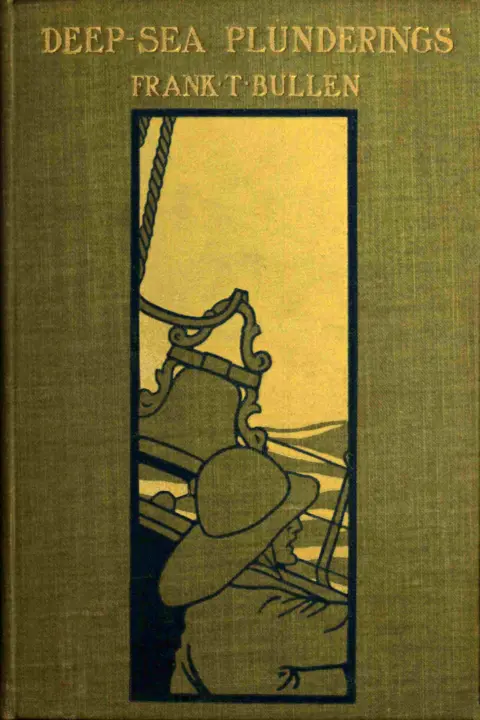
THE CLASSIC COLLECTION · 1901
"Deep-Sea Plunderings" by Frank Thomas Bullen is a collection of maritime adventures written in the late 19th century. The book explores the thrilling experiences of seafarers, particularly focusing on the world of whaling, ship life, and human encounters at sea, revealing the challenges and dangers faced by sailors in their pursuit of fortune. The opening of the novel introduces readers to the clipper ship Mirzapore, sailing toward Melbourne. As the elegant vessel glides through the sea, the chief officer, Mr. Curzon, disdainfully comments on an old whaling ship they encounter, showcasing the contrast between the gracefully designed Mirzapore and the antiquated vessel. As curiosity piques among the ship's passengers, they observe a whaling operation taking place, witnessing the perilous chase and harpooning of whales. The scene is charged with action and emotion as the crew members of the whaling ship demonstrate their skill, courage, and the brutal realities of their trade. The setting captures the essence of life at sea while foreshadowing the intricate human dramas and connections that will unfold throughout the stories in this collection.
Introduction adapted from the source catalogue; source summaries may be automatically generated.
Free to read · English · 97,853 words · No account needed
MAKE TIME FOR A GOOD BOOK
On by default. Untick to stop anonymous reading totals. Each page counts after 10 seconds in view. How this works.
Anonymous counting is on unless you have switched it off.
Happily for us who were left, our troubles were nearly at an end. One calm night of restless dozing under the warm sky, trying not to think of what a tiny bubble we made on the wide sea, we passed not uncomfortably. Just before dawn I felt rather than heard a throbbing, its regular pulsations beating steadily as if inside my head. But they had not lasted one minute before I knew them for the propeller-beat of a steamer, and strained my eyes around through the departing darkness for a sight of her. Straight for us she came, the watchful officer on the bridge having seen us more than a mile off. In the most matter-of-fact way we were taken on board, and Elsie was soon mothered by the skipper’s wife, while I was being made much of by the men. And that was all. Of all that mass of treasure that had caused the sacrifice of so many lives not one atom remained where it could ever again raise the demon of murder in human breasts. And although I could not realize all this, I really did not feel sorry that I had not succeeded in saving the slightest portion of it, my thankfulness at being spared alive being so great.
There were no passengers on board to make a fuss, so none was made. Three days afterwards we were at Hong Kong, and Elsie was handed over to the German Consul, who gravely took down my story, but I could see did not believe half of it. I bade good-bye to Elsie, having elected to remain by the steamer, where I was being well treated, and in due time reached England again, a step nearer to becoming a full-fledged seaman.
Elisha Cushing, skipper of the Beluga, South Seaman, of Martha’s Vineyard, was a hard-bitten Yankee of the toughest of that tough race. Even in the sternest of mankind there is usually to be found some soft spot, some deeply-hidden well of feeling that at the touch of the right hand will bubble up in a kindly stream, even though it be hermetically sealed to all the world beside. But those who knew Captain Cushing best were wont to say that he must have been cradled on an iceberg, spent his childhood in a whaler’s fo’c’sle, hardened himself by the constant contemplation and practice of cruelty, until, having arrived at the supreme position of master of his own ship, he was less of a man than a pitiless automaton who regarded neither God nor devil, and only looked upon other men as an engineer might upon the cogs of a machine. Few, indeed, are the men who, throughout a voyage lasting from three to four years, shut up within the narrow bounds of a small ship, could entirely do without human companionship, could abstain from some friendly intercourse, however infrequent, with those around them. Yet Captain Cushing was even such a man. No one knew how he passed his abundant leisure. He was never seen reading, he did not smoke, no intoxicating drink was ever allowed on board his ship; in fact at all times, except when whale-fishing was being carried on, he was to all appearance a body without a mind, a figure of a man who moved and ate and slept mechanically, yet whom to offend was to court nothing less than torture. Those unspeculating eyes missed nothing; not a member of the crew but felt that in some not-to-be-explained fashion all his doings, almost his very thoughts, were known to the grim commander, and hard, indeed, was the lot of any unfortunate who in any way came athwart the stern code of rules that appeared to govern Captain Cushing’s command. Nevertheless he had one virtue--he did not interfere. So long as the business of the ship went on as goes a good clock, there was peace. The discipline was perfect; it reduced the human items that composed the Beluga’s crew to something very nearly resembling a piece of carefully constructed mechanism, for Captain Cushing’s genius lay that way. Out of the many crews that he had commanded during his thirty years’ exercise of absolute power he was wont to winnow officers that were a reflex of his own mind, and it mattered not how raw were the recruits bundled on board his ship at the last moment before leaving home, the Cushing system speedily reduced them to a condition of absolute mindlessness as far as any wish of their own was concerned. They became simply parts of the engine whereby Captain Cushing’s huge store of dollars was augmented.
Your reading position is saved on this browser. Take it to another device with a library code. Reading pages adapt to text, rather than matching a printed edition.
Frank Thomas Bullen

Frank Thomas Bullen

Frank Thomas Bullen

Frank Thomas Bullen
BEHIND THE BOOK
This eBook is for the use of anyone anywhere in the United States and most other parts of the world at no cost and with almost no restrictions whatsoever. You may copy it, give it away or re-use it under the terms of the Project Gutenberg License included with this eBook or online at www.gutenberg.org. If you are not located in the United States, you will have to check the laws of the country where you are located before using this eBook. Read the source licence.
The original source file, including credits and licence, is retained by this library. Request an original-format copy at no charge. Please include the book title and Project Gutenberg identifier #63270.
KEEP YOUR CURIOSITY GOING
Coulson Kernahan

Maurice Baring
Frances Wright
Cécile Tormay

Frederic Jesup Stimson

W. H. P. (William Henry Pope) Jarvis