
Recollections The Reminiscences of the Busy Life of One Who Has Played the Varied Parts of Sailor, Author & Lecturer
Frank Thomas Bullen
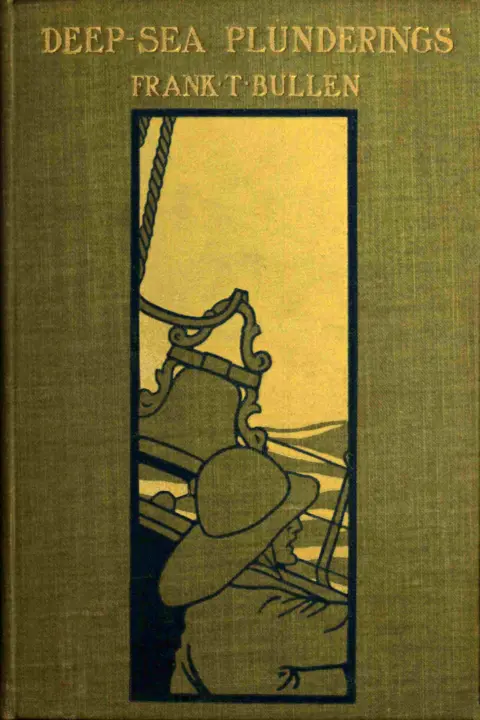
THE CLASSIC COLLECTION · 1901
"Deep-Sea Plunderings" by Frank Thomas Bullen is a collection of maritime adventures written in the late 19th century. The book explores the thrilling experiences of seafarers, particularly focusing on the world of whaling, ship life, and human encounters at sea, revealing the challenges and dangers faced by sailors in their pursuit of fortune. The opening of the novel introduces readers to the clipper ship Mirzapore, sailing toward Melbourne. As the elegant vessel glides through the sea, the chief officer, Mr. Curzon, disdainfully comments on an old whaling ship they encounter, showcasing the contrast between the gracefully designed Mirzapore and the antiquated vessel. As curiosity piques among the ship's passengers, they observe a whaling operation taking place, witnessing the perilous chase and harpooning of whales. The scene is charged with action and emotion as the crew members of the whaling ship demonstrate their skill, courage, and the brutal realities of their trade. The setting captures the essence of life at sea while foreshadowing the intricate human dramas and connections that will unfold throughout the stories in this collection.
Introduction adapted from the source catalogue; source summaries may be automatically generated.
Free to read · English · 97,853 words · No account needed
MAKE TIME FOR A GOOD BOOK
On by default. Untick to stop anonymous reading totals. Each page counts after 10 seconds in view. How this works.
Anonymous counting is on unless you have switched it off.
Next in size and importance among deep-sea fish, excluding sharks, about which I have said so much elsewhere that I do not propose dealing with them here, is the albacore, tunny or tuña, all of which are sub-varieties of, or local names for the same huge mackerel. They abound in every tropical sea, and are also found in certain favourable waters, such as the Mediterranean and Pacific coast of America. Like the sword-fish their habits of breeding are unknown, since they have their home in the solitudes of the ocean. But they are one of the fish most frequently met with by seafarers, as, like several others of the same great family, they are fond of following a ship. A sailing ship that is, for the throb of the propeller, apart from the speed of the vessel, is effectual in preventing their attendance upon steamers, so that passengers by steamships have few opportunities of observing them. But in sailing vessels, gliding placidly along under the easy pressure of gentle breezes, or lying quietly waiting for the friendly wind, ample scope is given for study of their every-day life. Very occasionally too, some seaman, more skilful or enterprising than his fellows, will succeed in catching one by trolling a piece of white rag or a polished spoon with a powerful hook attached. Yet such is the vigour and so great is the size of these huge mackerel, some attaining a length of six feet and a weight of five hundred pounds, that their capture from a ship is infrequent.
In size, beauty, and importance, the “dolphin” easily claims the next place to the albacore. But an unaccountable confusion has gathered around this splendid fish on account of his popular name. The dolphin of mythological sculpture bears no resemblance either to the popularly named dolphin of the seaman and the poets, or the scientifically named dolphin of the natural histories, which is a mammal, and identical with the porpoise. One thing is certain, that no sailor will ever speak of the porpoise as a dolphin, or call Coryphena hippuris anything else. Of this lovely denizen of the deep sea, it is difficult to speak soberly. Even the dullest of men wax enthusiastic over its glories, feeling sure that none of all beautiful created things can approach it for splendour of array. I have often tried to distinguish its different hues, watching it long and earnestly as it basked alongside in the limpid blue environment of its home. But my efforts have always been in vain, since every turn of its elegant form revealed some new combination of dazzling tints blending and brightening in such radiant loveliness that any classification of their shades was impossible. Then a swift wave of the wide forked tail-fin would send the lithe body all a-quiver in a new direction, where, catching a stray sunbeam it would blaze like burnished silver reflecting the golden gleam, and the overtaxed eye must needs turn away for relief. Then suddenly the marvellous creature would spring into activity, launching itself in long vibrant leaps through the air after its prey, a fleeting school of flying fish, that with all their winged speed could not escape the lethal jaws of their splendid pursuer. Having read of the wondrously changing colours of a dying dolphin I watched with great eagerness the first one that ever I saw caught. Great was my disappointment and resentment against those who had perpetrated and perpetuated such a fable. Compared with the glory of the living creature, the fading hues of its vesture when dying were as lead is to gold. Only by most careful watching was it possible to distinguish the changing colour schemes, faint and dim, as if with departing vitality they too were compelled to fade and die away into darkness. On the utilitarian side too the dolphin is beloved by the sailor, for its flesh is whiter and more sapid than that of any other deep-sea fish except the flying fish, which are too small and too infrequently got hold of on board ship to be taken much account of for food. Yet, in spite of its wondrous speed, the dolphin, when congregated in considerable numbers, often falls a prey to the giant albacore, which hurls itself into their midst, clashing its great jaws and destroying many more than it devours.
Your reading position is saved on this browser. Take it to another device with a library code. Reading pages adapt to text, rather than matching a printed edition.
Frank Thomas Bullen

Frank Thomas Bullen

Frank Thomas Bullen

Frank Thomas Bullen
BEHIND THE BOOK
This eBook is for the use of anyone anywhere in the United States and most other parts of the world at no cost and with almost no restrictions whatsoever. You may copy it, give it away or re-use it under the terms of the Project Gutenberg License included with this eBook or online at www.gutenberg.org. If you are not located in the United States, you will have to check the laws of the country where you are located before using this eBook. Read the source licence.
The original source file, including credits and licence, is retained by this library. Request an original-format copy at no charge. Please include the book title and Project Gutenberg identifier #63270.
KEEP YOUR CURIOSITY GOING
Coulson Kernahan

Maurice Baring
Frances Wright
Cécile Tormay

Frederic Jesup Stimson

W. H. P. (William Henry Pope) Jarvis