
Recollections The Reminiscences of the Busy Life of One Who Has Played the Varied Parts of Sailor, Author & Lecturer
Frank Thomas Bullen
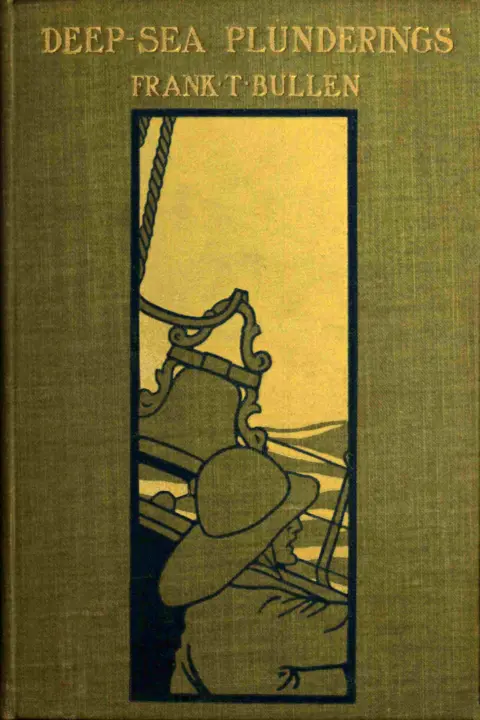
THE CLASSIC COLLECTION · 1901
"Deep-Sea Plunderings" by Frank Thomas Bullen is a collection of maritime adventures written in the late 19th century. The book explores the thrilling experiences of seafarers, particularly focusing on the world of whaling, ship life, and human encounters at sea, revealing the challenges and dangers faced by sailors in their pursuit of fortune. The opening of the novel introduces readers to the clipper ship Mirzapore, sailing toward Melbourne. As the elegant vessel glides through the sea, the chief officer, Mr. Curzon, disdainfully comments on an old whaling ship they encounter, showcasing the contrast between the gracefully designed Mirzapore and the antiquated vessel. As curiosity piques among the ship's passengers, they observe a whaling operation taking place, witnessing the perilous chase and harpooning of whales. The scene is charged with action and emotion as the crew members of the whaling ship demonstrate their skill, courage, and the brutal realities of their trade. The setting captures the essence of life at sea while foreshadowing the intricate human dramas and connections that will unfold throughout the stories in this collection.
Introduction adapted from the source catalogue; source summaries may be automatically generated.
Free to read · English · 97,853 words · No account needed
MAKE TIME FOR A GOOD BOOK
On by default. Untick to stop anonymous reading totals. Each page counts after 10 seconds in view. How this works.
Anonymous counting is on unless you have switched it off.
Surely we may pause awhile to contemplate the overmastering courage of the earliest seafarers, who, in spite of all these terrors, unappalled by the comparison between their tiny shallops and the mighty waves that towered above them, set boldly out from shore into the unknown, obeying that deeply rooted instinct of migration which has peopled every habitable part of the earth’s surface. Those who remember their childhood’s dread of the dark, with its possible population of bogeys, who have ever been lost in early youth in some lonely place, can have some dim conception, though only a dim one, after all, of the inward battle these ancients fought and won, until it became possible for the epigram to be written in utmost truth--
“The seas but join the nations they divide.”
But, after all, we are not now concerned with the warlike doings of men. It is with the actualities of submarine struggle we wish to deal--those wars without an armistice, where to be defeated is to be devoured, and from the sea-shouldering whale down to the smallest sea-insect every living thing is carnivorous, dependent directly upon the flesh of its neighbours for its own life, and incapable of altruism in any form whatever, except among certain of the mammalia and the sharks. In dealing with the more heroic phases of this unending warfare, then, it must be said, once for all, that the ancient writers had a great deal of reason on their side. They distorted and exaggerated, of course, as all children do, but they did not disbelieve. But moderns, rushing to the opposite extreme, have neglected the marvels of the sea by the simple process of disbelieving in them, except in the case of the sea-serpent, that myth which seems bound to persist for ever and ever. Only of late years have the savants of the world allowed themselves to be convinced of the existence of a far more wondrous monster than the sea-serpent (if that “loathly worm” were a reality), the original Kraken of old-world legends. Hugest of all the mollusca, whose prevailing characteristics are ugliness, ferocity, and unappeasable hunger, he has lately asserted himself so firmly that current imaginative literature bristles with allusions to him, albeit oftentimes in situations where he could by no possibility be found. No matter, he has supplied a long-felt want; but the curious fact remains that he is not a discovery, but a re-appearance. The gigantic cuttle-fish of actual, indisputable fact is, in all respects except size, the Kraken; and any faithful representation of him will justify the assertion that no imagination could add anything to the terror-breeding potentialities of his aspect. That is so, even when he is viewed by the light of day in the helplessness of death or disabling sickness, or in the invincible grip of his only conqueror. In his proper realm, crouching far below the surface of the sea in some coral cave or labyrinth of rocks, he must present a sight so awful that the imagination recoils before it. For consider him but a little. He possesses a cylindrical body reaching in the largest specimens yet recorded as having been seen, a length of between sixty and seventy feet, with an average girth of half that amount. That is to say, considerably larger than a Pullman railway-car. Now, this immense mass is of boneless gelatinous matter capable of much greater distension than a snake; so that in the improbable event of his obtaining an extra-abundant supply of food, it is competent to swell to the occasion and still give the flood of digestive juices that it secretes full opportunity to dispose of the burden with almost incredible rapidity. Now, the apex of this mighty cylinder--I had almost said “tail,” but remembered that it would give a wrong impression, since it is the part of the monster that always comes first when he is moving from place to place, is conical, that is to say, it tapers off to a blunt point something like a whitehead torpedo. Near this apex there is a broad fin-like arrangement looking much like the body of a skate without its tail, which, however, is used strictly for steering purposes only. So far there is nothing particularly striking about the appearance of this mighty cylinder except in colour. This characteristic varies in different individuals, but is always reminiscent of the hues of a very light-coloured leopard; that is to say, the ground is of a livid greenish white, while the detail is in splashes and spots of lurid red and yellow, with an occasional nimbus of pale blue around these deeper markings. But it is the head of the monster that appals. Nature would seem in the construction of this greatest of all molluscs to have combined every weapon of offence possessed by the rest of the animal kingdom in one amazing arsenal, disposing them in such a manner that not only are they capable of terrific destruction, but their appearance defies adequate description.
Your reading position is saved on this browser. Take it to another device with a library code. Reading pages adapt to text, rather than matching a printed edition.
Frank Thomas Bullen

Frank Thomas Bullen

Frank Thomas Bullen

Frank Thomas Bullen
BEHIND THE BOOK
This eBook is for the use of anyone anywhere in the United States and most other parts of the world at no cost and with almost no restrictions whatsoever. You may copy it, give it away or re-use it under the terms of the Project Gutenberg License included with this eBook or online at www.gutenberg.org. If you are not located in the United States, you will have to check the laws of the country where you are located before using this eBook. Read the source licence.
The original source file, including credits and licence, is retained by this library. Request an original-format copy at no charge. Please include the book title and Project Gutenberg identifier #63270.
KEEP YOUR CURIOSITY GOING
Coulson Kernahan

Maurice Baring
Frances Wright
Cécile Tormay

Frederic Jesup Stimson

W. H. P. (William Henry Pope) Jarvis