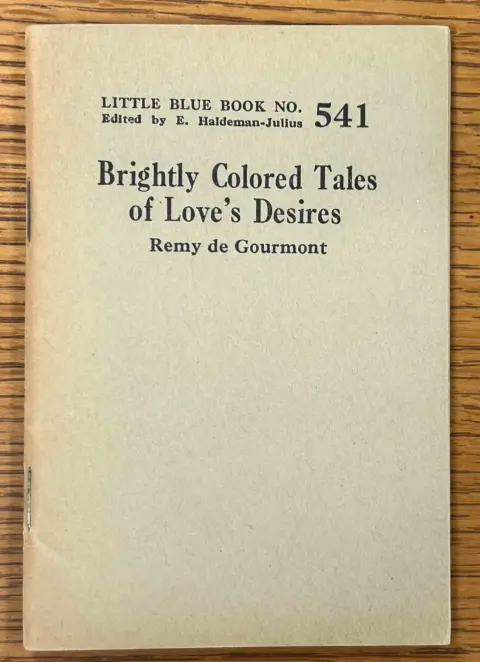
Stories in green, zinzolin, rose, purple, mauve, lilac and orange
Remy de Gourmont
THE CLASSIC COLLECTION · 1921
"Decadence, and Other Essays on the Culture of Ideas" by Remy de Gourmont is a collection of philosophical essays written in the late 19th century. This work explores the interplay of ideas and the notion of decadence in relation to contemporary culture and thought. The essays delve into themes such as the nature of beauty, education, and the role of women in language, questioning established beliefs and examining the underlying currents of ideas that shape perception and society. The opening of the collection introduces Gourmont's concept of the "disassociation of ideas," where he contrasts the traditional acceptance of ideas with the notion of creating new associations or disassociations. He discusses the creative intelligence required to reframe old ideas and challenges the durability of commonly held beliefs, referring to them as "commonplaces." Gourmont employs analytical reasoning to dissect how ideas associate and disassociate, emphasizing individual thought's role in challenging societal norms and suggesting that the process of disassociation is necessary for intellectual liberation. Throughout, he presents a provocative critique of established truths, setting the stage for a deeper exploration of the complexities of human thought in the subsequent essays.
Introduction adapted from the source catalogue; source summaries may be automatically generated.
Free to read · English · 56,624 words · No account needed
MAKE TIME FOR A GOOD BOOK
On by default. Untick to stop anonymous reading totals. Each page counts after 10 seconds in view. How this works.
Anonymous counting is on unless you have switched it off.
It is seen that there is often an enormous gap between the common meaning of a word and its real significance in the depths of obscure verbal consciousnesses, whether because several associated ideas are expressed by a single word, or because the primitive idea has been submerged by the invasion of a secondary idea. It is thus possible--especially in dealing with generalizations--to write sentences having at once an apparent and a secret meaning. Words, which are signs, are almost always ciphers as well. The unconscious conventional language is very much in use, and there are even matters where it is the only one employed. But cipher implies deciphering. It is not easy to understand even the sincerest writing, and the author himself often goes astray because the meaning of words varies not only from one man to another, but from moment to moment, in the case of the same man. Language is thus a great cause of deception. It evolves in abstraction, while life evolves in complete concrete reality. Between speech and the things designated by speech, there is the same distance as between a landscape and the description of a landscape. And it must still further be borne in mind that the landscapes which we depict are known to us, most often, only through words which are, in turn, reflections of anterior words. Yet we understand each other. It is a miracle which I have no intention of analyzing at present. It will be more to our purpose, in concluding this sketch, which is merely a method, to undertake the examination of the quite modern ideas of art and of beauty.
I am ignorant of their origins, but they are later than the classic languages, which possess no fixed and precise words to express them, though the ancients were as well able as we to enjoy the reality they contain--better, even. They are intertangled. The idea of art is dependent upon the idea of beauty; but this latter idea is itself nothing but the idea of harmony, and the idea of harmony reduces itself to the idea of logic. The beautiful is that which is in its place. Thence arise the sentiments of pleasure given us by beauty. Or rather, beauty is a logic which is perceived as a pleasure. If this be admitted, it will at once be understood why the idea of beauty, in societies dominated by women, is almost always restricted to the idea of feminine beauty. Beauty is a woman. There is in this an interesting subject for analysis, but the question is somewhat complicated. It would be necessary to show, first, that woman is no more beautiful than man; that, situated on the same plane in nature, constructed on the same model, made of the same flesh, she would appear to a sensitive intelligence, exterior to humanity, exactly the female of man--exactly what, for man, a jenny is to a jack. And, observing them more closely, the Martian, who wished to learn something concerning the aesthetics of terrestrial forms, would even note that, if there be a real difference in beauty between a man and a woman of the same race, of the same caste, and of the same age, this difference is almost always in favour of the man; and that, moreover, if neither the man nor the woman be entirely beautiful, the defects of the human race are more accentuated in the woman, where the twofold projection of the belly and the buttocks--sexual attractions, no doubt--breaks unpleasantly the double line of the silhouette. The curve of the breasts is almost inflected under the influence of the back, which has a hollow tendency. Cranach's nudes confess naïvely these eternal imperfections of woman. Another defect which artists, when they have taste, remedy instinctively, is the shortness of the legs, so marked in the photographs of nude women. This cold anatomy of feminine beauty has often been made. It is, then, useless to insist upon it--all the more because, unfortunately, its verification is only too easy. But if woman's beauty be so vulnerable to criticism, how does it happen that, in spite of all, it remains indisputable--that it has become for us the very basis and leaven of the idea of beauty? It is a sexual illusion. The idea of beauty is not a pure idea. It is intimately connected with the idea of carnal pleasure. Stendhal had an obscure perception of this line of reasoning when he defined beauty as "a promise of happiness." Beauty is a woman, even for women themselves, who have carried docility with regard to men to the point of adopting this aphorism which they are capable of understanding only under the form of extreme sensual perversion. We know, however, that women have a particular type of beauty, which men have naturally branded "doll-like." If women were sincere, they would long ago have stigmatized equally the type of feminine beauty by which man most readily lets himself be seduced.
Your reading position is saved on this browser. Take it to another device with a library code. Reading pages adapt to text, rather than matching a printed edition.
Remy de Gourmont
Remy de Gourmont
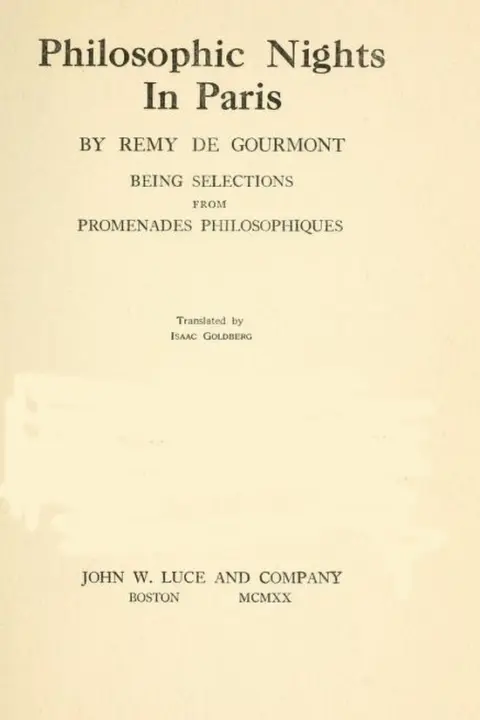
Remy de Gourmont
BEHIND THE BOOK
This eBook is for the use of anyone anywhere in the United States and most other parts of the world at no cost and with almost no restrictions whatsoever. You may copy it, give it away or re-use it under the terms of the Project Gutenberg License included with this eBook or online at www.gutenberg.org. If you are not located in the United States, you will have to check the laws of the country where you are located before using this eBook. Read the source licence.
The original source file, including credits and licence, is retained by this library. Request an original-format copy at no charge. Please include the book title and Project Gutenberg identifier #46728.
KEEP YOUR CURIOSITY GOING

David Patterson (Spirit) Hatch

David Patterson (Spirit) Hatch

David Patterson (Spirit) Hatch
Coulson Kernahan

Ralph Waldo Emerson

Maurice Baring