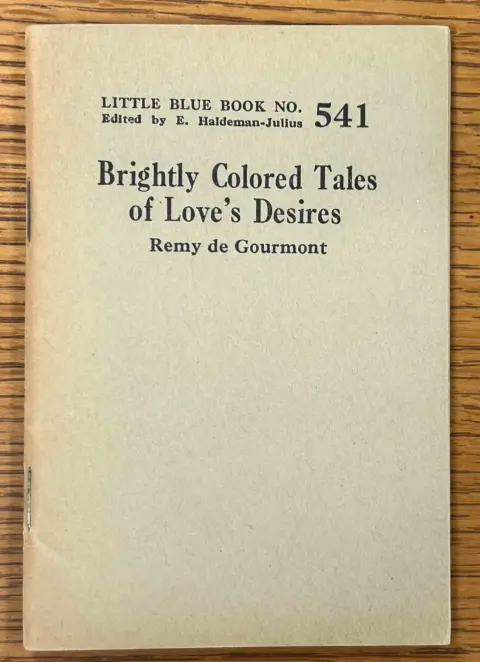
Stories in green, zinzolin, rose, purple, mauve, lilac and orange
Remy de Gourmont
THE CLASSIC COLLECTION · 1921
"Decadence, and Other Essays on the Culture of Ideas" by Remy de Gourmont is a collection of philosophical essays written in the late 19th century. This work explores the interplay of ideas and the notion of decadence in relation to contemporary culture and thought. The essays delve into themes such as the nature of beauty, education, and the role of women in language, questioning established beliefs and examining the underlying currents of ideas that shape perception and society. The opening of the collection introduces Gourmont's concept of the "disassociation of ideas," where he contrasts the traditional acceptance of ideas with the notion of creating new associations or disassociations. He discusses the creative intelligence required to reframe old ideas and challenges the durability of commonly held beliefs, referring to them as "commonplaces." Gourmont employs analytical reasoning to dissect how ideas associate and disassociate, emphasizing individual thought's role in challenging societal norms and suggesting that the process of disassociation is necessary for intellectual liberation. Throughout, he presents a provocative critique of established truths, setting the stage for a deeper exploration of the complexities of human thought in the subsequent essays.
Introduction adapted from the source catalogue; source summaries may be automatically generated.
Free to read · English · 56,624 words · No account needed
MAKE TIME FOR A GOOD BOOK
On by default. Untick to stop anonymous reading totals. Each page counts after 10 seconds in view. How this works.
Anonymous counting is on unless you have switched it off.
Ideas cannot be classed as true and false. The idea is necessarily true. An idea that can be disputed is an idea mingled with concrete notions, that is to say, a truth. The work of disassociation tends, precisely, to free the truth from all its fragile part, in order to obtain the pure, one, and consequently unassailable idea. But if words were never used save in their unique and absolute sense, connected discourse would be difficult. There must be left a little of that vagueness and flexibility which usage has given them; and, in particular, too much stress must not be laid upon the gap separating the abstract from the concrete. There is an intermediate state between ice and water--that in which the latter begins to congeal, when it still cracks and yields under the pressure of the hand plunged into it. Perhaps we should not even demand that the words contained in philosophic handbooks should abdicate all pretension to ambiguity.
The idea of army, which aroused serious polemics, and which was liberated an instant, only to be obscured anew, is one of those that border on the concrete and cannot be spoken of without minute references to reality. The idea of justice, on the contrary, can be considered in itself, in abstracto. In the inquiry made by M. Ribot on the subject of general ideas, almost all those who heard the word Justice pronounced, saw, in their mind's eye, the legendary lady with the scales. There is, in this traditional representation of an abstract idea, a notion of the very origin of that idea.
The idea of justice is, in fact, nothing but the idea of equilibrium. Justice is the dead-point in a series of acts--the ideal point at which contrary forces neutralize each other to produce inertia. Life which had passed this dead-point of absolute justice could not longer live, since the idea of life, identical with that of a conflict of forces, is necessarily the idea of justice. The reign of justice could only be the reign of silence and of petrification. Mouths cease to speak--vain organs of stupefied brains--and arms uplifted in suspended gesture describe nothing further in the frozen air. Theologians situated justice beyond the world, in eternity. There only can it be conceived, and there only can it, without danger to life, exercise once and for all its tyranny which knows but one sort of decree, the decree of death. The idea of justice, then, clearly belongs to the series of ideas that are indisputable and undemonstrable. Nothing can be done with it in its pure state. It must be associated with some element of fact, or we must cease using a word which corresponds only to an inconceivable entity. To tell the truth, the idea of justice is perhaps here disassociated for the first time. Under this name men allege sometimes the idea of punishment, which is very familiar to them, sometimes the idea of non-punishment--a neutral idea, mere shadow of the former. It is question of punishing the guilty and of not disturbing the innocent--a distinction which, in order to be comprehensible, would immediately imply a definition of guilt and a definition of innocence. That is difficult, these words from the moral dictionary having to-day nothing but a dwindling and entirely relative significance. And why, it might be asked, should a guilty man be punished? It would seem, on the contrary, as if the innocent man, who is supposed to be healthy and normal, were much more capable of supporting punishment than the guilty man, who is sick and weakly. Why should not the imbecile, who has let himself be robbed, be punished instead of the robber, who has certain excuses to offer? That is what justice would decree if, instead of a theological conception, it were still, as at Sparta, an imitation of nature. Nothing exists save by virtue of disequilibrium, of injustice. Every existence is a theft practised upon other existences. No life flourishes except in a cemetery. If, instead of being the denier of natural laws, humanity wished to become their auxiliary, it would seek to protect the strong against the coalition of the weak, and give the people to the aristocrats as a footstool. It would seem, on the contrary, as if that which is to-day understood by justice were, simultaneously with the punishment of the guilty, the extermination of the strong, and, simultaneously with the non-punishment of the innocent, the exaltation of the humble. The origin of this complex, bastard, hypocritical idea should then be sought in the Gospel, in the "woe to the rich" of the Jewish demagogues. Thus understood, the idea of justice appears contaminated at once by hatred and by envy. It no longer retains anything of its original meaning, and one cannot attempt its analysis without danger of being duped by the vulgar meaning of the words. Yet, with a little care, it would be seen that the depreciation of this useful term arose originally from a confusion between the idea of right and the idea of punishment. The day when justice came to mean sometimes criminal justice, sometimes civil justice, the world confused these two practical notions, and the teachers of the people, incapable of a serious effort of disassociation, have come to magnify a misunderstanding which, moreover, serves their own interests. The real idea of justice appears then, finally, as quite non-existent in the very word which figures in the human vocabulary. This word resolves itself, on analysis, into elements which are still very complex, and among which may be distinguished the idea of right and the idea of punishment. But there is so much that is illogical in this curious coupling, that we should be inclined to doubt the accuracy of our operation, did not the social facts furnish its proof.
Your reading position is saved on this browser. Take it to another device with a library code. Reading pages adapt to text, rather than matching a printed edition.
Remy de Gourmont
Remy de Gourmont
Remy de Gourmont
BEHIND THE BOOK
This eBook is for the use of anyone anywhere in the United States and most other parts of the world at no cost and with almost no restrictions whatsoever. You may copy it, give it away or re-use it under the terms of the Project Gutenberg License included with this eBook or online at www.gutenberg.org. If you are not located in the United States, you will have to check the laws of the country where you are located before using this eBook. Read the source licence.
The original source file, including credits and licence, is retained by this library. Request an original-format copy at no charge. Please include the book title and Project Gutenberg identifier #46728.
KEEP YOUR CURIOSITY GOING

David Patterson (Spirit) Hatch

David Patterson (Spirit) Hatch

David Patterson (Spirit) Hatch
Coulson Kernahan

Ralph Waldo Emerson

Maurice Baring