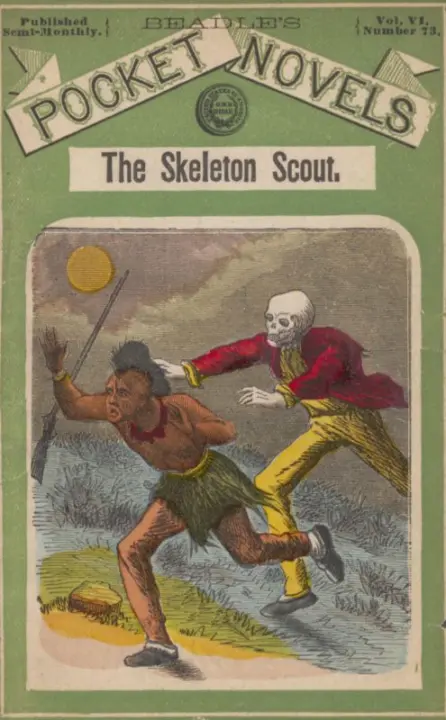
The skeleton scout; or, The border block
Albert W. Aiken
THE CLASSIC COLLECTION · 1883
"Dead Shot; Or, The White Vulture: A Romance of the Yellowstone" by Albert W. Aiken is a novel written in the late 19th century. The story unfolds in the rugged landscape of the Yellowstone region, primarily focusing on the tense interactions among various characters, including settlers and Native Americans. Central to the narrative are Abe Colt, known as the "Crow-Killer," a skilled prairie guide exacting revenge on the Crow tribe, and Dave Reed, a young guide with an intriguing connection to a mysterious stranger, setting the stage for conflict and romantic entanglements. At the start of the tale, readers are introduced to Fort Bent, a crucial outpost for wagon-trains heading to Montana, where the atmosphere is rife with tension due to the looming threat of Indian attacks. Abe Colt and Dave Reed stand out as two formidable characters, seasoned in the dangers of the frontier, each harboring significant histories that intertwine with the local tribes. The plot thickens with the appearance of a stranger who bears an uncanny resemblance to Dave, which sparks suspicion and curiosity among the guides. As tensions mount, the narrative hints at approaching conflict with the Crow tribe led by the young warrior known as the "White Vulture." The opening chapters set a vivid and suspenseful stage for the storyline, rich with danger, revenge, and the possibilities of love amidst turmoil.
Introduction adapted from the source catalogue; source summaries may be automatically generated.
Free to read · English · 35,484 words · No account needed
MAKE TIME FOR A GOOD BOOK
On by default. Untick to stop anonymous reading totals. Each page counts after 10 seconds in view. How this works.
Anonymous counting is on unless you have switched it off.
“Oh, Dave!” cried Leona, clinging to her lover, “will they separate us? Oh, I would rather die than lose you!”
“Hope for the best, Leona,” said Dave, softly, yet in a voice tremulous
with emotion.
“Do you think we can escape?” she asked, looking up into the guide’s face with those large blue eyes, so beautiful, so full of love and trust.
“I don’t know,” said Dave, sadly, “Heaven alone knows. We’ll do the best we can; but, if the red-skins have discovered us, I’m afraid that nothing on earth can save us.”
The “Crow-Killer” had been listening anxiously at the door of the lodge. The war-whoops had ceased, and a dead silence reigned in the Indian camp.
“Well, Abe?” questioned Dave.
“I don’t hear any thing more,” said Abe. “After all, maybe it was only some of the Injuns in one of their drunken sprees; but what they were doing up hyar, beyond the lodge, puzzles me. At present they’re right between us an’ the wood; so we can’t stir without running into their clutches.”
Just then another chorus of yells rung out on the air; the Indians were apparently approaching the lodge, as the yells were getting nearer and nearer every moment.
“Dave!” cried the “Crow-Killer,” “I’m afeard we’re gone up; the Injuns are coming nearer every moment.”
“Can we not fight our way through them?” cried the young guide, in
desperation.
“Nary chance for that,” and the “Crow-Killer” shook his head sagely. “If we are discovered, better not make any resistance; we shall only enrage ’em without doing us any good. If we fight ’em, we’re sure to be overpowered, ’cos they’re a hundred to one; they’ll only kill us outright; while, if we submit, they’ll shut us up as prisoners, till they get ready to torture us, and we then stand some chance of escaping. Just think, Dave, you an’ I dead, what will become of the little gal?”
Then came on the night-air the sound of hurried footsteps, approaching
closer and closer.
“They’re coming!” cried the “Crow-Killer.” “I’m afeard, Dave, that it’s all up with us; the devils seem to be heading right for the lodge.”
“Can we not cut a hole and escape through the back of the lodge?” said
Dave, eagerly.
“That’s jist what I were a thinking ’bout; but the cussed red-skins seem to be all around us. I guess we mought as well keep quiet awhile, ’cos they may not be after us, arter all--thar’s no tellin’. Maybe it’s only some of the drunken Injuns.”
Your reading position is saved on this browser. Take it to another device with a library code. Reading pages adapt to text, rather than matching a printed edition.
Albert W. Aiken
Albert W. Aiken
Albert W. Aiken
Albert W. Aiken
BEHIND THE BOOK
This eBook is for the use of anyone anywhere in the United States and most other parts of the world at no cost and with almost no restrictions whatsoever. You may copy it, give it away or re-use it under the terms of the Project Gutenberg License included with this eBook or online at www.gutenberg.org. If you are not located in the United States, you will have to check the laws of the country where you are located before using this eBook. Read the source licence.
The original source file, including credits and licence, is retained by this library. Request an original-format copy at no charge. Please include the book title and Project Gutenberg identifier #65527.
KEEP YOUR CURIOSITY GOING
Coulson Kernahan

Maurice Baring
Frances Wright
Cécile Tormay

Frederic Jesup Stimson

W. H. P. (William Henry Pope) Jarvis