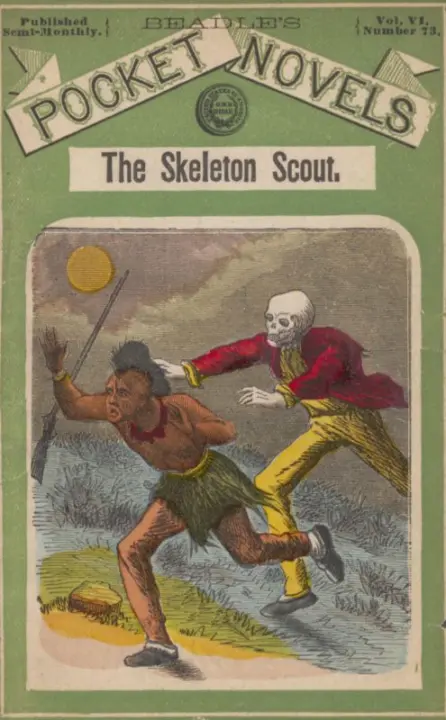
The skeleton scout; or, The border block
Albert W. Aiken
THE CLASSIC COLLECTION · 1883
"Dead Shot; Or, The White Vulture: A Romance of the Yellowstone" by Albert W. Aiken is a novel written in the late 19th century. The story unfolds in the rugged landscape of the Yellowstone region, primarily focusing on the tense interactions among various characters, including settlers and Native Americans. Central to the narrative are Abe Colt, known as the "Crow-Killer," a skilled prairie guide exacting revenge on the Crow tribe, and Dave Reed, a young guide with an intriguing connection to a mysterious stranger, setting the stage for conflict and romantic entanglements. At the start of the tale, readers are introduced to Fort Bent, a crucial outpost for wagon-trains heading to Montana, where the atmosphere is rife with tension due to the looming threat of Indian attacks. Abe Colt and Dave Reed stand out as two formidable characters, seasoned in the dangers of the frontier, each harboring significant histories that intertwine with the local tribes. The plot thickens with the appearance of a stranger who bears an uncanny resemblance to Dave, which sparks suspicion and curiosity among the guides. As tensions mount, the narrative hints at approaching conflict with the Crow tribe led by the young warrior known as the "White Vulture." The opening chapters set a vivid and suspenseful stage for the storyline, rich with danger, revenge, and the possibilities of love amidst turmoil.
Introduction adapted from the source catalogue; source summaries may be automatically generated.
Free to read · English · 35,484 words · No account needed
MAKE TIME FOR A GOOD BOOK
On by default. Untick to stop anonymous reading totals. Each page counts after 10 seconds in view. How this works.
Anonymous counting is on unless you have switched it off.
“As fast as the crow flies to his nest; his braves mourn him as dead and gone to the happy hunting-grounds, but the scalp of the Sioux chief will never hang in the smoke of a Mandan lodge,” and the savage drew his tall form up proudly. Then, bending his eyes on the train, he asked: “Does my white brother hunt with the white wigwams, that go to the setting sun?” and with his eyes he indicated the emigrant-wagons as he spoke.
“Yes, I am their guide,” answered Dave.
“And the tall chief, who wears the hide of the coyote,” indicating Abe, who was in conversation with the corporal, as he spoke, “does he hunt with my brother?”
“Yes; we are the chiefs of the train,” said Dave, wondering at the
curiosity of the Indian.
“What is my tall white brother called?” asked the red-skin, pointing to
Abe.
“Abe Colt.”
“Crow-Killer?” questioned the savage, with a slight uneasiness
perceptible in his manner.
“Yes,” answered Dave, secretly wondering that his companion’s name should be so well known to the Yancton Sioux; “you have heard of the ‘Crow-Killer’ then?” he asked.
“The deeds of a great brave on the war-path travel like the white clouds, when the winds blow over the prairie. The ‘Crow-Killer’ is a great chief,” answered the Indian, a peculiar gleam in his dark eyes, as he looked upon the famous Indian fighter.
“Does my brother go soon?” asked Dave.
“When the moon comes, the Sioux chief rides like the wind for the Big river, (Missouri); his warriors wait for him, and the singing bird that sings for the chief, sings not when the wigwam is empty and the nest is cold.” Then the Indian gazed upon the crowd with the same stolid glance as before.
Dave having gained all the information that he could, rejoined Abe and
the corporal.
“Wal, who and what is he?” asked Abe.
“He says he’s a Sioux of the Yancton tribe, separated from the rest of his braves in a fight with the Mandans on the Powder river; and that he came here for food and drink,” answered Dave to Abe’s question.
“Well, now I think of it,” said the corporal, “I remember hearing the boys saying something, this morning, about an Indian coming in, hungry, and they giving him food.”
“A Yancton Sioux, eh?” said Abe, half to himself.
“Yes; what do you think of him?” asked Dave.
Your reading position is saved on this browser. Take it to another device with a library code. Reading pages adapt to text, rather than matching a printed edition.
Albert W. Aiken
Albert W. Aiken
Albert W. Aiken
Albert W. Aiken
BEHIND THE BOOK
This eBook is for the use of anyone anywhere in the United States and most other parts of the world at no cost and with almost no restrictions whatsoever. You may copy it, give it away or re-use it under the terms of the Project Gutenberg License included with this eBook or online at www.gutenberg.org. If you are not located in the United States, you will have to check the laws of the country where you are located before using this eBook. Read the source licence.
The original source file, including credits and licence, is retained by this library. Request an original-format copy at no charge. Please include the book title and Project Gutenberg identifier #65527.
KEEP YOUR CURIOSITY GOING
Coulson Kernahan

Maurice Baring
Frances Wright
Cécile Tormay

Frederic Jesup Stimson

W. H. P. (William Henry Pope) Jarvis