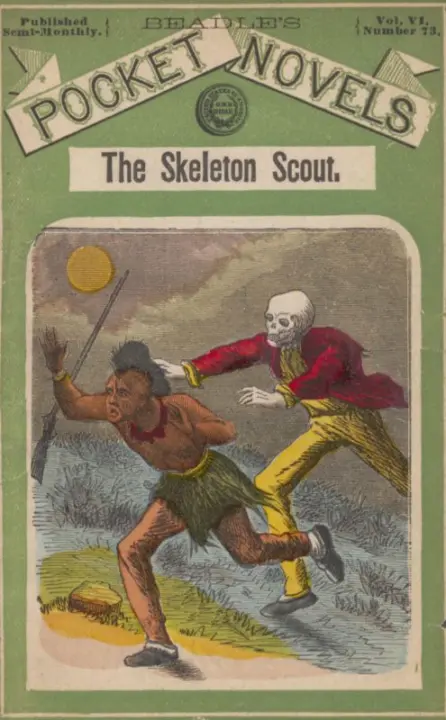
The skeleton scout; or, The border block
Albert W. Aiken
THE CLASSIC COLLECTION · 1883
"Dead Shot; Or, The White Vulture: A Romance of the Yellowstone" by Albert W. Aiken is a novel written in the late 19th century. The story unfolds in the rugged landscape of the Yellowstone region, primarily focusing on the tense interactions among various characters, including settlers and Native Americans. Central to the narrative are Abe Colt, known as the "Crow-Killer," a skilled prairie guide exacting revenge on the Crow tribe, and Dave Reed, a young guide with an intriguing connection to a mysterious stranger, setting the stage for conflict and romantic entanglements. At the start of the tale, readers are introduced to Fort Bent, a crucial outpost for wagon-trains heading to Montana, where the atmosphere is rife with tension due to the looming threat of Indian attacks. Abe Colt and Dave Reed stand out as two formidable characters, seasoned in the dangers of the frontier, each harboring significant histories that intertwine with the local tribes. The plot thickens with the appearance of a stranger who bears an uncanny resemblance to Dave, which sparks suspicion and curiosity among the guides. As tensions mount, the narrative hints at approaching conflict with the Crow tribe led by the young warrior known as the "White Vulture." The opening chapters set a vivid and suspenseful stage for the storyline, rich with danger, revenge, and the possibilities of love amidst turmoil.
Introduction adapted from the source catalogue; source summaries may be automatically generated.
Free to read · English · 35,484 words · No account needed
MAKE TIME FOR A GOOD BOOK
On by default. Untick to stop anonymous reading totals. Each page counts after 10 seconds in view. How this works.
Anonymous counting is on unless you have switched it off.
“That man’s face!” answered Abe, still staring intently upon the
stranger.
“Well, what of it?”
“Why, he’s the perfect image of you!”
Dave now started in surprise, and turned his keen glance upon the stranger. As Abe had said, save that the unknown was darker in color, there was, indeed, a wonderful resemblance between the two men--the same long black hair, curling at the ends--the same flashing black eyes, the same expression on the face, almost the same size, and features marvelously like those of the young guide.
“Yes, he does look like me,” said Dave, surveying the stranger with a
puzzled air.
“Like you! You couldn’t be more alike if you were run in the same mold,” said the “Crow-Killer.”
“It is very strange, to say the least.” Dave spoke thoughtfully.
“Strange, you bet!” answered Abe, tersely.
And yet, at this very moment, to a close observer, there was something else stranger than all, and that was the resemblance in the general expression of the features that both Dave Reed and the stranger bore to Abe, the “Crow-Killer.” Their eyes were black and his were gray, and yet they looked alike. Had they been clad alike, a stranger would have taken the three for father and sons.
“He looks like an Injun, and yet he is too light colored for one,” said
Dave.
“Yes,” responded the “Crow-Killer,” watching the unknown with a keen glance, “he ain’t one of our party I know. I guess he’s a stranger hyar too, for he don’t seem to know any of the folks round. He don’t look exactly like an Injun, but he may be one with white blood in him; that would account for his light color.”
“I’ll go over and find out who he is,” said Dave.
“Go it, young hoss!” answered the “Crow-Killer,” “that’s a good idea.”
One of the corporals attached to the post at this moment approached the
two guides.
“Who is that chap over thar? do you know him?” asked the guide.
The corporal took a good look at the motionless figure, wrapped in the
gaudy blanket.
“I don’t know him; a stranger in our ranche, I reckon.”
“You have never seen him before then?” said Dave.
“I think not. I guess he’s one of the Mandan Injuns come in to get some whisky or something of that sort.”
“He ain’t no Mandan,” said Abe, after another good look.
Dave bent his steps toward the stranger.
Your reading position is saved on this browser. Take it to another device with a library code. Reading pages adapt to text, rather than matching a printed edition.
Albert W. Aiken
Albert W. Aiken
Albert W. Aiken
Albert W. Aiken
BEHIND THE BOOK
This eBook is for the use of anyone anywhere in the United States and most other parts of the world at no cost and with almost no restrictions whatsoever. You may copy it, give it away or re-use it under the terms of the Project Gutenberg License included with this eBook or online at www.gutenberg.org. If you are not located in the United States, you will have to check the laws of the country where you are located before using this eBook. Read the source licence.
The original source file, including credits and licence, is retained by this library. Request an original-format copy at no charge. Please include the book title and Project Gutenberg identifier #65527.
KEEP YOUR CURIOSITY GOING
Coulson Kernahan

Maurice Baring
Frances Wright
Cécile Tormay

Frederic Jesup Stimson

W. H. P. (William Henry Pope) Jarvis