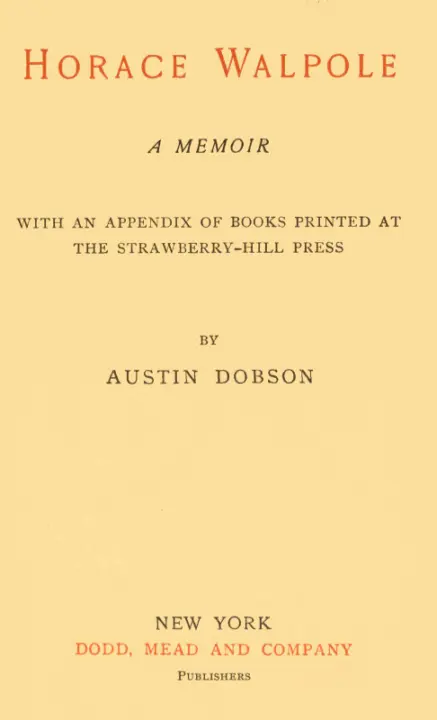
Horace Walpole: A memoir With an appendix of books printed at the Strawberry Hill Press
Austin Dobson
THE CLASSIC COLLECTION · 1908
"De Libris: Prose and Verse" by Austin Dobson is a collection of literary essays and poetry written during the early 20th century. This work explores various themes related to books, literature, and the joys and tribulations of reading and writing. Through a series of reflections and poems, Dobson addresses the sentimental value attached to books, the nature of literature itself, and the creative process behind writing. The opening of the text features a prologue where Dobson addresses the reader in a conversational tone, asking for their benevolence as he presents his musings. He explains that he composed these reflections not out of ambition to please a larger audience but rather to share thoughts that might resonate with a kindred spirit. The prologue sets the stage for essays that delve into the associations people have with books and their meanings, detailing personal anecdotes and contemplating the emotional connections that literature fosters, establishing a rich and engaging tone for the collection.
Introduction adapted from the source catalogue; source summaries may be automatically generated.
Free to read · English · 36,728 words · No account needed
MAKE TIME FOR A GOOD BOOK
On by default. Untick to stop anonymous reading totals. Each page counts after 10 seconds in view. How this works.
Anonymous counting is on unless you have switched it off.
Notes:
[47] It was, no doubt, identical with the "Original Articles of Agreement" (Add. MSS. 18,861) between Milton and Samuel Symmons, printer, dated 27th April, 1667, presented by Rogers in 1852 to the British Museum. Besides the above-mentioned L5 down, there were to be three further payments of L5 each on the sale of three editions, each of 1300 copies. The second edition appeared in 1674, the year of the author's death.
[48] He was acquitted. His notes, in pencil, and relating chiefly to his Diversions of Parley, were actually written in the Tower. Rogers, who was present at the trial in November, mentioned, according to Dyce, a curious incident bearing upon a now obsolete custom referred to by Goldsmith and others. As usual, the prisoner's dock, in view of possible jail-fever, was strewn with sweet-smelling herbs-fennel, rosemary and the like. Tooke indignantly swept them away. Another of several characteristic anecdotes told by Rogers of Tooke is as follows:--Being asked once at college what his father was, he replied, "A Turkey Merchant." Tooke pere was a poulterer in Clare Market.
But the mere recapitulation of titles readily grows tedious, even to the elect; and I turn to some of the volumes with which, from references in the Table-Talk and Recollections, their owner might seem to be more intimately connected. Foremost among these--one would think--should come his own productions. Most of these, no doubt, are included under the auctioneers' heading of "Works and Illustrations." In the "Library" proper, however, there are few traces of them. There is a quarto copy of the unfortunate Columbus, with Stothard's sketches; and there is the choice little Pleasures of Memory of 1810, with Luke Clennell's admirable cuts in facsimile from the same artist's pen-and-ink,--a volume which, come what may, will always hold its own in the annals of book-illustration. That there were more than one of these latter may be an accident. Rogers, nevertheless, like many book-lovers, must have indulged in duplicates. According to Hayward, once at breakfast, when some one quoted Gray's irresponsible outburst concerning the novels of Marivaux and Crebillon le fils, Rogers asked his guests, three in number, whether they were familiar with Marivaux's Vie de Marianne, a book which he himself confesses to have read through six times, and which French critics still hold, on inconclusive evidence, to have been the "only begetter" of Richardson's Pamela and the sentimental novel. None of the trio knew anything about it. "Then I will lend you each a copy," rejoined Rogers; and the volumes were immediately produced, doubtless by that faithful and indefatigable factotum, Edmund Paine, of whom his master was wont to affirm that he would not only find any book in the house, but out of it as well. What is more (unless it be assumed that the poet's stock was larger still), one, at least, of the three copies must have been returned, since there is a copy in the catalogue. As might be expected in the admirer of Marivaux's heroine, the list is also rich in Jean-Jacques, whose "gout vif pour les dejeuners," this Amphitryon often extolled, quoting with approval Rousseau's opinion that "C'est le temps de la journee ou nous sommes le plus tranquilles, ou nous causons le plus a noire aise." Another of his favourite authors was Manzoni, whose Promessi Sposi he was inclined to think he would rather have written than all Scott's novels; and he never tired of reading Louis Racine's Memoires of his father, 1747,--that "filon de l'or pur du dix-septieme siecle"--as Villemain calls it--"qui se prolonge dans l'age suivant." Some of Rogers's likings sound strange enough nowadays. With Campbell, he delighted in Cowper's Homer, which he assiduously studied, and infinitely preferred to that of Pope. Into Chapman's it must be assumed that he had not looked--certainly he has left no sonnet on the subject. Milton was perhaps his best-loved bard. "When I was travelling in Italy (he says), I made two authors my constant study for versification,--Milton and Crowe" (The italics are ours.) It is an odd collocation; but not unintelligible. William Crowe, the now forgotten Public Orator of Oxford, and author of Lewesdon Hill, was an intimate friend; a writer on versification; and, last but not least, a very respectable echo of the Miltonic note, as the following, from a passage dealing with the loss in 1786 of the Halsewell East Indiaman off the coast of Dorset, sufficiently testifies:--
Your reading position is saved on this browser. Take it to another device with a library code. Reading pages adapt to text, rather than matching a printed edition.
Austin Dobson
Austin Dobson
Austin Dobson
Austin Dobson
BEHIND THE BOOK
This eBook is for the use of anyone anywhere in the United States and most other parts of the world at no cost and with almost no restrictions whatsoever. You may copy it, give it away or re-use it under the terms of the Project Gutenberg License included with this eBook or online at www.gutenberg.org. If you are not located in the United States, you will have to check the laws of the country where you are located before using this eBook. Read the source licence.
The original source file, including credits and licence, is retained by this library. Request an original-format copy at no charge. Please include the book title and Project Gutenberg identifier #9979.
KEEP YOUR CURIOSITY GOING

David Patterson (Spirit) Hatch

David Patterson (Spirit) Hatch

David Patterson (Spirit) Hatch
Cécile Tormay

Moritz Busch
John L. Ransom