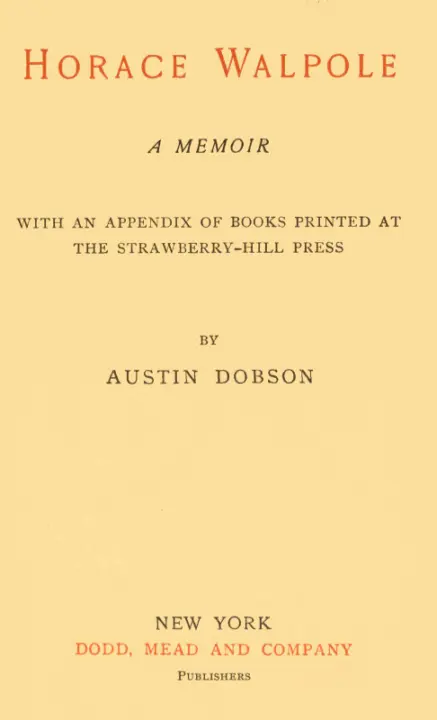
Horace Walpole: A memoir With an appendix of books printed at the Strawberry Hill Press
Austin Dobson
THE CLASSIC COLLECTION · 1908
"De Libris: Prose and Verse" by Austin Dobson is a collection of literary essays and poetry written during the early 20th century. This work explores various themes related to books, literature, and the joys and tribulations of reading and writing. Through a series of reflections and poems, Dobson addresses the sentimental value attached to books, the nature of literature itself, and the creative process behind writing. The opening of the text features a prologue where Dobson addresses the reader in a conversational tone, asking for their benevolence as he presents his musings. He explains that he composed these reflections not out of ambition to please a larger audience but rather to share thoughts that might resonate with a kindred spirit. The prologue sets the stage for essays that delve into the associations people have with books and their meanings, detailing personal anecdotes and contemplating the emotional connections that literature fosters, establishing a rich and engaging tone for the collection.
Introduction adapted from the source catalogue; source summaries may be automatically generated.
Free to read · English · 36,728 words · No account needed
MAKE TIME FOR A GOOD BOOK
On by default. Untick to stop anonymous reading totals. Each page counts after 10 seconds in view. How this works.
Anonymous counting is on unless you have switched it off.
Note:
[22] Maria Edgeworth, by Helen Zimmern, 1888, p. 13.
The training she underwent from the inexorable Mr, Day was continued by her father when she quitted school, and moved with her family to the parental seat at Edgeworthstown in Ireland. Mr. Edgeworth, whose principles were as rigorous as those of his friend, devoted himself early to initiating her into business habits. He taught her to copy letters, to keep accounts, to receive rents, and, in short, to act as his agent and factotum. She frequently accompanied him in the many disputes and difficulties which arose with his Irish tenantry; and, apart from the insight which this must have afforded her into the character and idiosyncrasies of the people, she no doubt very early acquired that exact knowledge of leases and legacies and dishonest factors which is a noticeable feature even of her children's books.[23] It is some time, however, before we hear of any successor to "Generosity"; but, in 1782, her father, with a view to provide her with an occupation for her leisure, proposed to her to prepare a translation of the Adele et Theodore of Madame de Genlis, those letters upon education by which that gentle and multifarious moralist acquired--to use her own words--at once "the suffrages of the public, and the irreconcilable hatred of all the so-called philosophers and their partisans." At first there had been no definite thought of print in Mr, Edgeworth's mind. But as the work progressed, the idea gathered strength; and he began to prepare his daughter's manuscript for the press. Then, unhappily, when the first volume was finished, Holcroft's complete translation appeared, and made the labour needless. Yet it was not without profit. It had been excellent practice in aiding Miss Edgeworth's faculty of expression, and increasing her vocabulary--to say nothing of the influence which the portraiture of individuals and the satire of reigning follies which are the secondary characteristics of Madame de Genlis's most well-known work, may have had on her own subsequent efforts as a novelist. Meanwhile her mentor, Mr. Day, was delighted at the interruption of her task. He possessed, to the full, that rooted antipathy to feminine authorship of which we find so many traces in Miss Burney's novels and elsewhere; and he wrote to congratulate Mr. Edgeworth on having escaped the disgrace of having a translating daughter. At this time, as already stated, he himself had not become the author of Sandford and Merton, which, as a matter of fact, owed its inception to the Edgeworths, being at first simply intended as a short story to be inserted in the Harry and Lucy Mr. Edgeworth wrote in conjunction with his second wife, Honora Sneyd. As regards the question of publication, both Maria and her father, although sensible of Mr. Day's prejudices, appear to have deferred to his arguments. Nor were these even lost to the public, for we are informed that, in Miss Edgeworth's first book, ten years later, the Letters to Literary Ladies, she employed and embodied much that he had advanced. But for the present, she continued to write--though solely for her private amusement--essays, little stories, and dramatic sketches. One of these last must have been "Old Poz," a pleasant study of a country justice and a gazza ladra, which appeared in Part II. of the first issue of the Parent's Assistant, and which, we are told, was acted by the Edgeworth children in a little theatre erected in the dining-room for the purpose. According to her sisters, it was Miss Edgeworth's practice first to write her stories on a slate, and then to read them out. If they were approved, she transcribed them fairly. "Her writing for children"--says one of her biographers--"was a natural outgrowth of a practical study of their wants and fancies; and her constant care of the younger children gave her exactly the opportunity required to observe the development of mind incident to the age and capacity of several little brothers and sisters." According to her own account, her first critic was her father. "Whenever I thought of writing anything, I always told him [my father] my first rough plans; and always, with the instinct of a good critic, he used to fix immediately upon that which would best answer the purpose.--'Sketch that, and shew it to me.'--These words, from the experience of his sagacity, never failed to inspire me with hope of success. It was then sketched. Sometimes, when I was fond of a particular part, I used to dilate on it in the sketch; but to this he always objected--'I don't want any of your painting--none of your drapery!--I can imagine all that--let me see the bare skeleton.'"
Your reading position is saved on this browser. Take it to another device with a library code. Reading pages adapt to text, rather than matching a printed edition.
Austin Dobson
Austin Dobson
Austin Dobson
Austin Dobson
BEHIND THE BOOK
This eBook is for the use of anyone anywhere in the United States and most other parts of the world at no cost and with almost no restrictions whatsoever. You may copy it, give it away or re-use it under the terms of the Project Gutenberg License included with this eBook or online at www.gutenberg.org. If you are not located in the United States, you will have to check the laws of the country where you are located before using this eBook. Read the source licence.
The original source file, including credits and licence, is retained by this library. Request an original-format copy at no charge. Please include the book title and Project Gutenberg identifier #9979.
KEEP YOUR CURIOSITY GOING

David Patterson (Spirit) Hatch

David Patterson (Spirit) Hatch

David Patterson (Spirit) Hatch
Cécile Tormay

Moritz Busch
John L. Ransom