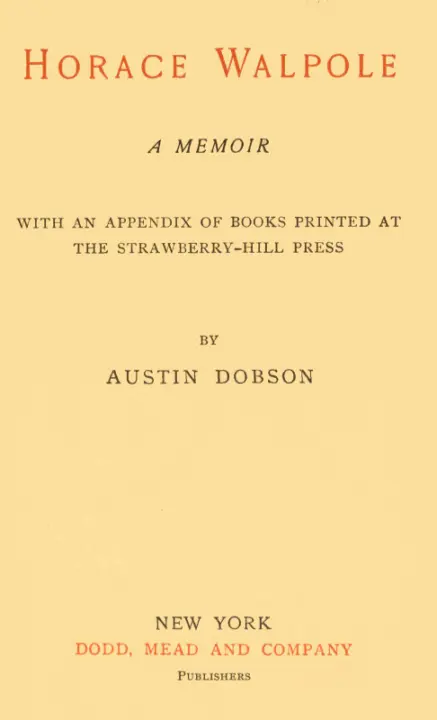
Horace Walpole: A memoir With an appendix of books printed at the Strawberry Hill Press
Austin Dobson
THE CLASSIC COLLECTION · 1908
"De Libris: Prose and Verse" by Austin Dobson is a collection of literary essays and poetry written during the early 20th century. This work explores various themes related to books, literature, and the joys and tribulations of reading and writing. Through a series of reflections and poems, Dobson addresses the sentimental value attached to books, the nature of literature itself, and the creative process behind writing. The opening of the text features a prologue where Dobson addresses the reader in a conversational tone, asking for their benevolence as he presents his musings. He explains that he composed these reflections not out of ambition to please a larger audience but rather to share thoughts that might resonate with a kindred spirit. The prologue sets the stage for essays that delve into the associations people have with books and their meanings, detailing personal anecdotes and contemplating the emotional connections that literature fosters, establishing a rich and engaging tone for the collection.
Introduction adapted from the source catalogue; source summaries may be automatically generated.
Free to read · English · 36,728 words · No account needed
MAKE TIME FOR A GOOD BOOK
On by default. Untick to stop anonymous reading totals. Each page counts after 10 seconds in view. How this works.
Anonymous counting is on unless you have switched it off.
[7] Montaigne has a somewhat similar illustration: "As Cleanthes The Man of Taste's idol, in matters dramatic, is said, that as the voice being forciblie pent in the narrow gullet of a trumpet, at last issueth forth more strong and shriller, so me seemes, that a sentence cunningly and closely couched in measure-keeping Posie, darts it selfe forth more furiously, and wounds me even to the quicke". (Essayes, bk. i. ch. xxv. (Florio's translation).
The Man of Taste's idol, in matters dramatic, is Colley Cibber, who, however, deserves the laurel he wears, not for The Careless Husband, his best comedy, but for his Epilogues and other Plays.
It pleases me, that Pope unlaurell'd goes, While Cibber wears the Bays for Play-house Prose, So Britain's Monarch once uncover'd sate, While Bradshaw bully'd in a broad-brimmed hat,--
a reminiscence of King Charles's trial which might have been added to Bramston stock quotations. The productions of "Curll's chaste press" are also this connoisseur's favourite reading,--the lives of players in particular, probably on the now obsolete grounds set forth in Carlyie's essay on Scott.[8] Among these the memoirs of Cibber's "Lady Betty Modish," Mrs. Oldfield, then lately dead, and buried in Westminster Abbey, are not obscurely indicated.
Note:
[8] "It has been said. 'There are no English lives worth reading except those of Players, who by the nature of the case have bidden Respectability good-day.'"
In morals our friend--as might be expected circa l730--is a Freethinker and Deist. Tindal is his text-book: his breviary the Fable of the Bees;--
T' Improve In Morals Mandevil I read,
And Tyndal's Scruples are my settled Creed.
I travell'd early, and I soon saw through
Religion all, e'er I was twenty-two.
Shame, Pain, or Poverty shall I endure,
When ropes or opium can my ease procure?
When money's gone, and I no debts can pay,
Self-murder is an honourable way.
As Pasaran directs I'd end my life,
And kill myself, my daughter, and my wife.
He would, of course, have done nothing of the kind; nor, for the matter of that, did his Piedmontese preceptor.[9]
Note:
[9] Count Passeran was a freethinking nobleman who wrote A Philosophical Discourse on Death, in which he defended suicide, though he refrained from resorting to it himself. Pope refers to him in the Epilogue to the Satires, Dialogue i. 124:--
If Blount despatch'd himself, he play'd the man,
And so may'st thou, illustrious Passeran!
Nil admirari is the motto of the Man of Taste in Building, where he is naturally at home. He can see no symmetry in the Banqueting House, or in St. Paul's Covent Garden, or even in St. Paul's itself.
Your reading position is saved on this browser. Take it to another device with a library code. Reading pages adapt to text, rather than matching a printed edition.
Austin Dobson
Austin Dobson
Austin Dobson
Austin Dobson
BEHIND THE BOOK
This eBook is for the use of anyone anywhere in the United States and most other parts of the world at no cost and with almost no restrictions whatsoever. You may copy it, give it away or re-use it under the terms of the Project Gutenberg License included with this eBook or online at www.gutenberg.org. If you are not located in the United States, you will have to check the laws of the country where you are located before using this eBook. Read the source licence.
The original source file, including credits and licence, is retained by this library. Request an original-format copy at no charge. Please include the book title and Project Gutenberg identifier #9979.
KEEP YOUR CURIOSITY GOING

David Patterson (Spirit) Hatch

David Patterson (Spirit) Hatch

David Patterson (Spirit) Hatch
Cécile Tormay

Moritz Busch
John L. Ransom