
The Writing of News A Handbook with Chapters on Newspaper Correspondence and Copy Reading
Charles G. (Charles Griffith) Ross
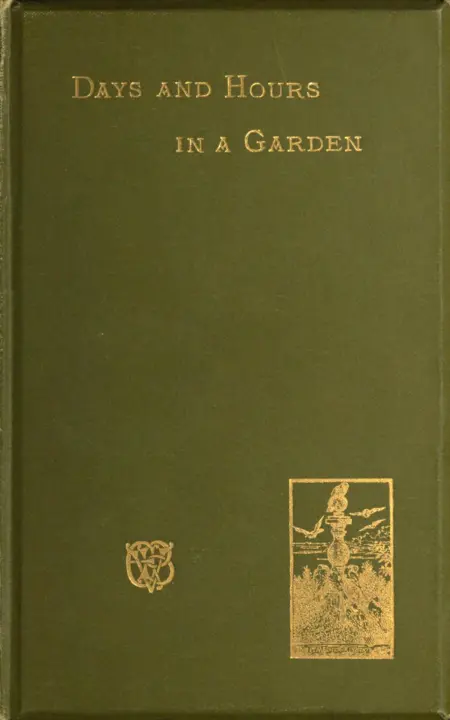
THE CLASSIC COLLECTION · 1884
"Days and Hours in a Garden" by E. V. B. is a reflective account written in the late 19th century. This work offers a meditative exploration of gardening and nature, focusing on the daily joys and challenges of maintaining a garden. The narrative weaves personal observations about plants, wildlife, and the seasons, revealing a deep affection for the beauty and complexity of the natural world. The opening of the book sets a tranquil tone as the author shares the history of their garden, which is only eleven years old, alongside the reflections of how it has transformed and matured over time. The text paints a lively picture of the garden's inhabitants, including birds and the memories attached to the flora and fauna, while alluding to poignant reflections on change and loss. Through rich descriptions, the author captures the rhythm of nature and the cyclical changes within the garden, revealing a thoughtful appreciation of both its beauty and its inevitable transformations.
Introduction adapted from the source catalogue; source summaries may be automatically generated.
Free to read · English · 32,717 words · No account needed
MAKE TIME FOR A GOOD BOOK
On by default. Untick to stop anonymous reading totals. Each page counts after 10 seconds in view. How this works.
Anonymous counting is on unless you have switched it off.
We have made a new Lavender border, and now I hope to have enough for the bees, and afterwards enough, when dried, to lay within the drawers and wardrobes, and give us “all the perfume of summer, when summer is gone;” enough, too, for pot-pourri, though we do not always make this fresh each year. It takes time, and there is so little time in these days! and often the Roses are too wet, and the Lavender too scarce. The recipe we use is an old one: the paper is yellow, and the ink faded. But our best pot-pourri of these days comes not near the undying fragrance of some Rose leaves--three generations old--that we still preserve in one or two old covered jars and bowls of Oriental porcelain. Along the south wall, an oblong bed is planted with dark purple Heartsease, and two more with yellow. There are six beds, and in the spring they will glow resplendently with a setting of Crocuses, white, yellow, and lilac; meanwhile a good layer of cocoanut fibre gives a look of comfort for the winter; and moreover, rather annoys the field-mice.
Under the Holly hedge, facing south, a narrow border has been made ready to receive a quantity of white Iris roots. The Holly hedge, planted for shelter and for pleasure, along a broad walk on one side of the carriage drive, is not in itself a success as yet. It was put in four years ago, but the trees were too old, I think; this year it is flushed all over with scarlet berries.
I am sorry to have to remove my beloved white Irises, but they have increased so enormously as to make some change necessary. Nearly twenty years ago I carried home from the south of France a few small roots in a green pitcher. For half that time they grew and multiplied on the sunny terraces of a sweet Somersetshire garden, and now for ten other years the same roots, transplanted here, have flourished, if possible, still more abundantly. It may be fancy only, but I think our white Irises might not have succeeded as they do, had they not been loved so well. Everybody has a favourite flower, I suppose--the white Iris is mine--the Fleur-de-lys of France--the lily of Florence. Nothing can be more refined and lovely than the thin, translucent petals. To see these flowers at their best, one must get up and go into the garden at five o’clock on some fine morning at the end of May. I did it once, and as I walked beside their shining rows in the clear daylight, I felt there were no such pearly shadows, nor any such strange purity in the whiteness of other flowers. We have given away a great many, but I fear I am not altogether sorry that they do not seem always to succeed elsewhere as they do with us. I am trying to collect every different Iris I know of. We have now several which are very beautiful, and we should have more were it not that numbers die off after, perhaps, one short summer’s loveliness. They dwindle and become sickly, and then altogether disappear. Almost our whole stock of one well-established kind--an old inhabitant of the garden--was destroyed by mice two seasons ago. The flower is bronze-brown, with a golden blaze in the middle. La Marquise (Iris Lurida?), an old-fashioned dove-coloured sort, with purple frays on the falls, will grow anywhere. So will the large, broad-leaved, pale lilac kind, and the yellow Algerian. A little black wild Iris, that fringes the vineyard trenches about Florence, we have either lost or it will not flower. They call it here “La Vedova.” I brought home some roots once from Bellosguardo, and we put them in where all the warmest rays of the south sun would find them. But only the long, narrow, wild onion-like leaves appear--or, I fancy, they are the Vedova’s leaves. Still I do not lose hope, but watch for it always when March comes round; and some day, somewhere, I think, my little “widow” is sure to surprise me. The wild yellow Italian Tulip, that came with the Iris, succeeds here well. The patch of pale gold never fails, by the first week in April, to enliven the sunny side of a Yew hedge. A few untidy yellow blooms, supported on slender limp stalks, live there, just the same as in their own dear Italy. I stoop down to gather one, and for a moment the English garden is not there.... Before me lies a grassy vineyard path--there are the great open farm-sheds, full of sunlight and sunlit shade--and the pair of grey long-horned oxen, calmly waiting for the yoke. Near them, with her knitting, stands a patient sad-eyed woman, while happy children run down the path at play, or tie up bunches of yellow Tulips under the fig-trees.... Then there is a tall, white flag Iris, whose place is not yet fairly fixed. It is a handsome thing, and quite unlike the Fleur-de-lys. I think of mixing it in with the yellow Flags and Osmunda Regalis beside the little watercourse. Last July, to watch the slow blooming of some Japanese Iris in the kitchen garden gave me intense delight. They grew tall and straight, with curiously ribbed leaves. The single flower at the top of each stem opened out very flat, with rounded petals, rich purple in colour, and measuring nearly seven inches across. One saw at once it was the purple flower the Prince, in the German fairy tale, found on the mountains, and carried off to disenchant his love with, in the old witch’s cottage by the wood--only a large pearl lay in the centre of that flower. (There is no such thing as anachronism in fairy tales!)
Your reading position is saved on this browser. Take it to another device with a library code. Reading pages adapt to text, rather than matching a printed edition.
BEHIND THE BOOK
This eBook is for the use of anyone anywhere in the United States and most other parts of the world at no cost and with almost no restrictions whatsoever. You may copy it, give it away or re-use it under the terms of the Project Gutenberg License included with this eBook or online at www.gutenberg.org. If you are not located in the United States, you will have to check the laws of the country where you are located before using this eBook. Read the source licence.
The original source file, including credits and licence, is retained by this library. Request an original-format copy at no charge. Please include the book title and Project Gutenberg identifier #69862.
KEEP YOUR CURIOSITY GOING
Charles G. (Charles Griffith) Ross
Hannah Webster Foster

Emily Lawless
Edwin Hamlin Carr

Charles De Lano Hine
Andrew Ure