THE CLASSIC COLLECTION✦An outlaw’s diary: the CommuneCLASSIC FREE BOOKS
An outlaw’s diary: the Commune
Cécile Tormay
THE CLASSIC COLLECTION · 1915
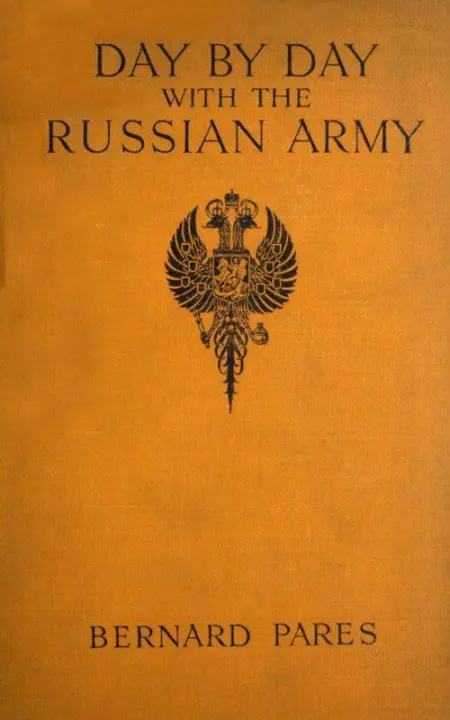
"Day by Day with the Russian Army, 1914-15" by Bernard Pares is a historical account written in the early 20th century. The book provides a firsthand perspective of the author's experiences as an official British observer with the Russian armies during World War I. It chronicles the complexities of the Russian military campaign in Galicia, detailing the socio-political dynamics and the conditions of the soldiers in the field, as well as their interactions with locals in the territories they occupied. The opening of this work introduces the author’s background and insights gained from years of interest in Russia, which positions him as an informed observer as the war begins. It sets the stage for his imminent journey to the front just weeks after the declaration of war. Pares describes his preparations, connections with prominent figures, and the enthusiasm of the Russian populace as they mobilize for conflict. Alongside his observations, he highlights the contrasts between the military advance, the socio-political ramifications, and the spirit of the soldiers and civilians, illustrating a nation at war and its implications for identity and sacrifice.
Introduction adapted from the source catalogue; source summaries may be automatically generated.
Free to read · English · 80,979 words · No account needed
MAKE TIME FOR A GOOD BOOK
On by default. Untick to stop anonymous reading totals. Each page counts after 10 seconds in view. How this works.
Anonymous counting is on unless you have switched it off.
May 6.--Alarm at 4 a.m. We march in the advanced guard and are to go to the river Wislok. With fifteen men I go scouting, direction of Wyzjowa, Dembow and Blazkow, or rather south of Blazkow, Hill 291. We are to reconnoitre the course of the river Wislok to see if the enemy is there. I go with Polnerycz; he goes off a little to the north. We get to Czerinne. In the morning there were Cossacks here everywhere. Every one is afraid of the Germans.[28] On the road, we buy some eggs. We got to the top of the hill, and in front of us lay the Wislok. We could not advance further. German scouts. The Russian artillery is cannonading us from the opposite heights. I and my men look for cover in a deep ditch. Only two go forward on their knees up the hill, and keep a look out; two I send to a hut to cook some potatoes. Columns are moving along the road to Blazkow. I think it is our battalion coming up. I send two men to the village and meanwhile read the newspaper. At my order the thinned ranks go forward. God of Mercy have mercy on us. I wonder who of us will survive. Two o'clock. We eat some potatoes. The battalion is in the village. I go forward to it. We got there safely. In the village two of our batteries are taking up position. We get some dinner. Unexpectedly there arrive two civilians. I thought I knew one of them. Just then he came up to me and said in pure German, "Sir, I have the honour to report myself from captivity." It was Tandler of my squad, who with Palme, of the Rifles, was taken prisoner by the Russians in December and escaped. They were disguised as Poles. Tandler spoke Bohemian well, and the Russians took him for a Pole. The other pretended to be dumb. The schoolmaster of the village of Blazkow helped them. The first company went forward towards the river. At night we were to attack the heights beyond the river. The Russians have burned the bridges. We must ford the river. I left my knapsack in the kitchen and took with me only my field glasses, ... spade and revolver. At 12 o'clock we get up, have a meal and drink black coffee. We come to the river, the 4th company in front, at 2 a.m. The road was very dusty. Behind us a Russian shell set the hut on fire. Our 4th company arrived at the burned bridge. Just then we came under a rain of bullets. All lay down. Next to me was Sub-Lieutenant Bader. I call Kahlen and want to give orders but it is no use. We run along the marsh to the bank of the river; I see its shining surface. Just one plunge forward and, with the name of God, we are in the water. Some fall behind in the water. I see that the copse on the opposite bank is full of our men and hear the rear ranks coming through the river. About 600 yards from us a hut was set on fire, and lit up the house to the right. We are going towards the flaming hut. The sub-lieutenant doesn't want to go forward, saying that he has no orders. I lost him. Our right flank is already engaged. We hear a Russian machine gun. I send an orderly to the left and want to know who is there, as so far there is not a sound on that side. We run forward about 300 yards and begin going up the hill. At 100 or 115 yards in front of us we see the trenches. I don't know whether they are Russians' or ours. The firing does not slacken. If the Russians have gone, then they may come back. "Forward," I shout, "first battalion, forward, hurrah," but no one wants to move. All our men turn to the left, and no one listens to me. Only when I repeat the order and explain that there are very few Russians, they go forward. Three or four Russians are still firing; the rest throw away their guns and throw up their hands, about seventy. I leave four men with them and go forward. To the left of us the Russian machine guns are firing on our flank. We are joined by a company of the 2nd Rifles. I direct them quickly to the left, where I see flashes of musketry fire. Myself I go at a quick pace to the hill. I see that the Russians are returning and can easily turn our 4th company. Quickly forward. It is sad to think of so many lives. The will of God be done. Just then I heard from behind shouts of hurrah and bullets whistling. This was the reserve of the 98th Regiment, which was going to attack the Russians whom we had already taken prisoners, and took us for retreating Russians. They fire at us with machine gun. I shout out, use my whistle and at last succeed in stopping the fire. I look round to the left and see that Captain Tezera coming up. I am very tired, tortured with thirst and can hardly stand on my legs. With a gesture I explain to him the position of affairs to the left. He is wounded in the hand. Our men quickly entrench on the hill. Czwanczara takes me to a hut and makes some coffee. They now suggest that I should go to the first-aid point. I am in the village of Bukowa. I wait for Janikowski with clean linen, so as to change. The Russian shrapnels are bursting in Bukowa, above which are our trenches. After paying the hostess I go to look for the doctor. Everywhere there is a mass of wounded, ours and the Russians. Some dead Russians lie on the road. In the hut I happen to meet our major. I tell him that I am going off. He seems very annoyed, and says that he has no one to replace me. The doctor of the 2nd Rifles looked me over. He was anxious about my lungs, otherwise it was simply fatigue and a bad cold. At the first-aid point there were a mass of wounded; lots of them ours. I met Janikowski. I heard from him that among the wounded were Boguslaw, Minster, Klein, Tepser, Werner, Silberbauer, seriously; and killed Radlenbacher, Gezl, Scoutmaster Malina, and Altman. The field hospital was in the school. There were many wounded in head and chest and stomach. I slept with the slightly wounded, and had a fairly good night.
Your reading position is saved on this browser. Take it to another device with a library code. Reading pages adapt to text, rather than matching a printed edition.
BEHIND THE BOOK
This eBook is for the use of anyone anywhere in the United States and most other parts of the world at no cost and with almost no restrictions whatsoever. You may copy it, give it away or re-use it under the terms of the Project Gutenberg License included with this eBook or online at www.gutenberg.org. If you are not located in the United States, you will have to check the laws of the country where you are located before using this eBook. Read the source licence.
The original source file, including credits and licence, is retained by this library. Request an original-format copy at no charge. Please include the book title and Project Gutenberg identifier #55702.
KEEP YOUR CURIOSITY GOING
Cécile Tormay

Moritz Busch
John L. Ransom
Frances Wright
Cécile Tormay

Mabel Potter Daggett