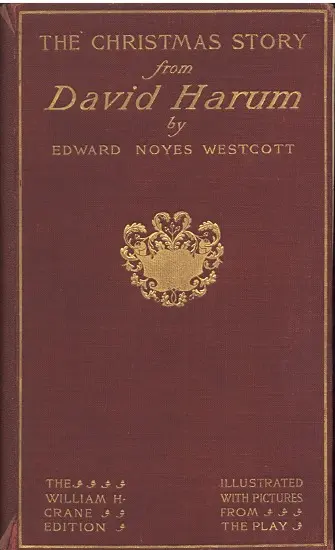
The Christmas Story from David Harum
Edward Noyes Westcott
THE CLASSIC COLLECTION · 1898
"David Harum" by Edward Noyes Westcott is a novel published in 1898. The story centers on David Harum, a small-town banker and horse trader whose unorthodox business philosophy challenges conventional morality. Speaking in rural New York dialect, Harum justifies dubious trading practices with his own version of the Golden Rule. This bestseller resonated particularly with businessmen of the era, offering a more relaxed code of ethics than typical novels of the time. The book's success sparked adaptations for stage, film, and radio.
Introduction adapted from the source catalogue; source summaries may be automatically generated.
Free to read · English · 106,979 words · No account needed
MAKE TIME FOR A GOOD BOOK
On by default. Untick to stop anonymous reading totals. Each page counts after 10 seconds in view. How this works.
Anonymous counting is on unless you have switched it off.
"Well, sir," replied the man, "I notice at table, sir, for one thing. We've been alone here off and on a good bit, sir, and he used always to have a pleasant word or two to say to me, and may be to ask me questions and that, sir; but for a long time lately he hardly seems to notice me. Of course, there ain't any need of his saying anything, because I know all he wants, seeing I've waited on him so long, but it's different in a way, sir."
"Does he go out in the evening to his club?" asked John.
"Very rarely, sir," said Jeffrey. "He mostly goes to his room after dinner, an' oftentimes I hear him walking up an' down, up an' down, and, sir," he added, "you know he often used to have some of his friends to dine with him, and that ain't happened in, I should guess, for a year."
"Have things gone wrong with him in any way?" said John, a sudden
anxiety overcoming some reluctance to question a servant on such a
subject.
"You mean about business, and such like?" replied Jeffrey. "No, sir, not so far as I know. You know, Mr. John, sir, that I pay all the house accounts, and there hasn't never been no--no shortness, as I might say, but we're living a bit simpler than we used to--in the matter of wine and such like--and, as I told you, we don't have comp'ny no more."
"Is that all?" asked John, with some relief.
"Well, sir," was the reply, "perhaps it's because Mr. Lenox is getting older and don't care so much about such things, but I have noticed that he hasn't had anything new from the tailor in a long time, and really, sir, though perhaps I oughtn't to say it, his things is getting a bit shabby, sir, and he used to be always so partic'lar."
John got up and walked over to the window which looked out at the rear of the house. The words of the old servant disquieted him, notwithstanding that there was nothing so far that could not be accounted for without alarm. Jeffrey waited for a moment and then asked:
"Is there anything I can do for you, Mr. John? Will you be having
luncheon here, sir?"
"No, thank you, Jeff," said John; "nothing more now, and I will lunch here. I'll come down and see Ann presently."
"Thank you, sir," said Jeffrey, and withdrew.
Your reading position is saved on this browser. Take it to another device with a library code. Reading pages adapt to text, rather than matching a printed edition.
Edward Noyes Westcott
BEHIND THE BOOK
This eBook is for the use of anyone anywhere in the United States and most other parts of the world at no cost and with almost no restrictions whatsoever. You may copy it, give it away or re-use it under the terms of the Project Gutenberg License included with this eBook or online at www.gutenberg.org. If you are not located in the United States, you will have to check the laws of the country where you are located before using this eBook. Read the source licence.
The original source file, including credits and licence, is retained by this library. Request an original-format copy at no charge. Please include the book title and Project Gutenberg identifier #17617.
KEEP YOUR CURIOSITY GOING
Coulson Kernahan

Maurice Baring
Frances Wright
Cécile Tormay

Frederic Jesup Stimson

W. H. P. (William Henry Pope) Jarvis