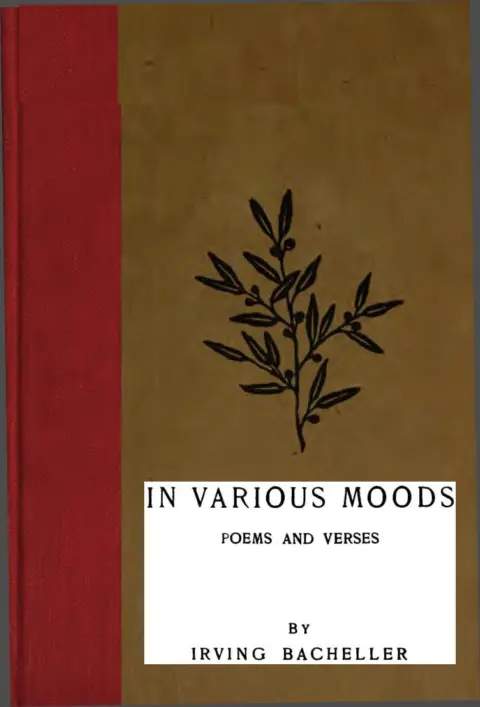
In Various Moods: Poems and Verses
Irving Bacheller
THE CLASSIC COLLECTION · 1903
"Darrel of the Blessed Isles" by Irving Bacheller is a novel written in the early 20th century, reflecting themes of personal growth and the quest for identity amid life's challenges. The narrative follows a character named Sidney Trove, a boy of mysterious origins, who is raised by the Allens in a rural, simplistic life. As he grows, Trove grapples with the enigmas of his identity, shaped by his early experiences, the kindness of those around him, and his aspirations for a brighter future. The opening of the novel introduces Sidney Trove, who is discovered as a small child in a red sleigh by Theron Allen and his wife, amidst a snowbound landscape. Trove's arrival is mystifying; he speaks an unfamiliar language, showcasing his unknown origins. As he integrates into the Allen family, he quickly adapts to his new life, eventually thriving physically and intellectually. As the chapters unfold, they establish a rich backdrop of rural life, characterized by hard work, nature, and the steadfast morals of the characters, while hinting at the adventures and growth that await Trove on his journey toward self-discovery. The narrative ultimately invites readers to explore themes of belonging, the power of kindness, and the impact of personal choices in shaping one's destiny.
Introduction adapted from the source catalogue; source summaries may be automatically generated.
Free to read · English · 70,566 words · No account needed
MAKE TIME FOR A GOOD BOOK
On by default. Untick to stop anonymous reading totals. Each page counts after 10 seconds in view. How this works.
Anonymous counting is on unless you have switched it off.
They skirted the pond, crossing a long ridge on its farther shore. At a spring of cool water in a deep ravine they halted to drink and rest. Suddenly they heard a sound of men approaching; and when the latter had come near, a voice, deep, vibrant, and musical as a harp-string, in these lines of Hamlet:--
"'Why right; you are i' the right;
And so without more circumstance at all,
I hold it fit that we shake hands and part;
You as your business and desire shall point you;
For every man has business and desire
Such as it is; and for mine own part
Look you, I'll go pray.'"
Then said Darrel, loudly:--
"'These are but wild and whirling words, my lord.'"
Two men, a guide in advance, came along the trail--one, a most impressive figure, tall, erect, and strong; its every move expressing grace and power.
Again the deep music of his voice, saying:--
"'I'm sorry they offend you heartily; yes, faith, heartily.'"
And Darrel rejoined, his own rich tone touching the note of
melancholy in the other:--
"'There's no offence, my lord.'"
"'What Horatio is this?" the stranger inquired, offering his hand.
"A player?"
"Ay, as are all men an' women," said Darrel, quickly. "But I, sor,
have only a poor part. Had I thy lines an' makeup, I'd win
applause."
The newcomers sat down, the man who had spoken removing his hat. Curly locks of dark hair, with now a sprinkle of silver in them, fell upon his brows. He had large brown eyes, a mouth firm and well modelled, a nose slightly aquiline, and wore a small, dark imperial--a mere tuft under his lip.
"Well, Colonel, you have paid me a graceful compliment," said he.
"Nay, man, do not mistake me rank," said Darrel.
"Indeed--what is it?"
"Friend," he answered, quickly. "In good company there's no higher rank. But if ye think me unworthy, I'll be content with 'Mister.'"
"My friend, forgive me," said the stranger, approaching Darrel.
"Murder and envy and revenge and all evil are in my part, but no
impertinence."
"I know thy rank, sor. Thou art a gentleman," said Darrel. "I've seen thee 'every inch a king.'"
Darrel spoke to the second period in that passage of Lear, the majesty and despair of the old king in voice and gesture. The words were afire with feeling as they came off his tongue, and all looked at him with surprise.
"Ah, you have seen me play it," said the stranger. "There's no other Lear that declares himself with that gesture."
Your reading position is saved on this browser. Take it to another device with a library code. Reading pages adapt to text, rather than matching a printed edition.
Irving Bacheller
Irving Bacheller
Irving Bacheller
Irving Bacheller
BEHIND THE BOOK
This eBook is for the use of anyone anywhere in the United States and most other parts of the world at no cost and with almost no restrictions whatsoever. You may copy it, give it away or re-use it under the terms of the Project Gutenberg License included with this eBook or online at www.gutenberg.org. If you are not located in the United States, you will have to check the laws of the country where you are located before using this eBook. Read the source licence.
The original source file, including credits and licence, is retained by this library. Request an original-format copy at no charge. Please include the book title and Project Gutenberg identifier #12102.
KEEP YOUR CURIOSITY GOING
Coulson Kernahan

Maurice Baring
Frances Wright
Cécile Tormay

Frederic Jesup Stimson

W. H. P. (William Henry Pope) Jarvis