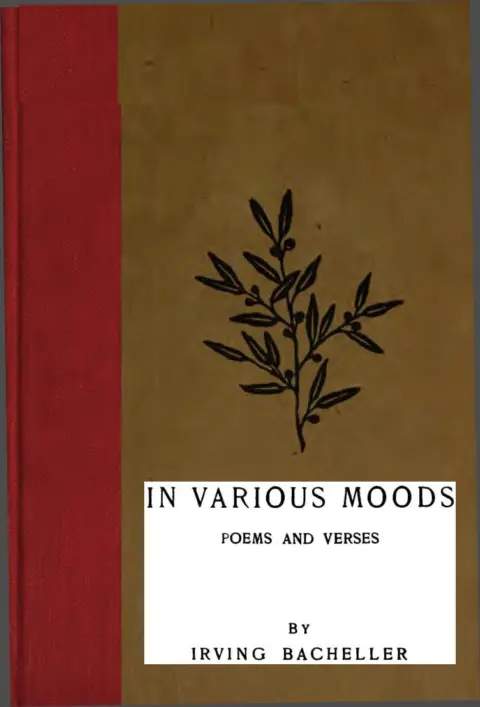
In Various Moods: Poems and Verses
Irving Bacheller
THE CLASSIC COLLECTION · 1903
"Darrel of the Blessed Isles" by Irving Bacheller is a novel written in the early 20th century, reflecting themes of personal growth and the quest for identity amid life's challenges. The narrative follows a character named Sidney Trove, a boy of mysterious origins, who is raised by the Allens in a rural, simplistic life. As he grows, Trove grapples with the enigmas of his identity, shaped by his early experiences, the kindness of those around him, and his aspirations for a brighter future. The opening of the novel introduces Sidney Trove, who is discovered as a small child in a red sleigh by Theron Allen and his wife, amidst a snowbound landscape. Trove's arrival is mystifying; he speaks an unfamiliar language, showcasing his unknown origins. As he integrates into the Allen family, he quickly adapts to his new life, eventually thriving physically and intellectually. As the chapters unfold, they establish a rich backdrop of rural life, characterized by hard work, nature, and the steadfast morals of the characters, while hinting at the adventures and growth that await Trove on his journey toward self-discovery. The narrative ultimately invites readers to explore themes of belonging, the power of kindness, and the impact of personal choices in shaping one's destiny.
Introduction adapted from the source catalogue; source summaries may be automatically generated.
Free to read · English · 70,566 words · No account needed
MAKE TIME FOR A GOOD BOOK
On by default. Untick to stop anonymous reading totals. Each page counts after 10 seconds in view. How this works.
Anonymous counting is on unless you have switched it off.
"We're going to be friends," said he, in a low, gentle voice. He took from his pocket a lot of cards and gave one to each.
"Here's a story," he continued. "See--I put it in plain print for you with pen and ink. It's all about a bear and a boy, and is in ten parts. Here's the first chapter. Take it home with you to-night--"
He stopped suddenly. He had turned in his chair and could see none of the boys. He did not move, but slowly took off a pair of glasses he had been wearing.
"Joe Beach," said he, coolly, "come out here on the floor."
There was a moment of dead silence. That big youth--the terror of Linley School--was now red and dumb with amazement. His deviltry had begun, but how had the teacher seen it with his back turned?
"I'll think it over," said the boy, sullenly.
The teacher laid down his book, calmly, walked to the seat of the young rebel, took him by the collar and the back of the neck, tore him out of the place where his hands and feet were clinging like the roots of a tree, dragged him roughly to the aisle and over the floor space, taking part of the seat along, and stood him to the wall with a bang that shook the windows. There was no halting--it was all over in half a minute.
"You'll please remain there," said he, coolly, "until I tell you to
sit down."
He turned his back on the bully, walked slowly to his chair, and
opened his book again.
"Take it home with you to-night," said he, continuing his talk to the primer class. "Spell it over, so you won't have to stop long between words. All who read it well to-morrow will get another chapter."
They began to study at home. Wonder grew, and pleasure came with
labour as the tale went on.
He dismissed the primer readers, calling the first class in geography. As they took their places he repaired the broken seat, a part of which had been torn off the nails. The fallen rebel stood leaning, his back to the school. He had expected help, but the reserve force had failed him.
"Joe Beach--you may take your seat," said the teacher, in a kind of
parenthetical tone.
"Geography starts at home," he continued, beginning the recitation. "Who can tell me where is the Linley schoolhouse?"
A dozen hands went up.
"You tell," said he to one.
"It's here," was the answer.
"Where's here?"
A boy looked thoughtful.
"Nex' t' Joe Linley's cow-pastur'," he ventured presently,
Your reading position is saved on this browser. Take it to another device with a library code. Reading pages adapt to text, rather than matching a printed edition.
Irving Bacheller
Irving Bacheller
Irving Bacheller
Irving Bacheller
BEHIND THE BOOK
This eBook is for the use of anyone anywhere in the United States and most other parts of the world at no cost and with almost no restrictions whatsoever. You may copy it, give it away or re-use it under the terms of the Project Gutenberg License included with this eBook or online at www.gutenberg.org. If you are not located in the United States, you will have to check the laws of the country where you are located before using this eBook. Read the source licence.
The original source file, including credits and licence, is retained by this library. Request an original-format copy at no charge. Please include the book title and Project Gutenberg identifier #12102.
KEEP YOUR CURIOSITY GOING
Coulson Kernahan

Maurice Baring
Frances Wright
Cécile Tormay

Frederic Jesup Stimson

W. H. P. (William Henry Pope) Jarvis