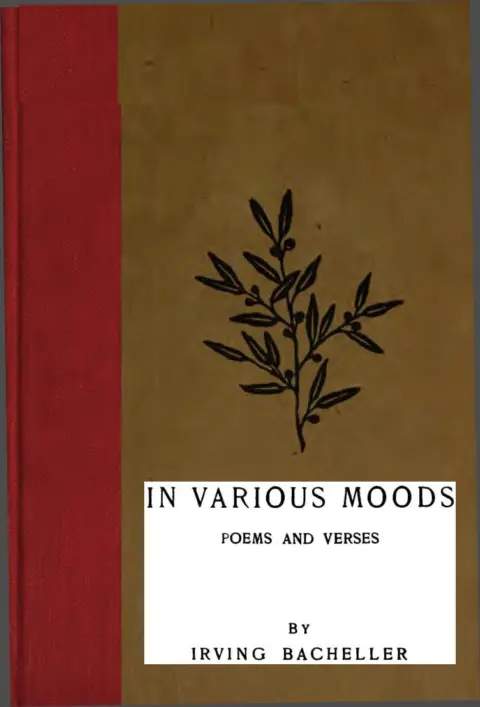
In Various Moods: Poems and Verses
Irving Bacheller
THE CLASSIC COLLECTION · 1903
"Darrel of the Blessed Isles" by Irving Bacheller is a novel written in the early 20th century, reflecting themes of personal growth and the quest for identity amid life's challenges. The narrative follows a character named Sidney Trove, a boy of mysterious origins, who is raised by the Allens in a rural, simplistic life. As he grows, Trove grapples with the enigmas of his identity, shaped by his early experiences, the kindness of those around him, and his aspirations for a brighter future. The opening of the novel introduces Sidney Trove, who is discovered as a small child in a red sleigh by Theron Allen and his wife, amidst a snowbound landscape. Trove's arrival is mystifying; he speaks an unfamiliar language, showcasing his unknown origins. As he integrates into the Allen family, he quickly adapts to his new life, eventually thriving physically and intellectually. As the chapters unfold, they establish a rich backdrop of rural life, characterized by hard work, nature, and the steadfast morals of the characters, while hinting at the adventures and growth that await Trove on his journey toward self-discovery. The narrative ultimately invites readers to explore themes of belonging, the power of kindness, and the impact of personal choices in shaping one's destiny.
Introduction adapted from the source catalogue; source summaries may be automatically generated.
Free to read · English · 70,566 words · No account needed
MAKE TIME FOR A GOOD BOOK
On by default. Untick to stop anonymous reading totals. Each page counts after 10 seconds in view. How this works.
Anonymous counting is on unless you have switched it off.
"Well, sor, under the ancient law, ye reap as ye have sown, but more abundantly. I gave me coat to one that needed it more, an' by the goodness o' God I have reaped another an' two friends. Hold to thy course, boy, thou shalt have friends an' know their value. An' then thou shalt say, 'I'll be kind to this man because he may be a friend;' an' love shall increase in thee, an' around thee, an' bring happiness. Ah, boy! in the business o' the soul, men pay thee better than they owe. Kindness shall bring friendship, an' friendship shall bring love, an' love shall bring happiness, an' that, sor, that is the approval o' God. What speculation hath such profit? Hast thou learned to think?"
"I hope I have," said the boy.
"Prithee--think a thought for me. What is the first law o' life?"
There was a moment of silence.
"Thy pardon, boy," said the venerable tinker, filling a clay pipe and stretching himself on a lounge. "Thou art not long out o' thy clouts. It is, 'Thou shalt learn to think an' obey.' Consider how man and beast are bound by it. Very well--think thy way up. Hast thou any fear?"
The old man was feeling his gray hair, thoughtfully.
"Only the fear o' God," said the boy, after a moment of hesitation.
"Well, on me word, I am full sorry," said the tinker. "Though mind ye, boy, fear is an excellent good thing, an' has done a work in the world. But, hear me, a man had two horses the same age, size, shape, an' colour, an' one went for fear o' the whip, an' the other went as well without a whip in the wagon. Now, tell me, which was the better horse?"
"The one that needed no whip."
"Very well!" said the old man, with emphasis. "A man had two sons, an' one obeyed him for fear o' the whip, an' the other, because he loved his father, an' could not bear to grieve him. Tell me again, boy, which was the better son?"
"The one that loved him," said the boy.
"Very well! very well!" said the old man, loudly. "A man had two neighbours, an' one stole not his sheep for fear o' the law, an' the other, sor, he stole them not, because he loved his neighbour. Now which was the better man?"
"The man that loved him."
"Very well! very well! and again very well!" said the tinker, louder than before. "There were two kings, an' one was feared, an' the other, he was beloved; which was the better king?"
"The one that was beloved."
Your reading position is saved on this browser. Take it to another device with a library code. Reading pages adapt to text, rather than matching a printed edition.
Irving Bacheller
Irving Bacheller
Irving Bacheller
Irving Bacheller
BEHIND THE BOOK
This eBook is for the use of anyone anywhere in the United States and most other parts of the world at no cost and with almost no restrictions whatsoever. You may copy it, give it away or re-use it under the terms of the Project Gutenberg License included with this eBook or online at www.gutenberg.org. If you are not located in the United States, you will have to check the laws of the country where you are located before using this eBook. Read the source licence.
The original source file, including credits and licence, is retained by this library. Request an original-format copy at no charge. Please include the book title and Project Gutenberg identifier #12102.
KEEP YOUR CURIOSITY GOING
Coulson Kernahan

Maurice Baring
Frances Wright
Cécile Tormay

Frederic Jesup Stimson

W. H. P. (William Henry Pope) Jarvis