
The Story of Siena and San Gimignano
Edmund G. Gardner
THE CLASSIC COLLECTION · 1923
"Dante" by Edmund G. Gardner is a scholarly publication written in the early 20th century. This work serves as a revision of Gardner’s earlier "Dante Primer," reflecting insights into the life and significance of the poet Dante Alighieri, with discussions surrounding his notable work, the "Divina Commedia." The book explores not only Dante's literary accomplishments but also his historical and political contexts, examining his role as a national hero for Italy. The opening portion begins by situating Dante within the backdrop of the Middle Ages, highlighting the tumultuous political landscape of Italy during his lifetime, marked by conflicts between the Guelfs and Ghibellines. It introduces Dante’s background, including his family lineage and the city of Florence where he was born. As it transitions into his youth, the narrative touches on his love for Beatrice, a significant influence in his poetic work, and outlines the early events leading to his eventual exile which would shape much of his writing and philosophical thought throughout his life. This introductory section lays the groundwork for deeper explorations of Dante's contributions to literature and the evolving nature of Italian society during his era.
Introduction adapted from the source catalogue; source summaries may be automatically generated.
Free to read · English · 60,071 words · No account needed
MAKE TIME FOR A GOOD BOOK
On by default. Untick to stop anonymous reading totals. Each page counts after 10 seconds in view. How this works.
Anonymous counting is on unless you have switched it off.
THE COMING OF CHARLES OF VALOIS.--The government still shrank from directly opposing the Pope, who, by letter from Cardinal Matteo d’Acquasparta, demanded the continuation of the service of a hundred horsemen. On June 19th, 1301, in a united meeting of the Councils of the Hundred, of the Captain, and of the Capitudini, and again in the Council of the Hundred apart, Dante spoke against compliance, urging “quod de servitio faciendo domini Papae nihil fiat”--with the result that the matter was postponed. In the united Councils of the Hundred, the Captain, the Podestà, and the Capitudini, on September 13th, he pleaded for the preservation of the Ordinances of Justice (a sign that the State was regarded as in peril). On this occasion all the twenty-one arts were represented, which we may connect with Leonardo Bruni’s statement that Dante had advised the Priors to strengthen themselves with the support of the “moltitudine del popolo.” On September 20th, in the Council of the Captain, he supported a request of the ambassadors of the Commune of Bologna (then allied with the Bianchi) for free passage for their importation of grain. On September 28th, again in the Council of the Captain, he defended a certain Neri di Gherardino Diedati (whose father was destined to share the poet’s fate) from an injust charge. This is the last recorded time that Dantes Alagherii consuluit in Florence. Already Charles of Valois was on his way, preparing to “joust with the lance of Judas” (Purg. xx. 70-78). On November 1st, after giving solemn pledges to the Signoria (Dino Compagni being one of the Priors), Charles with 1200 horsemen entered Florence without opposition.
Leonardo Bruni asserts that Dante was absent at Rome on an embassy to the Pope when the latter’s “peacemaker” entered Florence. It would appear that the Florentine government had requested the allied Commune of Bologna to send an embassy to Boniface, simultaneously with an embassy from Siena with which were associated three ambassadors from Florence: Maso di Ruggierino Minerbetti, Corazza da Signa, and Dante Alighieri. Their purpose was to make their own terms with the Pontiff in order to avert the intervention of Charles. The mission set out at the beginning of October; but one of the Bolognese ambassadors, Ubaldino Malavolti, having business of his own with the Florentine government, delayed the others so long that they did not arrive in time.[5] Boccaccio asserts that, when the Bianchi proposed to send Dante on such an embassy, he answered somewhat arrogantly: “If I go, who stays? and if I stay, who goes?” According to Dino Compagni, Boniface sent two of the Florentines--Maso Minerbetti and Corazza da Signa--back to Florence to demand submission to his will, but detained Dante at his court. The fact of Dante taking part in such an embassy is confirmed by the author of the Ottimo Commento, as also by an anonymous commentator on the canzone of the Tre donne, and, though seriously questioned by many Dante scholars, it is now generally accepted as historical. The other two ambassadors returned almost simultaneously with the arrival of the French prince. Yielding to necessity and trusting to his solemn oath, the Signoria, in a parliament held in S. Maria Novella, gave Charles authority to pacify the city; which he set about doing by restoring the Neri to power. Corso Donati with his allies entered Florence in arms, to plunder and massacre at their pleasure, the last Signoria of the Bianchi being compelled to resign on November 7th (cf. Purg. vi. 143, 144). A second effort by the Cardinal Matteo from the Pope to reconcile the two factions was resisted by Charles and the Neri; and the work of proscription began. The new Podestà, Cante de’ Gabrielli da Gubbio, passed sentence after sentence against the ruined Bianchi. Finally, at the beginning of April, their chiefs were betrayed into a real or pretended conspiracy against Charles, and driven out with their followers and adherents, both nobles and burghers, six hundred in number; their houses were destroyed, and their goods confiscated, themselves sentenced as rebels. On April 4th, 1302, Charles left Florence, covered with disgrace and full of plunder, leaving the government entirely in the hands of the Neri. “Having cast forth the greatest part of the flowers from thy bosom, O Florence,” writes Dante in the De Vulgari Eloquentia, “the second Totila went fruitlessly to Sicily” (V. E. ii. 6).
Your reading position is saved on this browser. Take it to another device with a library code. Reading pages adapt to text, rather than matching a printed edition.
Edmund G. Gardner
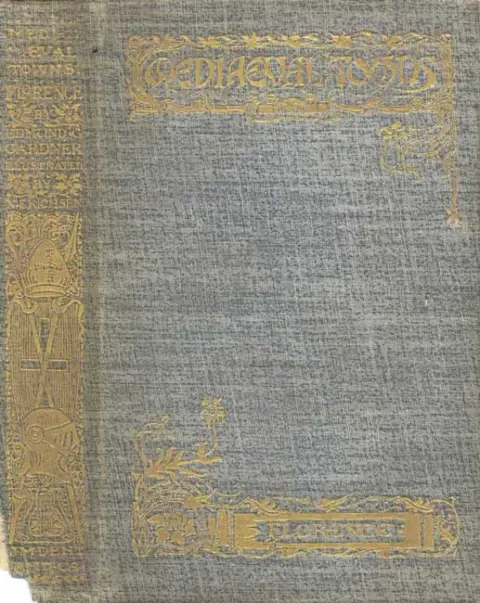
Edmund G. Gardner
BEHIND THE BOOK
This eBook is for the use of anyone anywhere in the United States and most other parts of the world at no cost and with almost no restrictions whatsoever. You may copy it, give it away or re-use it under the terms of the Project Gutenberg License included with this eBook or online at www.gutenberg.org. If you are not located in the United States, you will have to check the laws of the country where you are located before using this eBook. Read the source licence.
The original source file, including credits and licence, is retained by this library. Request an original-format copy at no charge. Please include the book title and Project Gutenberg identifier #71990.
KEEP YOUR CURIOSITY GOING
Cécile Tormay

Moritz Busch
John L. Ransom
Frances Wright
Cécile Tormay

Mabel Potter Daggett