
The Story of Siena and San Gimignano
Edmund G. Gardner
THE CLASSIC COLLECTION · 1923
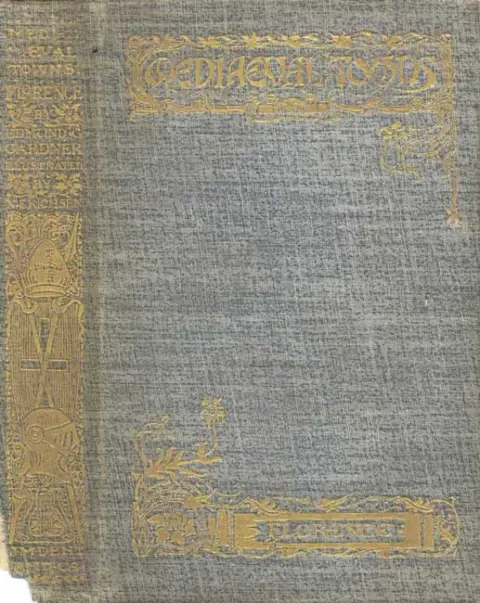
"Dante" by Edmund G. Gardner is a scholarly publication written in the early 20th century. This work serves as a revision of Gardner’s earlier "Dante Primer," reflecting insights into the life and significance of the poet Dante Alighieri, with discussions surrounding his notable work, the "Divina Commedia." The book explores not only Dante's literary accomplishments but also his historical and political contexts, examining his role as a national hero for Italy. The opening portion begins by situating Dante within the backdrop of the Middle Ages, highlighting the tumultuous political landscape of Italy during his lifetime, marked by conflicts between the Guelfs and Ghibellines. It introduces Dante’s background, including his family lineage and the city of Florence where he was born. As it transitions into his youth, the narrative touches on his love for Beatrice, a significant influence in his poetic work, and outlines the early events leading to his eventual exile which would shape much of his writing and philosophical thought throughout his life. This introductory section lays the groundwork for deeper explorations of Dante's contributions to literature and the evolving nature of Italian society during his era.
Introduction adapted from the source catalogue; source summaries may be automatically generated.
Free to read · English · 60,071 words · No account needed
MAKE TIME FOR A GOOD BOOK
On by default. Untick to stop anonymous reading totals. Each page counts after 10 seconds in view. How this works.
Anonymous counting is on unless you have switched it off.
[37] In Purg. xxx. 109-117, Dante thus distinguishes between the ovra de le rote magne and the larghezza di grazie divine in his own case. St. Gregory the Great, speaking of the correspondence of men with the angelic orders, uses the phrase: divinae largitatis munere refecti (Hom. in Evangelia, ii. 34).
[38] I venture to retain this reading, although the testo critico now gives: E’n la sua volontade.
[39] The Vulgate has virtutes caelorum, in Matt. xxiv. and Luke xxi., where the English Bible reads “the powers of the heavens.”
[40] St. John of Damascus.
[41] Note the scansion of the previous line (37): Io che al divino da l’umano. There is no syneresis in ïo, no elision of the e in che; thus emphasising Dante’s personal experience, his wonder that it should be vouchsafed to him, and producing the slow movement, the solemn intonation of the line.
The following notes do not attempt to give a full bibliography, but merely a selection of works that will be found useful by the readers of this Primer.
Le Opere di Dante, testo critico della Società Dantesca Italiana, a cura di M. Barbi, E. G. Parodi, F. Pellegrini, E. Pistelli, P. Rajna, E. Rostagno, G. Vandelli. Con indice analitico dei nomi e delle cose di Mario Casella. Florence, 1921. The “Sexcentenary Dante.”
Le Opere di Dante Alighieri, a cura del Dr. E. Moore, nuovamente rivedute nel testo dal Dr. Paget Toynbee. Fourth edition. Oxford, 1923.
A Dictionary of Proper Names and Notable Matters in the Works of Dante, by Paget Toynbee. Oxford, 1898.
A Concise Dictionary of Proper Names and Notable Matters in the Works of Dante, by Paget Toynbee, Oxford, 1914.
Concordance of the “Divina Commedia.” By E. A. Fay. Boston, 1888.
Concordanza delle opere italiane in prosa e del Canzoniere di Dante Alighieri. By E. S. Sheldon and A. C. White. Oxford, 1905.
Dantis Alagherii Operum Latinorum Concordantiae. By E. K. Rand and E. H. Wilkins, Oxford, 1912.
Caggese, R., Firenze dalla decadenza di Roma al Risorgimento d’Italia. Vols. i. and ii. Florence, 1912-1913.
Casini, T., Letteratura italiana: storia ed esempi. Vols. i. and ii.
Rome, 1909.
Dino Compagni, La Cronica con introduzione e commento di G. Luzzatto. Milan, 1906. (English translation of the Chronicle by E. Benecke and A. G. F. Howell in the “Temple Classics,” London.)
D’Ancona, A., and Bacci, O., Manuale della letteratura italiana, vol.
i. Florence.
Gaspary, A., History of Early Italian Literature to the Death of Dante, translated by H. Oelsner. London, 1901.
Del Lungo, I., Dino Compagni e la sua Cronica (Florence, 1879-1887); I Bianchi e i Neri (second edition. Milan, 1921).
Your reading position is saved on this browser. Take it to another device with a library code. Reading pages adapt to text, rather than matching a printed edition.
Edmund G. Gardner
Edmund G. Gardner
BEHIND THE BOOK
This eBook is for the use of anyone anywhere in the United States and most other parts of the world at no cost and with almost no restrictions whatsoever. You may copy it, give it away or re-use it under the terms of the Project Gutenberg License included with this eBook or online at www.gutenberg.org. If you are not located in the United States, you will have to check the laws of the country where you are located before using this eBook. Read the source licence.
The original source file, including credits and licence, is retained by this library. Request an original-format copy at no charge. Please include the book title and Project Gutenberg identifier #71990.
KEEP YOUR CURIOSITY GOING
Cécile Tormay

Moritz Busch
John L. Ransom
Frances Wright
Cécile Tormay

Mabel Potter Daggett