
The Story of Siena and San Gimignano
Edmund G. Gardner
THE CLASSIC COLLECTION · 1923
"Dante" by Edmund G. Gardner is a scholarly publication written in the early 20th century. This work serves as a revision of Gardner’s earlier "Dante Primer," reflecting insights into the life and significance of the poet Dante Alighieri, with discussions surrounding his notable work, the "Divina Commedia." The book explores not only Dante's literary accomplishments but also his historical and political contexts, examining his role as a national hero for Italy. The opening portion begins by situating Dante within the backdrop of the Middle Ages, highlighting the tumultuous political landscape of Italy during his lifetime, marked by conflicts between the Guelfs and Ghibellines. It introduces Dante’s background, including his family lineage and the city of Florence where he was born. As it transitions into his youth, the narrative touches on his love for Beatrice, a significant influence in his poetic work, and outlines the early events leading to his eventual exile which would shape much of his writing and philosophical thought throughout his life. This introductory section lays the groundwork for deeper explorations of Dante's contributions to literature and the evolving nature of Italian society during his era.
Introduction adapted from the source catalogue; source summaries may be automatically generated.
Free to read · English · 60,071 words · No account needed
MAKE TIME FOR A GOOD BOOK
On by default. Untick to stop anonymous reading totals. Each page counts after 10 seconds in view. How this works.
Anonymous counting is on unless you have switched it off.
THE HEAVEN OF VENUS.--The third heaven, the sphere of Venus, is moved by the celestial Principalities, whose office is to influence earthly rulers to imitate the principality of God, by uniting love with their lordship. They are those, according to St. Bernard, “by whose management and wisdom all principality on earth is set up, ruled, limited, transferred, diminished, and changed.” Into this sphere descend the souls of purified lovers, brilliant lights moving circle-wise and hidden in the rays of their own joy. Carlo Martello, son of Charles II. of Naples, and son-in-law of Rudolph of Hapsburg, who, by reason of his marriage with Clemenza, might have healed the feuds of Guelfs and Ghibellines, pictures the realms over which he should have ruled, denounces the misgovernment of his own house, and explains the influence of the celestial bodies for the constitution of society and the government of states (Par. viii.). Cunizza da Romano, the famous sister of Ezzelino, rebukes the anarchy of the March of Treviso; a “modern child of Venus,” she here appears as the type of a perfect penitent (Par. ix.). Like her, Folco of Marseilles, poet then prelate, but here recorded only as troubadour, remembers the love sins of his youth, not with sorrow, but with gratitude to the Divine Mercy and wonder at the mysteries of Providence. Rahab of Jericho, the highest spirit of this sphere, is a type of the Church, saved by Christ’s blood from the ruin of the world; and, with a fine thrust at the loveless avarice of the Pope and his cardinals, Dante passes with Beatrice beyond the shadow of the earth.
THE HEAVEN OF THE SUN.--To mark this higher grade of bliss and knowledge, Dante pauses on his entrance into the fourth sphere, the heaven of the Sun, to sing again of the Creation, the work of the Blessed Trinity, and the order of the Universe, the visible expression of the perfection of Divine art (Par. x. 1-21). The Sun is ruled by the celestial Powers, the angelic order that represents the Divine majesty and power, combats the powers of darkness, and stays diseases. Here, in two garlands of celestial lights surrounding Dante and Beatrice, appear the glorious souls of twenty-four teachers and doctors, who illuminated the world by example and doctrine; the twofold work of co-operation with the celestial Powers, which is seen in its supereminent degree in the lives of St. Francis and St. Dominic, the champions who led the armies of Christ against the powers of darkness and healed the spiritual diseases of the Christian world. St. Thomas Aquinas, the great light of the Dominicans, after naming the other eleven spirits of his circle (Albertus Magnus, Gratian, Peter Lombard, Solomon, Dionysius, Orosius, Boëthius, Isidore, Bede, Richard of St. Victor, and Siger), sings the glorious panegyric of St. Francis, the seraphic bridegroom of Poverty, laments the backsliding of the Dominicans (Par. xi.). St. Bonaventura, once minister-general of the Franciscans, extols the marvellous life of St. Dominic, the cherubical lover of Faith, the great paladin in Holy Church’s victorious battle where St. Francis bore the standard of the Crucified (Par. xii.). Lamenting the degenerate state of the Franciscans, he names the eleven spirits that accompany him; two of the followers of St. Francis, Illuminato and Agostino; Hugh of St. Victor; Peter Comestor, Peter of Spain (the logician whose elevation to the papacy as John XXI. may be ignored in Paradise), Nathan, Chrysostom, St. Anselm, Aelius Donatus (the Latin grammarian), Rabanus Maurus, and the Calabrian abbot Joachim. Lovers of poverty, rebukers of corruption, historians, mystics, theologians, writers of humble text-books are here associated in the same glory, as servants of truth in the same warfare against the powers of darkness. They illustrate what St. Bonaventura calls the broadness of the illuminative way. Each group closes with a spirit whose orthodoxy had been at least questioned. Siger of Brabant, the champion of Averroism at the university of Paris, had “syllogised invidious truths,” and met with a violent death at the Papal Court at Orvieto about 1284. Joachim of Flora, “endowed with prophetic spirit,” had foretold the advent of the epoch of the Holy Ghost, in which the Everlasting Gospel, the spiritual interpretation of the Gospel of Christ, would leave no place for disciplinary institutions; his later followers among the Franciscans had been condemned at the Council of Anagni in 1256.
Your reading position is saved on this browser. Take it to another device with a library code. Reading pages adapt to text, rather than matching a printed edition.
Edmund G. Gardner
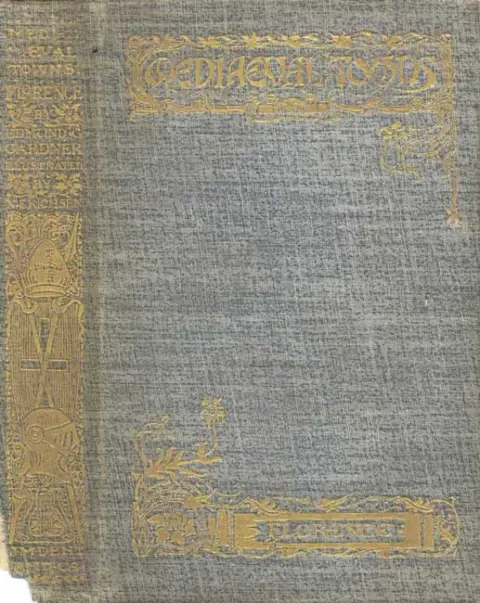
Edmund G. Gardner
BEHIND THE BOOK
This eBook is for the use of anyone anywhere in the United States and most other parts of the world at no cost and with almost no restrictions whatsoever. You may copy it, give it away or re-use it under the terms of the Project Gutenberg License included with this eBook or online at www.gutenberg.org. If you are not located in the United States, you will have to check the laws of the country where you are located before using this eBook. Read the source licence.
The original source file, including credits and licence, is retained by this library. Request an original-format copy at no charge. Please include the book title and Project Gutenberg identifier #71990.
KEEP YOUR CURIOSITY GOING
Cécile Tormay

Moritz Busch
John L. Ransom
Frances Wright
Cécile Tormay

Mabel Potter Daggett