
The Story of Siena and San Gimignano
Edmund G. Gardner
THE CLASSIC COLLECTION · 1923
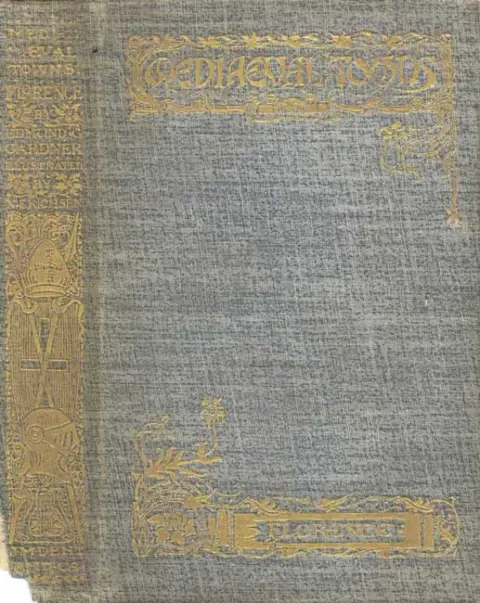
"Dante" by Edmund G. Gardner is a scholarly publication written in the early 20th century. This work serves as a revision of Gardner’s earlier "Dante Primer," reflecting insights into the life and significance of the poet Dante Alighieri, with discussions surrounding his notable work, the "Divina Commedia." The book explores not only Dante's literary accomplishments but also his historical and political contexts, examining his role as a national hero for Italy. The opening portion begins by situating Dante within the backdrop of the Middle Ages, highlighting the tumultuous political landscape of Italy during his lifetime, marked by conflicts between the Guelfs and Ghibellines. It introduces Dante’s background, including his family lineage and the city of Florence where he was born. As it transitions into his youth, the narrative touches on his love for Beatrice, a significant influence in his poetic work, and outlines the early events leading to his eventual exile which would shape much of his writing and philosophical thought throughout his life. This introductory section lays the groundwork for deeper explorations of Dante's contributions to literature and the evolving nature of Italian society during his era.
Introduction adapted from the source catalogue; source summaries may be automatically generated.
Free to read · English · 60,071 words · No account needed
MAKE TIME FOR A GOOD BOOK
On by default. Untick to stop anonymous reading totals. Each page counts after 10 seconds in view. How this works.
Anonymous counting is on unless you have switched it off.
BEATRICE AND DANTE.--The precise significance of the reproaches which Beatrice pours upon Dante for his mode of life after her death, with the poet’s own bitter shame and intense repentance (xxx., xxxi.), depends upon the view taken of his character and the nature of the wanderings represented in the dark wood. That these aberrations were mainly philosophical and intellectual, as sometimes supposed, appears highly improbable. We would regard Dante’s confession here as one of his most personal utterances, and hold that the cherubically inspired singer of righteousness is deliberately casting aside the allegorical veil which, in the Convivio, he had attempted to throw over the things in the past which still severed him from the ideal life when he wrote: “I fear the infamy of having followed such great passion.” It is a personal episode, in which Beatrice is the woman loved and to whose memory the poet has been unfaithful, standing out clearly from the allegorical mystery by which it is surrounded and in which it is set. After Matelda has drawn Dante through Lethe, the four cardinal virtues, which “perfect the intellect and appetite of man according to the capacity of human nature,” lead him to the breast of the mystic Griffin; and, in response to the song of the three theological virtues, which perfect man supernaturally, Beatrice at last unveils her countenance to his gaze: “O splendour of living light eternal.”
CONCLUDING ALLEGORIES OF THE “PURGATORIO.”--The allegory is resumed. In the light of this revelation, now that he is purified and free from sin, Dante beholds a vision of the Church and Empire (Purg. xxxii.). That glorious procession had first presented an ideal of the Church as Divine Providence intended it to be, before it became the vessel that the serpent of simony broke; the Bride that the Divine Spouse ordained for the guidance of the world. Such being the ideal, Dante beholds in a series of allegorical visions its history, in conjunction with the Empire, from the first coming to Rome down to the transference of the papal chair to Avignon. The great procession moves on through the divine forest, the Griffin still drawing the chariot with Beatrice seated upon it; Matelda with Dante and Statius following after the right wheel. Even as the divine origin of the Church has been seen in the triumphal car, so now the divine origin of the Empire is indicated in the desolate and despoiled tree which they reach. The tree of knowledge of good and evil, since the prohibition to eat of that tree was the beginning of law and the duty of obedience, represents Natural Law or Natural Justice, what Dante calls ius; which “in things is nought else than the similitude of the divine will” (Mon. ii. 2). The expression of this natural justice and the means for its effectuation in human society is Law, which Dante identifies with the Empire, and thus the tree becomes the symbol of the Empire and of the obedience due to it. The tree is destitute of flowers and foliage till the Griffin comes to it, who plucks nothing from it: “Thus is preserved the seed of all justice” (Purg. xxxii. 48; cf. our Lord’s words to St. John, Matt. iii. 15). Justice can alone be fulfilled when the Church follows this example of her Divine Founder, and usurps none of the temporal rights of the Empire. After the chariot has been bound to the tree, the previously bare plant breaks out into purple leaves and flowers. The Griffin and his train return to Heaven, leaving Beatrice to guard the chariot of the Church, seated beneath the shadow of the Imperial Tree, upon its root, which is Rome. In a new series of visions Dante beholds the sequel; he sees the conflict of the past, contemplates the corruption of the present, hearkens to the hope of the future. The persecution of the Church by the early Roman Emperors is followed by the inroad of the first heresies; and the donation of Constantine by the rising of the dragon of schism or simony. By more assumption of secular power and dignities, the chariot becomes monstrously transformed, and shamelessly usurped by the harlot, who represents the corrupt ecclesiastical authority enthroned in the place of Revelation, a false and degraded theology based upon the Decretals instead of the true divine science of the Scripture and the Fathers. By her side a giant appears who, after alternate caressing and scourging of the usurper, unbinds the transfigured chariot from the tree, and drags it away through the forest--symbolical of the interference of the royal house of France, ending in the transference of the Papacy from Rome to Avignon.
Your reading position is saved on this browser. Take it to another device with a library code. Reading pages adapt to text, rather than matching a printed edition.
Edmund G. Gardner
Edmund G. Gardner
BEHIND THE BOOK
This eBook is for the use of anyone anywhere in the United States and most other parts of the world at no cost and with almost no restrictions whatsoever. You may copy it, give it away or re-use it under the terms of the Project Gutenberg License included with this eBook or online at www.gutenberg.org. If you are not located in the United States, you will have to check the laws of the country where you are located before using this eBook. Read the source licence.
The original source file, including credits and licence, is retained by this library. Request an original-format copy at no charge. Please include the book title and Project Gutenberg identifier #71990.
KEEP YOUR CURIOSITY GOING
Cécile Tormay

Moritz Busch
John L. Ransom
Frances Wright
Cécile Tormay

Mabel Potter Daggett