
Last letters from the living dead man
David Patterson (Spirit) Hatch
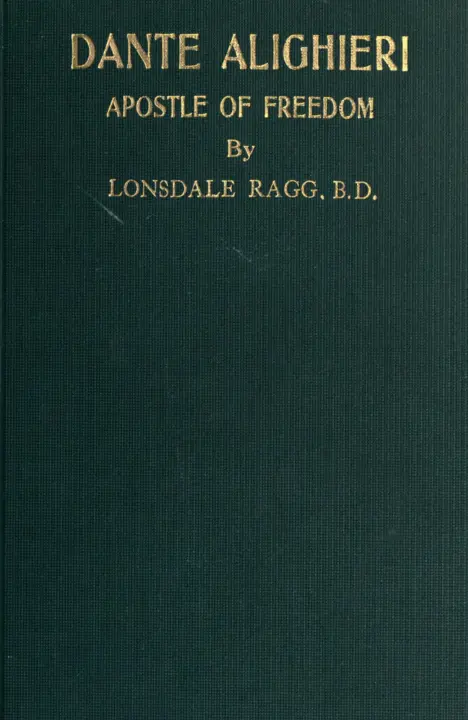
THE CLASSIC COLLECTION · 1921
"Dante Alighieri, Apostle of Freedom: War-time and Peace-time Essays" by Lonsdale Ragg is a collection of essays written in the early 20th century. This work delves into the multifaceted legacy of Dante Alighieri, portraying him as a champion of freedom across various domains, such as political, intellectual, and spiritual realms. Through this exploration, the author connects Dante's themes to contemporary issues, suggesting that the poet's insights are remarkably relevant in moments of conflict and struggle for liberty. The opening of this collection features Ragg's preface, establishing Dante as an "Apostle of Love" and freedom, reflecting on the historical resonance of his work amidst Italy's tumultuous past. Ragg emphasizes that Dante's contributions transcend time, suggesting that his ideals of liberty and justice have inspired generations, particularly during Italy's quest for unification and independence. This first section aims to contextualize Dante's relevance, inviting readers to consider how his perspectives on freedom could illuminate current challenges in society, especially in light of the atrocities of war.
Introduction adapted from the source catalogue; source summaries may be automatically generated.
Free to read · English · 52,453 words · No account needed
MAKE TIME FOR A GOOD BOOK
On by default. Untick to stop anonymous reading totals. Each page counts after 10 seconds in view. How this works.
Anonymous counting is on unless you have switched it off.
[156] “Quid nunc personat tuba novissimi Frederici? quid tintinabulum secundi Caroli? quid cornua Iohannis et Azzonis marchionum potentum? quid aliorum magnatum tibiae? nisi Venite carnifices, etc.,” p. 386, Oxf. Ed.; p. 330, Bemporad.
[157] V.E. II, vi. 42-6; p. 394, Oxf. Ed.; p. 343 sq., Bemporad.
[158] Hor. Ep. I., xiv, 43.
[159] No. 616.
[160] Dr. Reid, in an article on “Humour” (Encyclopaedia of Religion and Ethics, Vol. VI, p. 272), which had not yet appeared when these lines were written, describing the gift as follows: “Humour is invariably associated with alertness and breadth of mind, a keen sense of proportion, and faculties of quick observation and comparison. It involves a certain detachment from, or superiority to, the disturbing experiences of life. It appreciates the whimsicalities and contradictions of life, recognises the existence of what is unexpected or absurd, and extracts joy out of what might be a cause of sadness....”
[161] Op. cit. p. 51.
[162] Inf. xx. 61-3.
[163] Vol. II, p. 534.
[164] Par. i. 1 sqq., 103 sqq.
[165] Inf. iii. 16-18.
[166] Cf. e.g., the legend of St. Gregory alluded to in Purg. x. 75.
[167] Inf. iv. 131.
[168] See above, pp. 28 sqq. and “Dante and A League of Nations,” Anglo-Italian Review, December, 1918, pp. 327-335.
[169] Purg. i. 7 sqq.; Par. i. 13 sqq.; cf. Inf. ii. 7.
[170] Purg. vi. 118.
[171] Mediaeval Mind, Vol. II, p. 544.
[172] Inf. xxxi.
[173] Inf. iv. 144.
[174] Mediaeval Mind, Vol. II, p. 541, note.
[175] Par. xxv. 3.
[176] Conv. III, ix., fin.; p. 285, Oxf. Ed.; p. 227, Bemporad.
[177] Croce on the contrary urges with perhaps too great a bias in the other direction, that if Dante were not so great as a Poet, little would be thought of his achievements in other lines: “Se Dante non fosse, com’ è, grandissimo poeta, è da presumere che tutte quelle altre cose perderebbero rilievo.”—Poesia di Dante, p. 10.
[178] “On Dante the Poet,” see an admirable lecture delivered before the British Academy on May 4th, 1921, by Professor Cesare Foligno. (Humphrey Milford, 1/6 net). See also Appendix III.
[179] Osservatore Romano, May 4th, 1921. See Appendix II.
[180] La Poesia di Dante, Laterza, 1921.
[181] Id., pp. 9, 10.
[182] Id., p. 27.
[183] Cf. Statius’ words in Purg. xxii. 76—
Già era ’l mondo tutto quanto pregno
De la vera credenza, seminata
Per li messaggi dell’ etterno regno.
[184] See The New Teaching, edited by Prof. John Adams (Hodder and Stoughton, 1918, 10/6), pp. 9, 11. This work came into the writer’s hands after the virtual completion of the present essay; but it sums up so compactly the point of view of the modern principles he desired to illustrate, that he has found occasion to refer to it with some frequency.
[185] Cf. The New Teaching, p. 64, where Prof. J. Adams says of the study of English Literature: “the radical difference between the old teaching and the new is that we have passed from books about books to the books themselves.”
Your reading position is saved on this browser. Take it to another device with a library code. Reading pages adapt to text, rather than matching a printed edition.
BEHIND THE BOOK
This eBook is for the use of anyone anywhere in the United States and most other parts of the world at no cost and with almost no restrictions whatsoever. You may copy it, give it away or re-use it under the terms of the Project Gutenberg License included with this eBook or online at www.gutenberg.org. If you are not located in the United States, you will have to check the laws of the country where you are located before using this eBook. Read the source licence.
The original source file, including credits and licence, is retained by this library. Request an original-format copy at no charge. Please include the book title and Project Gutenberg identifier #63011.
KEEP YOUR CURIOSITY GOING
David Patterson (Spirit) Hatch

David Patterson (Spirit) Hatch

David Patterson (Spirit) Hatch

Ralph Waldo Emerson

Maurice Baring

Oscar Wilde & James McNeill Whistler