
Last letters from the living dead man
David Patterson (Spirit) Hatch
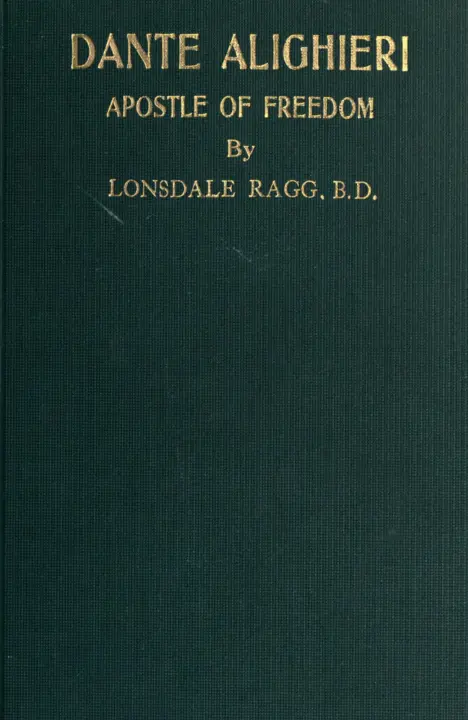
THE CLASSIC COLLECTION · 1921
"Dante Alighieri, Apostle of Freedom: War-time and Peace-time Essays" by Lonsdale Ragg is a collection of essays written in the early 20th century. This work delves into the multifaceted legacy of Dante Alighieri, portraying him as a champion of freedom across various domains, such as political, intellectual, and spiritual realms. Through this exploration, the author connects Dante's themes to contemporary issues, suggesting that the poet's insights are remarkably relevant in moments of conflict and struggle for liberty. The opening of this collection features Ragg's preface, establishing Dante as an "Apostle of Love" and freedom, reflecting on the historical resonance of his work amidst Italy's tumultuous past. Ragg emphasizes that Dante's contributions transcend time, suggesting that his ideals of liberty and justice have inspired generations, particularly during Italy's quest for unification and independence. This first section aims to contextualize Dante's relevance, inviting readers to consider how his perspectives on freedom could illuminate current challenges in society, especially in light of the atrocities of war.
Introduction adapted from the source catalogue; source summaries may be automatically generated.
Free to read · English · 52,453 words · No account needed
MAKE TIME FOR A GOOD BOOK
On by default. Untick to stop anonymous reading totals. Each page counts after 10 seconds in view. How this works.
Anonymous counting is on unless you have switched it off.
Dante certainly rises superior in fact to the contemporary theory of the Art of Poetry which he repeats in the Convivio and the De Vulgari Eloquentia.[391] It is this which makes his verse to be, as we have called it, the driving power of his message. But this homage to the traditional theory is not mere lip-service. Supreme poet as he is, he deliberately makes his sublime verse the instrument of spiritual teaching. And in so doing only renders it the more sublime.
[1] See esp. Inf. ix. 113; xx. 61: “Dante and the Redemption of Italy,”
p. 15.
[2] 1865: See ib. p. 19.
[3] Par. xxv. 1, 2.
[4] “Dante and Educational Principles,” pp. 83 sqq.
[5] Nos. III and VI.
[6] Nos. I, II, IV, and VIII.
[7] Prof. Foligno has, of course, no responsibility for the opinions set
forth in this volume.
[8] Le opere di Dante: testo critico della Società dantescha italiana, etc. Firenze: R. Bemporad & Figlio. MCMXXI. Cited in the notes as “Bemporad.” In the case of quotations from the prose works, an attempt has been made to consult the convenience of English readers by the reference to the paging of Dr. Moore’s Oxford Edition as well as to that of the Testo critico (Bemporad).
[9] Nos. V and VII.
[10] This Sermon was preached in Lincoln Cathedral on Aug. 14th, 1921 (Twelfth Sunday after Trinity).
[11] Par. i. 6-8.
[12] See Osservatore Romano, May 4th, 1921. And cf. Appendix II.
[13] Par. xvii. 55.
[14] Purg. xxiv. 52-4.
[15] Cf. A. G. Ferrers-Howell, “Dante and the Troubadours,” in the Memorial Volume, Dante, Essays in Commemoration, 1321-1921, London Univ. Press, 1921.
[16] Purg. xxiv. 57.
[17] Inf. iii. 5, 6.
[18] Purg. xvii. 103-105.
[19] Inf. i. 118-20.
[20] Purg. xxiii. 71-74.
[21] Par. iii. 70-72, 85.
[22] Par. xxxiii. 145.
[23] The Spiritual Message of Dante, Williams & Norgate, 1914, p. 225.
[24] 1 John iv. 16.
[25] Par. xxx. 133-7.
[26] Purg. xx. 43.
[27] Purg. i. 1.
[28] Par. xxv. 5.
[29] A pathetic episode connected with this Celebration is related in
Appendix I, p. 165.
[30] Giornale, p. 215: Art. “Firenze e Italia nel concetto e nel cuore
di Dante.”
[31] Giornale, p. 344.
[32] A similar chorus of reverent homage to Dante as the good genius of Italy’s fortunes, was evoked by the war, in the shape of “Dante e la Guerra,” Nos. 6-9 of Nuovo Convito, June-Sept., 1917.
[33] Par. ix. 27.
[34] “To the Defenders of the Piave: November, 1917, to November, 1918.” Art. in Anglo-Italian Review, Nov., 1918, p. 244.
[35] Purg. xxvii. 142.
[36] Il Purgatorio, p. 58.
[37] Par. xxxi. 85-89.
[38] Inf. i. 31-34.
[39] Loc. cit.
[40] Italy is likened by Dante to a wood (silva) in V.E., I, xi.
[41] Purg. vi. 76-fin.
[42] Purg. vi. 91 sqq.; Mon. I, xii.
[43] Purg. v. 61.
[44] See Mon. II, v. 132 sqq.; 159 sqq., quoted below; pp. 355 sq., Oxf. Ed.; p. 379, Bemporad.
[45] Inf. xii. 1-21.
Your reading position is saved on this browser. Take it to another device with a library code. Reading pages adapt to text, rather than matching a printed edition.
BEHIND THE BOOK
This eBook is for the use of anyone anywhere in the United States and most other parts of the world at no cost and with almost no restrictions whatsoever. You may copy it, give it away or re-use it under the terms of the Project Gutenberg License included with this eBook or online at www.gutenberg.org. If you are not located in the United States, you will have to check the laws of the country where you are located before using this eBook. Read the source licence.
The original source file, including credits and licence, is retained by this library. Request an original-format copy at no charge. Please include the book title and Project Gutenberg identifier #63011.
KEEP YOUR CURIOSITY GOING
David Patterson (Spirit) Hatch

David Patterson (Spirit) Hatch

David Patterson (Spirit) Hatch

Ralph Waldo Emerson

Maurice Baring

Oscar Wilde & James McNeill Whistler