THE CLASSIC COLLECTION✦An outlaw’s diary: the CommuneCLASSIC FREE BOOKS
An outlaw’s diary: the Commune
Cécile Tormay
THE CLASSIC COLLECTION · 1889
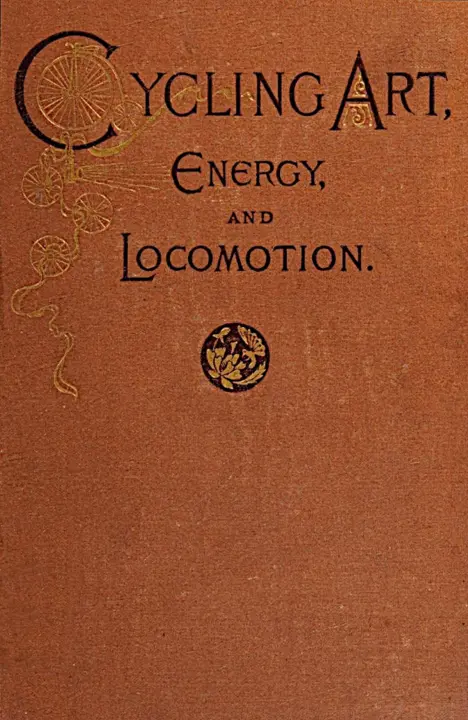
"Cycling Art, Energy, and Locomotion: A Series of Remarks on the Development of Bicycles, Tricycles, and Man-Motor Carriages" by Robert P. Scott is an informative publication written in the late 19th century. This work is focused on the principles of cycling, exploring the mechanical and physical aspects of bicycles and their evolution, while addressing the technological advancements that have impacted personal locomotion. Scott's objective seems to be not only to educate readers on the technical mechanics of cycling but also to promote greater appreciation and understanding of the cycling community and its culture. At the start of the text, the author emphasizes the historical significance of locomotion and the advancement of mechanical transportation, presenting the idea that the development of the cycle art represents a pivotal moment in personal transportation. He outlines the mechanisms and principles that underpin how bicycles operate, including insights into energy efficiency and human anatomy in relation to cycling performance. Scott conveys a sense of enthusiasm for the subject, as he introduces the various types of cycles and their specific mechanics, hinting at a more intricate analysis that challenges conventional understandings of movement and efficiency in cycling.
Introduction adapted from the source catalogue; source summaries may be automatically generated.
Free to read · English · 66,421 words · No account needed
MAKE TIME FOR A GOOD BOOK
On by default. Untick to stop anonymous reading totals. Each page counts after 10 seconds in view. How this works.
Anonymous counting is on unless you have switched it off.
“When the fly-wheel is thrown into gear, as aforesaid, it will serve to gather power, to facilitate the riding up-hill, and to steady the motion down-hill.
“2. The fly-wheel K, mounted on a separate shaft, J, the sliding pinion f, in combination with the lever g, substantially as herein shown and described, for the purpose specified.
“The above specification of my invention signed by me, this ninth day
of June, 1869.
“+Simon Wortmann.+”
You will have to make that front man do some work, Simon, or you will fall behind the band-wagon in spite of your fly-wheel.
“This invention relates to a new two- or three-wheeled velocipede, which is to be propelled by hand, and which is so constructed that it can be easily operated, and that the body will be sustained in the most advantageous position.
“The invention consists in several improvements of the driving-mechanism, of the foot-supports, and steering-mechanism, which, separately or combined, tend to produce a simple and convenient apparatus.
“A, in the drawing, represents the front wheel of my improved
velocipede.
“The rider, holding the feet on these fixed bars I, can readily, and by an imperceptible motion, turn the post to guide the apparatus in any desired direction.
“I claim as new, and desire to secure by Letters Patent,—
“1. The steering-post C, constructed, as described, of the two parallel bars a, a, hung upon the crank-axle B, and connected by the plates b, d, between which the end of the reach D is pivoted, said post being provided at its upper end with the crank-shaft J, and near its lower end with the foot-rests I, as herein described, for the purpose specified.”
Another manumotor carriage. Had the inventor ever attempted to climb some of the hills to be seen in Maryland, I fear he would have sacrificed his ambition, let the idea go unheralded to the world, and saved his patent fee.
“This invention relates to a new and useful improvement in velocipedes, and consists in the method in which power is applied for driving it.
“Power is applied to this ratchet by means of the pawls f and g, the former of which is pivoted to the frame h, and to which the saddle i is attached; the other pawl is pivoted to the frame J, to which the foot-pieces k are attached.
“When the weight of the rider is thrown either upon the saddle or upon the foot-pieces, the pawls act upon the ratchet-wheel, and rotate the axle.
“As before stated, motion is given the velocipede by working the pawls in the ratchet-wheel, as the weight of the rider is thrown alternately upon the saddle and upon the foot-pieces.
Your reading position is saved on this browser. Take it to another device with a library code. Reading pages adapt to text, rather than matching a printed edition.
BEHIND THE BOOK
This eBook is for the use of anyone anywhere in the United States and most other parts of the world at no cost and with almost no restrictions whatsoever. You may copy it, give it away or re-use it under the terms of the Project Gutenberg License included with this eBook or online at www.gutenberg.org. If you are not located in the United States, you will have to check the laws of the country where you are located before using this eBook. Read the source licence.
The original source file, including credits and licence, is retained by this library. Request an original-format copy at no charge. Please include the book title and Project Gutenberg identifier #74928.
KEEP YOUR CURIOSITY GOING
Cécile Tormay

Moritz Busch
John L. Ransom
Frances Wright
Cécile Tormay

Mabel Potter Daggett