
Holland, v. 1 (of 2)
Edmondo De Amicis
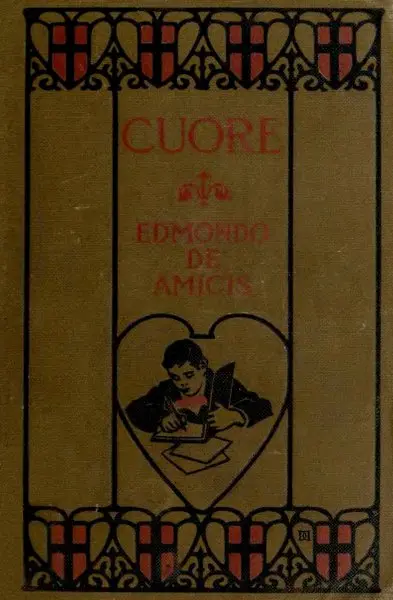
THE CLASSIC COLLECTION · 1887
"Cuore (Heart): An Italian Schoolboy's Journal" by Edmondo De Amicis is a children's novel published in 1886. Written as a diary, it follows eleven-year-old Enrico Bottini through his third-grade year in Turin, where he navigates friendships with classmates from diverse backgrounds. Through daily entries and monthly moral tales, the novel explores themes of compassion, family devotion, and Italian patriotism during the unification era. Each story presents different ethical lessons, from helping the poor to honoring one's country, creating a portrait of childhood shaped by social awareness and national identity.
Introduction adapted from the source catalogue; source summaries may be automatically generated.
Free to read · English · 97,310 words · No account needed
MAKE TIME FOR A GOOD BOOK
On by default. Untick to stop anonymous reading totals. Each page counts after 10 seconds in view. How this works.
Anonymous counting is on unless you have switched it off.
"Remain, Enrico; I will wait for you outside."
After exchanging a few words with his father, the little harlequin went through still another trick: erect upon a galloping horse, he appeared in four characters--as a pilgrim, a sailor, a soldier, and an acrobat; and every time that he passed near me, he looked at me. And when he dismounted, he began to make the tour of the circus, with his harlequin's cap in his hand, and everybody threw soldi or sugar-plums into it. I had two soldi ready; but when he got in front of me, instead of offering his cap, he drew it back, gave me a look and passed on. I was mortified. Why had he offered me that affront?
The performance came to an end; the proprietor thanked the audience; and all the people rose also, and thronged to the doors. I was confused by the crowd, and was on the point of going out, when I felt a touch on my hand. I turned round: it was the little harlequin, with his tiny brown face and his black curls, who was smiling at me; he had his hands full of sugar-plums. Then I understood.
"Will you accept these sugar-plums from the little harlequin?" said he
to me, in his dialect.
I nodded, and took three or four.
"Then," he added, "please accept a kiss also."
"Give me two," I answered; and held up my face to him. He rubbed off his floury face with his hand, put his arm round my neck, and planted two kisses on my cheek, saying:--
"There! take one of them to your father."
Tuesday, 21st.
What a sad scene was that which we witnessed to-day at the procession of the masks! It ended well; but it might have resulted in a great misfortune. In the San Carlo Square, all decorated with red, white, and yellow festoons, a vast multitude had assembled; masks of every hue were flitting about; cars, gilded and adorned, in the shape of pavilions; little theatres, barks filled with harlequins and warriors, cooks, sailors, and shepherdesses; there was such a confusion that one knew not where to look; a tremendous clash of trumpets, horns, and cymbals lacerated the ears; and the masks on the chariots drank and sang, as they apostrophized the people in the streets and at the windows, who retorted at the top of their lungs, and hurled oranges and sugar-plums at each other vigorously; and above the chariots and the throng, as far as the eye could reach, one could see banners fluttering, helmets gleaming, plumes waving, gigantic pasteboard heads moving, huge head-dresses, enormous trumpets, fantastic arms, little drums, castanets, red caps, and bottles;--all the world seemed to have gone mad. When our carriage entered the square, a magnificent chariot was driving in front of us, drawn by four horses covered with trappings embroidered in gold, and all wreathed in artificial roses, upon which there were fourteen or fifteen gentlemen masquerading as gentlemen at the court of France, all glittering with silk, with huge white wigs, a plumed hat, under the arm a small-sword, and a tuft of ribbons and laces on the breast. They were very gorgeous. They were singing a French canzonette in concert and throwing sweetmeats to the people, and the people clapped their hands and shouted. Suddenly, on our left, we saw a man lift a child of five or six above the heads of the crowd,--a poor little creature, who wept piteously, and flung her arms about as though in a fit of convulsions. The man made his way to the gentlemen's chariot; one of the latter bent down, and the other said aloud:--
Your reading position is saved on this browser. Take it to another device with a library code. Reading pages adapt to text, rather than matching a printed edition.
Edmondo De Amicis
BEHIND THE BOOK
This eBook is for the use of anyone anywhere in the United States and most other parts of the world at no cost and with almost no restrictions whatsoever. You may copy it, give it away or re-use it under the terms of the Project Gutenberg License included with this eBook or online at www.gutenberg.org. If you are not located in the United States, you will have to check the laws of the country where you are located before using this eBook. Read the source licence.
The original source file, including credits and licence, is retained by this library. Request an original-format copy at no charge. Please include the book title and Project Gutenberg identifier #28961.
KEEP YOUR CURIOSITY GOING
Coulson Kernahan

Maurice Baring
Frances Wright
Cécile Tormay

Frederic Jesup Stimson

W. H. P. (William Henry Pope) Jarvis