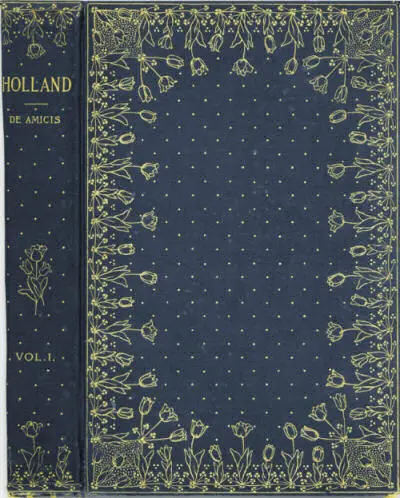
Holland, v. 1 (of 2)
Edmondo De Amicis
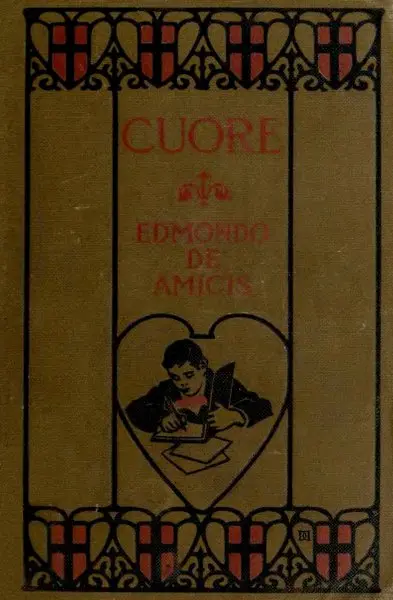
THE CLASSIC COLLECTION · 1887
"Cuore (Heart): An Italian Schoolboy's Journal" by Edmondo De Amicis is a children's novel published in 1886. Written as a diary, it follows eleven-year-old Enrico Bottini through his third-grade year in Turin, where he navigates friendships with classmates from diverse backgrounds. Through daily entries and monthly moral tales, the novel explores themes of compassion, family devotion, and Italian patriotism during the unification era. Each story presents different ethical lessons, from helping the poor to honoring one's country, creating a portrait of childhood shaped by social awareness and national identity.
Introduction adapted from the source catalogue; source summaries may be automatically generated.
Free to read · English · 97,310 words · No account needed
MAKE TIME FOR A GOOD BOOK
On by default. Untick to stop anonymous reading totals. Each page counts after 10 seconds in view. How this works.
Anonymous counting is on unless you have switched it off.
"Happy fellow!" he had said to me. Ah, no, Coretti, no; you are the happier, because you study and work too; because you are of use to your father and your mother; because you are better--a hundred times better--and more courageous than I, my dear schoolmate.
Friday, 18th.
Coretti was pleased this morning, because his master of the second class, Coatti, a big man, with a huge head of curly hair, a great black beard, big dark eyes, and a voice like a cannon, had come to assist in the work of the monthly examination. He is always threatening the boys that he will break them in pieces and carry them by the nape of the neck to the quaestor, and he makes all sorts of frightful faces; but he never punishes any one, but always smiles the while behind his beard, so that no one can see it. There are eight masters in all, including Coatti, and a little, beardless assistant, who looks like a boy. There is one master of the fourth class, who is lame and always wrapped up in a big woollen scarf, and who is always suffering from pains which he contracted when he was a teacher in the country, in a damp school, where the walls were dripping with moisture. Another of the teachers of the fourth is old and perfectly white-haired, and has been a teacher of the blind. There is one well-dressed master, with eye-glasses, and a blond mustache, who is called the little lawyer, because, while he was teaching, he studied law and took his diploma; and he is also making a book to teach how to write letters. On the other hand, the one who teaches gymnastics is of a soldierly type, and was with Garibaldi, and has on his neck a scar from a sabre wound received at the battle of Milazzo. Then there is the head-master, who is tall and bald, and wears gold spectacles, with a gray beard that flows down upon his breast; he dresses entirely in black, and is always buttoned up to the chin. He is so kind to the boys, that when they enter the director's room, all in a tremble, because they have been summoned to receive a reproof, he does not scold them, but takes them by the hand, and tells them so many reasons why they ought not to behave so, and why they should be sorry, and promise to be good, and he speaks in such a kind manner, and in so gentle a voice, that they all come out with red eyes, more confused than if they had been punished. Poor head-master! he is always the first at his post in the morning, waiting for the scholars and lending an ear to the parents; and when the other masters are already on their way home, he is still hovering about the school, and looking out that the boys do not get under the carriage-wheels, or hang about the streets to stand on their heads, or fill their bags with sand or stones; and the moment he makes his appearance at a corner, so tall and black, flocks of boys scamper off in all directions, abandoning their games of coppers and marbles, and he threatens them from afar with his forefinger, with his sad and loving air. No one has ever seen him smile, my mother says, since the death of his son, who was a volunteer in the army: he always keeps the latter's portrait before his eyes, on a little table in the head-master's room. He wanted to go away after this misfortune; he prepared his application for retirement to the Municipal Council, and kept it always on his table, putting off sending it from day to day, because it grieved him to leave the boys. But the other day he seemed undecided; and my father, who was in the director's room with him, was just saying to him, "What a shame it is that you are going away, Signor Director!" when a man entered for the purpose of inscribing the name of a boy who was to be transferred from another schoolhouse to ours, because he had changed his residence. At the sight of this boy, the head-master made a gesture of astonishment, gazed at him for a while, gazed at the portrait that he keeps on his little table, and then stared at the boy again, as he drew him between his knees, and made him hold up his head. This boy resembled his dead son. The head-master said, "It is all right," wrote down his name, dismissed the father and son, and remained absorbed in thought. "What a pity that you are going away!" repeated my father. And then the head-master took up his application for retirement, tore it in two, and said, "I shall remain."
Your reading position is saved on this browser. Take it to another device with a library code. Reading pages adapt to text, rather than matching a printed edition.
Edmondo De Amicis
BEHIND THE BOOK
This eBook is for the use of anyone anywhere in the United States and most other parts of the world at no cost and with almost no restrictions whatsoever. You may copy it, give it away or re-use it under the terms of the Project Gutenberg License included with this eBook or online at www.gutenberg.org. If you are not located in the United States, you will have to check the laws of the country where you are located before using this eBook. Read the source licence.
The original source file, including credits and licence, is retained by this library. Request an original-format copy at no charge. Please include the book title and Project Gutenberg identifier #28961.
KEEP YOUR CURIOSITY GOING
Coulson Kernahan

Maurice Baring
Frances Wright
Cécile Tormay

Frederic Jesup Stimson

W. H. P. (William Henry Pope) Jarvis