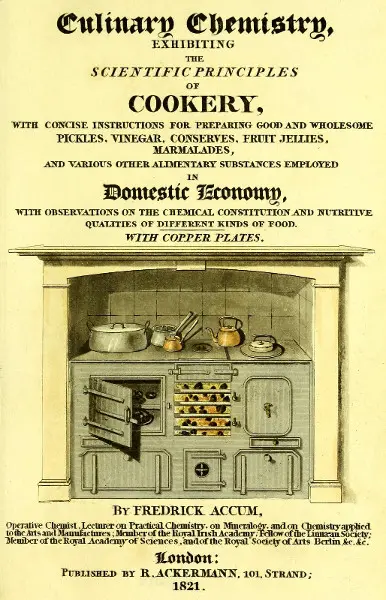
Culinary Chemistry The Scientific Principles of Cookery, with Concise Instructions for Preparing Good and Wholesome Pickles, Vinegar, Conserves, Fruit Jellies, Marmalades, and Various Other Alimentary Substances Employed in Domestic Economy, with Observations on the Chemical Constitution and Nutritive Qualities of Different Kinds of Food.
Pickled Red Cabbage 234 Pickled Onions 235 Pickled Walnuts 236 Pickled Cucumbers 237 Pickled Red Beet-root 239 Pickled Mushrooms 239 Pickled Artichoke 240 Sour Kraut 241 Mushroom Catsup 244 Tomata Catsup 246 Walnut Catsup 247
Conserved Fruits
Conservation of Recent Fruits without Sugar 249 Conserved Gooseberries 249 Conserved Orlean Plums 249 Conserved Green Gages 249 Conserved Damsons 249 Conserved Peaches 249 Conserved Nectarines 249 Conserved Bullaces 249 Conservation of Recent Fruits, by means of Sugar, in a liquid state 252 Conserved Apricots, by means of Sugar 252 Conserved Plums 252 Conserved Damsons 252 Conserved Green Gages 252 Conserved Peaches 252 Conserved Nectarines 252 Conserved Pine Apples 254 Conserved Pears 255 Conservation of Recent Fruits, by means of Sugar, in a solid form 256 Candied Orange, or Lemon Peel 256
Marmalades, Jams, AND Fruit Pastes.
Black Currant Paste 260 Apricot Paste 261 Peach Paste 261 Plum Paste 261 Cherry Paste 261 Quince Paste 261 Raspberry Paste 262 Orange and Lemon Paste 262 Raspberry Jam 263 Strawberry Jam 263 Currant Jam 263 Gooseberry Jam 263 Mulberry Jam 263 Apricot Jam 264 Orange Marmalade 265 Peach Marmalade 266 Pine Apple Marmalade 267 Apricot Marmalade 267 Fruit Jellies 268 Currant Jelly 269 Raspberry Jelly 270 Barberry Jelly 270 Gooseberry Jelly 271 Apple Jelly 271 Quince and Apricot Jelly 272 Fruit Syrups 272 Lemon Syrup 274 Orange Syrup 274 Mulberry Syrup 275 Raspberry and Currant Syrup 275 Preservation and Storing of Fruit, and Principal requisites of a good Fruit Room 276 Preservation of recent esculent roots, pot-herbs, and other culinary vegetables 280
Vinegar.
Method of Making Gooseberry Vinegar 289 Raspberry Vinegar 291 Chilli Vinegar 292 Tarragon Vinegar 292 Mint Vinegar 292 Eschallot Vinegar 292 Burnet Vinegar 292
Tea.
Natural History of the Tea Tree 295 Observations on the art of Making Tea, and singular effects of different kinds of Tea Pots on the Infusion of Tea 299 Japanese Method of Making Tea 301
Coffee.
Natural History of the Coffee Tree 305 Best Method of Making Coffee 308
Kitchen Fire-places, AND Cooking Utensils.
Saucepans and Stew Pans 329 Preserving Pans 330 Copper Cooking Utensils 331 Wooden Tubs 336
Cookery.
COOKERY IS A BRANCH OF CHEMICAL SCIENCE.
Cookery, or the art of preparing good and wholesome food, and of preserving all sorts of alimentary substances in a state fit for human sustenance, of rendering that agreeable to the taste which is essential to the support of life, and of pleasing the palate without injury to the system, is, strictly speaking, a branch of chemistry; but, important as it is both to our enjoyments and our health, it is also one of the least cultivated branches of that science. The culinary processes of roasting, boiling, baking, stewing, frying, broiling, the art of preserving meats, bacon, and hams; the preparations of sauces, pickles, and other condiments; the conserving of fruits; the care and keeping of vegetables; the making of jellies, jams, and marmalades, are all founded upon the principles of this science, and much waste of the material, as well as labour to the parties might often be spared, were those to whom the performance of such tasks is committed, made acquainted with simple chemical truths which would invariably lead to certain results. And, besides, the same knowledge would enable them to attain a much greater degree of perfection in curing and preserving all kinds of animal and vegetable aliments, and in combining the three grand requisites of taste, nutriment, and salubrity, in whatever manner they may be prepared. And, though this art is at present in rude hands, as all branches of chemistry were originally, there is no reason that it should remain so. A kitchen is, in fact, a chemical laboratory; the boilers, stew-pans, and cradle spit of the cook, correspond to the digestors, the evaporating basins, and the crucibles of the chemist. And numerous as the receipts of cookery are, the general operations (like the general process of chemistry) are but few. In some the object aimed at is, to extract the constituent parts of the food, so as to exhibit them in a separate state, or to combine them with other substances, to produce new compounds which differ widely from those from which they originated. In others, the qualities of the substances are simply altered by the action of fire, to render them more palatable and nutritious.