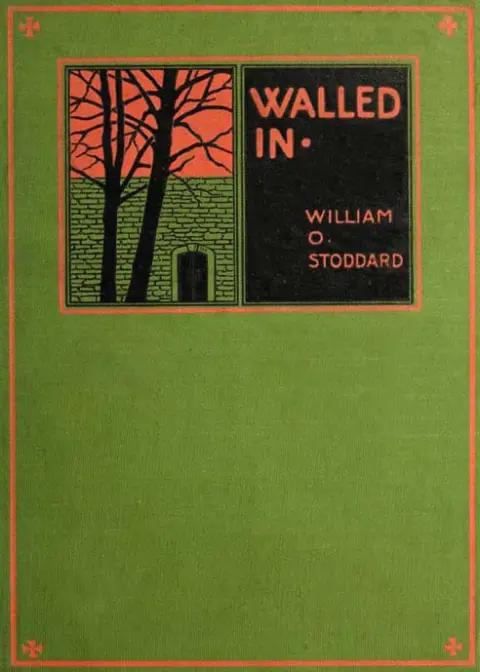
Walled In: A True Story of Randall’s Island
William O. Stoddard
THE CLASSIC COLLECTION · 1890
"Crowded Out o' Crofield; or, The Boy who made his Way" by William O. Stoddard is a novel written in the late 19th century. The story centers around a young boy, Jack Ogden, who dreams of escaping the confines of his small village, Crofield, to seek adventure and opportunity in the city. Through a series of daring escapades, including saving runaway horses and fishing exploits, Jack illustrates the spirit of determination and resourcefulness emblematic of youth. At the start of the tale, Jack stands at the door of the blacksmith shop, fueled by aspirations of adventure as he contemplates his small-town existence. The narrative introduces Jack's character as he faces the challenges of home life, expresses his desire to explore the wider world, and showcases his bravery when he intervenes to stop a runaway wagon. Additionally, the story hints at the budding romantic connection with his sister Mary, who also yearns for a life beyond their small town. The opening sets the stage for Jack’s journey from the constraints of Crofield to the possibilities of the city, filled with hope and youthful determination.
Introduction adapted from the source catalogue; source summaries may be automatically generated.
Free to read · English · 57,042 words · No account needed
MAKE TIME FOR A GOOD BOOK
On by default. Untick to stop anonymous reading totals. Each page counts after 10 seconds in view. How this works.
Anonymous counting is on unless you have switched it off.
"He's a gentleman," thought Jack, hardly aware that he himself had
bowed low as he went in, and that a smile of grim approval had followed
him.
In the pew behind them sat another man, as haughty looking, but just now wearing the same kind of smile as he leaned forward and asked in an audible whisper:
"General, who's your friend?"
"Mr. John Ogden, of Crofield, away up on the Cookyhutchie River. I netted him at the door," was the reply, in the same tone.
"Good catch?" asked the other.
"Just as good as I was, Judge, forty years ago. I'll tell you how that
was some day."
"Decidedly raw material, I should say."
"Well, so was I. I was no more knowing than he is. I remember what it is to be far away from home."
The hoarse, subdued whispers ceased; the two gentle men looked grim and severe again. Then there was a grand burst of music from the organ, the vast congregation stood up, and Jack rose with them.
He felt solemn enough, there was no doubt of that; but what he said to himself unconsciously took this shape:
"Jingo! If this isn't the greatest going to church I ever did! Hear that voice! The organ too--what music! Don't I wish Molly was here! I wish all the family were here."
The service went on and Jack listened attentively, in spite of a strong tendency in his eyes to wander among the pillars to the galleries, up into the lofty vault above him, or around among the pews full of people. He knew it was a good sermon and that the music was good, singing and all--especially when the congregation joined in "Old Hundred" and another old hymn that he knew. Still he had an increasing sense of being a very small fellow in a very large place. When he raised his head, after the benediction, he saw the owner of the pew turn toward him, bow low, and hold out his hand. Jack shook hands, of course.
"Good-morning, Mr. Ogden," said the gentleman gravely, with almost a frown on his face, but very politely, and then he turned and walked out of the pew. Jack also bowed as he shook hands, and said, "Good-morning. Thank you, sir. I hope you enjoyed the sermon."
"General," said the gentleman in the pew behind them, "pretty good for raw material. Keep an eye on him."
"No, I won't," said the general. "I've spoiled four or five in that
very way."
"Well, I believe you're right," said the judge, after a moment. "It's best for that kind of boy to fight his own battles. I had to."
Your reading position is saved on this browser. Take it to another device with a library code. Reading pages adapt to text, rather than matching a printed edition.
William O. Stoddard
William O. Stoddard
William O. Stoddard
William O. Stoddard
BEHIND THE BOOK
This eBook is for the use of anyone anywhere in the United States and most other parts of the world at no cost and with almost no restrictions whatsoever. You may copy it, give it away or re-use it under the terms of the Project Gutenberg License included with this eBook or online at www.gutenberg.org. If you are not located in the United States, you will have to check the laws of the country where you are located before using this eBook. Read the source licence.
The original source file, including credits and licence, is retained by this library. Request an original-format copy at no charge. Please include the book title and Project Gutenberg identifier #21846.
KEEP YOUR CURIOSITY GOING
Coulson Kernahan

Maurice Baring
Frances Wright
Cécile Tormay

Frederic Jesup Stimson

W. H. P. (William Henry Pope) Jarvis