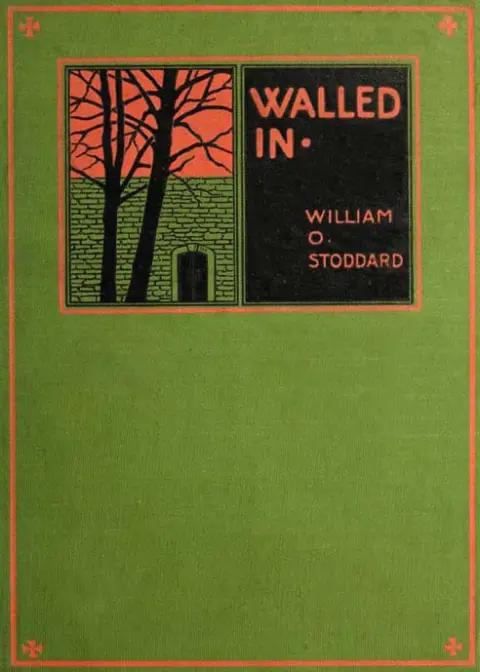
Walled In: A True Story of Randall’s Island
William O. Stoddard
THE CLASSIC COLLECTION · 1890
"Crowded Out o' Crofield; or, The Boy who made his Way" by William O. Stoddard is a novel written in the late 19th century. The story centers around a young boy, Jack Ogden, who dreams of escaping the confines of his small village, Crofield, to seek adventure and opportunity in the city. Through a series of daring escapades, including saving runaway horses and fishing exploits, Jack illustrates the spirit of determination and resourcefulness emblematic of youth. At the start of the tale, Jack stands at the door of the blacksmith shop, fueled by aspirations of adventure as he contemplates his small-town existence. The narrative introduces Jack's character as he faces the challenges of home life, expresses his desire to explore the wider world, and showcases his bravery when he intervenes to stop a runaway wagon. Additionally, the story hints at the budding romantic connection with his sister Mary, who also yearns for a life beyond their small town. The opening sets the stage for Jack’s journey from the constraints of Crofield to the possibilities of the city, filled with hope and youthful determination.
Introduction adapted from the source catalogue; source summaries may be automatically generated.
Free to read · English · 57,042 words · No account needed
MAKE TIME FOR A GOOD BOOK
On by default. Untick to stop anonymous reading totals. Each page counts after 10 seconds in view. How this works.
Anonymous counting is on unless you have switched it off.
They all turned suddenly toward the dam. A high ridge of water was sweeping down across the pond. It carried a crest of foam, logs, planks, and rubbish, shining white in the moonlight, and it rolled on toward the mill and the dam as if it had an errand.
Crash--roar--crash--and a plunging sound,--and it seemed as if the Crofield dam had vanished. But it had not. Only a section of its top work, in the middle, had been knocked away by the rushing stroke of those logs.
A frightened shout went up from the spectators, and it had hardly died away before there followed another splintering crash.
"The bridge!" shouted Jack.
The frail supports of the bridge, brittle with age and weather, already straining hard against the furious water, needed only the battering of the first heavy logs from the boom, and down they went.
"Gone!" exclaimed Mr. Ogden. "The hotel's gone, and the meeting-house, and the dam, and the bridge. There won't be anything left of Crofield, at this rate."
"I'm going to get out of it," said Jack.
"I'll never refuse you again," replied his father, with energy. "You may get out any way you can, and take your chances anywhere you please. I won't stand in your way."
The roar of the surging Cocahutchie was the only sound heard for a full minute, and then the miller spoke.
"The mill's safe," he said, with a very long breath of relief; "the breaking of that hole in the dam let the water and logs through, and the pond isn't rising. Hurrah!"
There was a very faint and scattering cheer, and Jack Ogden did not join in it. He had turned suddenly and walked away homeward, along the narrow strip of land that remained between the wide, swollen Cocahutchie and the fence.
At the end of the fence, where he came into his own street, away above where the head of the bridge had been, there was a large gathering. That around the mill had been nearly all of men and boys. Here were women and girls, and the smaller boys, whose mothers and aunts held them and kept them from going nearer the water. Jack found it of no use to say, "Oh, mother, I'm too muddy!" She didn't care how muddy he was, and Aunt Melinda cared even less, apparently. Bessie and Sue had evidently been crying; but Mary had not; and it was her hand on Jack's arm that led him away, up the street, toward their gate.
"Oh, Jack!" she exclaimed, "I'm so proud! Did you ride fast? I'm glad I can ride! I could have done it, too. It was splendid!"
Your reading position is saved on this browser. Take it to another device with a library code. Reading pages adapt to text, rather than matching a printed edition.
William O. Stoddard
William O. Stoddard
William O. Stoddard
William O. Stoddard
BEHIND THE BOOK
This eBook is for the use of anyone anywhere in the United States and most other parts of the world at no cost and with almost no restrictions whatsoever. You may copy it, give it away or re-use it under the terms of the Project Gutenberg License included with this eBook or online at www.gutenberg.org. If you are not located in the United States, you will have to check the laws of the country where you are located before using this eBook. Read the source licence.
The original source file, including credits and licence, is retained by this library. Request an original-format copy at no charge. Please include the book title and Project Gutenberg identifier #21846.
KEEP YOUR CURIOSITY GOING
Coulson Kernahan

Maurice Baring
Frances Wright
Cécile Tormay

Frederic Jesup Stimson

W. H. P. (William Henry Pope) Jarvis