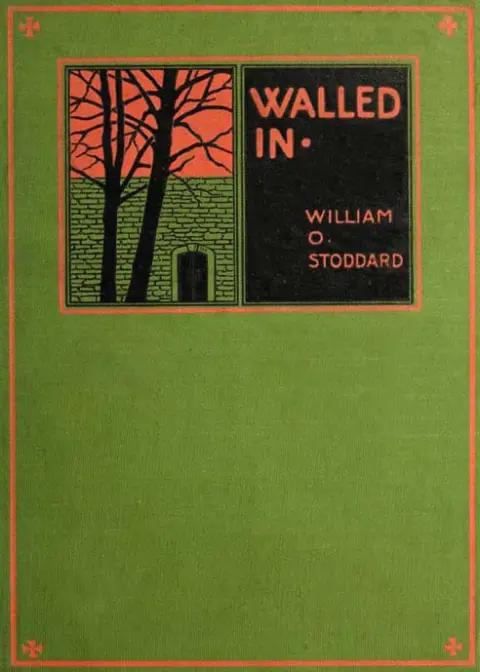
Walled In: A True Story of Randall’s Island
William O. Stoddard
THE CLASSIC COLLECTION · 1890
"Crowded Out o' Crofield; or, The Boy who made his Way" by William O. Stoddard is a novel written in the late 19th century. The story centers around a young boy, Jack Ogden, who dreams of escaping the confines of his small village, Crofield, to seek adventure and opportunity in the city. Through a series of daring escapades, including saving runaway horses and fishing exploits, Jack illustrates the spirit of determination and resourcefulness emblematic of youth. At the start of the tale, Jack stands at the door of the blacksmith shop, fueled by aspirations of adventure as he contemplates his small-town existence. The narrative introduces Jack's character as he faces the challenges of home life, expresses his desire to explore the wider world, and showcases his bravery when he intervenes to stop a runaway wagon. Additionally, the story hints at the budding romantic connection with his sister Mary, who also yearns for a life beyond their small town. The opening sets the stage for Jack’s journey from the constraints of Crofield to the possibilities of the city, filled with hope and youthful determination.
Introduction adapted from the source catalogue; source summaries may be automatically generated.
Free to read · English · 57,042 words · No account needed
MAKE TIME FOR A GOOD BOOK
On by default. Untick to stop anonymous reading totals. Each page counts after 10 seconds in view. How this works.
Anonymous counting is on unless you have switched it off.
"I'll take 'em, Jack," interrupted the landlord, testily. "I spoke first. Three pounds, and two is five pounds, and--"
"I'll give another dollar for the small traout," exclaimed Deacon Hawkins. "He can't have 'em all."
The landlord might have hesitated even then, but the excitement was catching, and Squire Jones was actually, but slowly, taking out his pocket-book.
"Five! There's your five, Jack. The big fish are mine. Take your money. Fetch 'em in," broke out old Livermore.
"There's my dollar,--and there's my traout,--" squealed the deacon.
"I was just a-goin' to saay--" at that moment growled the deep, heavy bass voice of Squire Jones.
"Too late," said the landlord. "He's taken my money. Come in, Jack. Come in and get yours, Deacon," and Jack walked on into the Washington House with six dollars in his hand, just as a boy he knew stuck his head under Squire Jones's arm and shouted:
"Jack!--Jack! Why didn't yer put 'em up at auction?"
It took but a minute to get rid of the very fine fish he had sold, and then the uncommonly successful angler made his way out of the Washington Hotel through the side door.
"I don't intend to answer any more questions," he said to himself; "and all that crowd is out there yet."
There was another reason that he did not give, for his perch, good as they were, and the wide-mouthed sucker, and the great, clumsy bullheads, looked mean and common, now that their elegant companions were gone. He felt almost ashamed of them until just as he reached the back yard of his own home.
A tall, grimy man, with his head under the pump, was vigorously scrubbing charcoal and iron dust from his face and hands and hair. "Jack," he shouted, "where'd you get that string o' fish? Best I've seen round here for ever so long."
Another voice came from the kitchen door, and in half a second it seemed to belong to a chorus of voices.
"Why, Jack Ogden! What a string of fish!"
"I caught 'em 'way down the Cocahutchie, Mother," said Jack. "I caught 'em all under water. Had to go right in after some of 'em."
"I should say you did," growled his father, almost jocosely, and then he and Mrs. Ogden and Aunt Melinda and the children crowded around to examine the fish, on the pump platform.
"Jack must do something better'n that," said his father, rubbing his face hard with the kitchen towel; "but he's had the best kind o' luck this time."
Your reading position is saved on this browser. Take it to another device with a library code. Reading pages adapt to text, rather than matching a printed edition.
William O. Stoddard
William O. Stoddard
William O. Stoddard
William O. Stoddard
BEHIND THE BOOK
This eBook is for the use of anyone anywhere in the United States and most other parts of the world at no cost and with almost no restrictions whatsoever. You may copy it, give it away or re-use it under the terms of the Project Gutenberg License included with this eBook or online at www.gutenberg.org. If you are not located in the United States, you will have to check the laws of the country where you are located before using this eBook. Read the source licence.
The original source file, including credits and licence, is retained by this library. Request an original-format copy at no charge. Please include the book title and Project Gutenberg identifier #21846.
KEEP YOUR CURIOSITY GOING
Coulson Kernahan

Maurice Baring
Frances Wright
Cécile Tormay

Frederic Jesup Stimson

W. H. P. (William Henry Pope) Jarvis