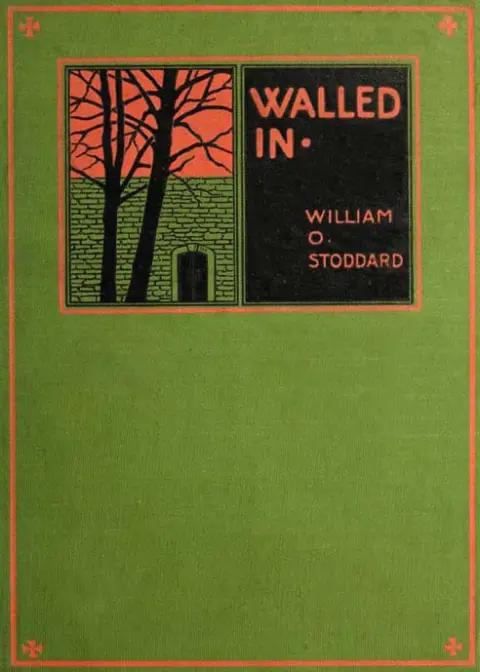
Walled In: A True Story of Randall’s Island
William O. Stoddard
THE CLASSIC COLLECTION · 1890
"Crowded Out o' Crofield; or, The Boy who made his Way" by William O. Stoddard is a novel written in the late 19th century. The story centers around a young boy, Jack Ogden, who dreams of escaping the confines of his small village, Crofield, to seek adventure and opportunity in the city. Through a series of daring escapades, including saving runaway horses and fishing exploits, Jack illustrates the spirit of determination and resourcefulness emblematic of youth. At the start of the tale, Jack stands at the door of the blacksmith shop, fueled by aspirations of adventure as he contemplates his small-town existence. The narrative introduces Jack's character as he faces the challenges of home life, expresses his desire to explore the wider world, and showcases his bravery when he intervenes to stop a runaway wagon. Additionally, the story hints at the budding romantic connection with his sister Mary, who also yearns for a life beyond their small town. The opening sets the stage for Jack’s journey from the constraints of Crofield to the possibilities of the city, filled with hope and youthful determination.
Introduction adapted from the source catalogue; source summaries may be automatically generated.
Free to read · English · 57,042 words · No account needed
MAKE TIME FOR A GOOD BOOK
On by default. Untick to stop anonymous reading totals. Each page counts after 10 seconds in view. How this works.
Anonymous counting is on unless you have switched it off.
"I'm going to the city!" he said, again, in a low but positive voice.
"I'll get there, somehow."
Just then a short, thick-set man came hurrying past him into the shop. He was probably the whitest man going into that or any other shop, and he spoke out at once, very fast, but with a voice that sounded as if it came through a bag of meal.
"Ogden," said he, "got him shod? If you have, I'll take him. What do you say about that trade?"
"I don't want any more room than there is here," said the blacksmith, "and I don't care to move my shop."
"There's nigh onto two acres, mebbe more, all along the creek from below the mill to Deacon Hawkins's line, below the bridge," wheezed the mealy, floury, dusty man, rapidly. "I'll get two hundred for it some day, ground or no ground. Best place for a shop."
"This lot suits me," said the smith, hammering away. "'Twouldn't pay me to move--not in these times."
The miller had more to say, while he unhitched his horse, but he led him out without getting any more favorable reply about the trade.
"Come and blow, Jack," said the smith, and the boy in the door turned promptly to take the handle of the bellows.
The little heap of charcoal and coke in the forge brightened and sent up fiery tongues, as the great leathern lungs wheezed and sighed, and Jack himself began to puff.
"I've got to have a bigger man than you are, for a blower and striker," said the smith. "He's coming Monday morning. It's time you were doing something, Jack."
"Why, father," said Jack, as he ceased pulling on the bellows, and the shoe came out of the fire, "I've been doing something ever since I was twelve. Been working here since May, and lots o' times before that. Learned the trade, too."
"You can make a nail, but you can't make a shoe," said his father, as he sizzed the bit of bent iron in the water-tub and then threw it on the ground. "Seven. That's all the shoes I'll make this morning, and there are seven of you at home. Your mother can't spare Molly, but you'll have to do something. It is Saturday, and you can go fishing, after dinner, if you'd like to. There's nothin' to ketch 'round here, either. Worst times there ever were in Crofield."
There was gloom as well as charcoal on the face of the blacksmith, but Jack's expression was only respectfully serious as he walked away, without speaking, and again stood in the door for a moment.
Your reading position is saved on this browser. Take it to another device with a library code. Reading pages adapt to text, rather than matching a printed edition.
William O. Stoddard
William O. Stoddard
William O. Stoddard
William O. Stoddard
BEHIND THE BOOK
This eBook is for the use of anyone anywhere in the United States and most other parts of the world at no cost and with almost no restrictions whatsoever. You may copy it, give it away or re-use it under the terms of the Project Gutenberg License included with this eBook or online at www.gutenberg.org. If you are not located in the United States, you will have to check the laws of the country where you are located before using this eBook. Read the source licence.
The original source file, including credits and licence, is retained by this library. Request an original-format copy at no charge. Please include the book title and Project Gutenberg identifier #21846.
KEEP YOUR CURIOSITY GOING
Coulson Kernahan

Maurice Baring
Frances Wright
Cécile Tormay

Frederic Jesup Stimson

W. H. P. (William Henry Pope) Jarvis