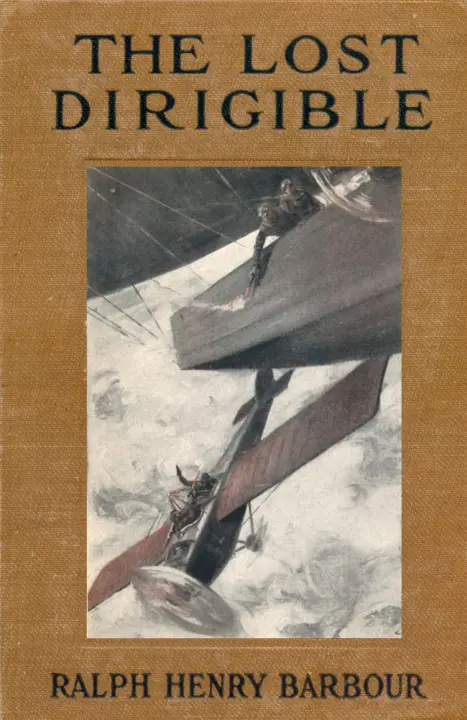
The lost dirigible
Ralph Henry Barbour
THE CLASSIC COLLECTION · 1911
"Crofton Chums" by Ralph Henry Barbour is a novel written in the early 20th century. The story revolves around the lives of three boys, Jim, Gil, and Poke, as they navigate their experiences at Crofton Academy and their interactions with new and old friends. Themes of friendship, school life, and personal growth are central to the narrative, engaging young readers with a mix of humor and adventure. The opening of the book introduces readers to Jim Hazard and his roommate Poke Endicott as they return to Crofton Academy, eagerly preparing for the upcoming school year. The scene captures their excitement for football and the camaraderie they share, setting up the light-hearted tone of the story. Their observations of the surrounding landscape and their anticipation of fellow students create a warm and nostalgic atmosphere. Meanwhile, the introduction of new characters, like Jeffrey Latham—who uses crutches—suggests the potential for deeper themes of acceptance and friendship, hinting that the challenges faced by individuals can bring about rich interactions and growth. As the boys settle into life at Sunnywood Cottage, the groundwork is laid for both personal and collective adventures at the academy.
Introduction adapted from the source catalogue; source summaries may be automatically generated.
Free to read · English · 60,436 words · No account needed
MAKE TIME FOR A GOOD BOOK
On by default. Untick to stop anonymous reading totals. Each page counts after 10 seconds in view. How this works.
Anonymous counting is on unless you have switched it off.
“Yes, I’d like silence,” said Poke severely. He began to write on the lid and the others, glad of a respite from thinking, watched him curiously. For a minute Poke scribbled and erased and frowned, but finally a satisfied smile dawned over his countenance.
“I’ve got it,” he announced. “Gil said all the Indian names had been used, my friends, but Gil, as usual, was wrong. Here, Jeff, is the name of your canoe.”
He tossed the box-lid to Jeffrey. On it he had printed in big letters:
“What’s that mean?” asked Jeffrey. Then it dawned on him and he burst into a laugh and handed the inscription on to Jim. “That’s bully, Poke! It really does look like Indian at first, too!”
“My Canoe,” Jim translated as he passed it on. “How did you think of
it, Poke?”
Poke waved his hand airily, signifying that the thing was too trivial
to be worth attention.
“The only thing,” said Gil, with a grin, “is that you’re pretty sure to call it ‘Mike’ for short.”
“Great!” laughed Jim. “You wanted something short and snappy and there it is; Mike. You can’t beat it.”
Hope was less enthusiastic about the name than the others, and said she thought it would be a shame to call anything as pretty as the crimson canoe, “Mike,” but Jeffrey was delighted with the suggestion. “It will look bully when it’s painted on,” he declared. “I suppose they’ll do it in gold, won’t they, Gil?”
“If you tell them to they will, I guess. Let’s get a move on, or we won’t get home before the game begins. Toss me another banana, Poke.”
“How many have you had already?” asked his chum severely.
“Only one; honest.”
“All right; catch. Who wants some more cake? There are three bananas left, too. Have one, Jim? Any one else in the audience like a banana? Shove the basket over, Hope, and I’ll dump these things in. What time is it?”
“After twelve,” replied Gil. “We’ll have to hurry a bit.”
“It won’t take us twenty minutes to get back after we’re started,” said Jeffrey. “We’ve got the current with us, you know.”
“That is indeed painful news,” grunted Poke. “I hoped to be able to
paddle back.”
“Jeff,” asked Hope as they retraced their steps, “will you teach me to paddle sometime? I’d love to know how. It isn’t hard, is it? It doesn’t look hard, anyway.”
Your reading position is saved on this browser. Take it to another device with a library code. Reading pages adapt to text, rather than matching a printed edition.
Ralph Henry Barbour
Ralph Henry Barbour
Ralph Henry Barbour
Ralph Henry Barbour
BEHIND THE BOOK
This eBook is for the use of anyone anywhere in the United States and most other parts of the world at no cost and with almost no restrictions whatsoever. You may copy it, give it away or re-use it under the terms of the Project Gutenberg License included with this eBook or online at www.gutenberg.org. If you are not located in the United States, you will have to check the laws of the country where you are located before using this eBook. Read the source licence.
The original source file, including credits and licence, is retained by this library. Request an original-format copy at no charge. Please include the book title and Project Gutenberg identifier #60894.
KEEP YOUR CURIOSITY GOING
Coulson Kernahan

Maurice Baring
Frances Wright
Cécile Tormay

Frederic Jesup Stimson

W. H. P. (William Henry Pope) Jarvis