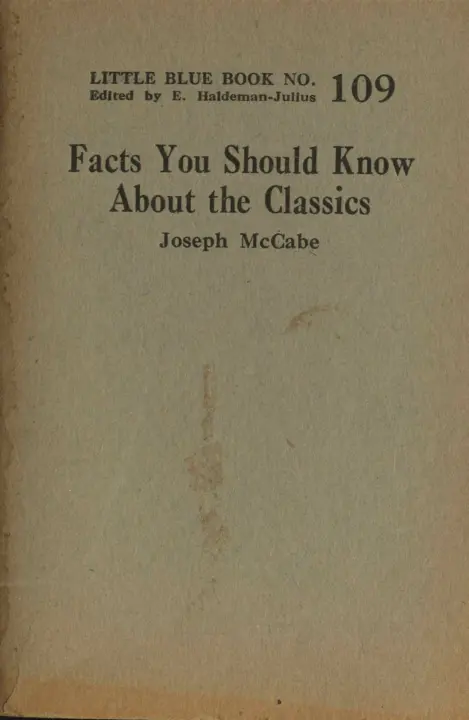
Facts you should know about the classics
Joseph McCabe
THE CLASSIC COLLECTION · 1916
"Crises in the History of the Papacy" by Joseph McCabe is a historical account written in the early 20th century. The book comprehensively examines the remarkable history of the Papacy, focusing on twenty pivotal Popes whose lives and influences significantly shaped both the Church and the broader spectrum of world history. It delves into the evolution of the institution, navigating through crises and transformations that have defined its role over centuries. At the start of the text, McCabe outlines the extraordinary and tumultuous history of the Papacy, noting its resilience through various social and political upheavals in Europe over fifteen centuries. The opening portion details how the early Christian community in Rome, consisting largely of impoverished believers living in obscurity, faced immense challenges, yet gradually rose to prominence. The text introduces the dynamics of early church leadership, particularly the struggles between influential figures like St. Callistus and the scholar Hippolytus, as they navigated theological disputes and the complexities of church governance. The setting encapsulates a time when Christianity was burgeoning but far from mainstream acceptance, laying the groundwork for the Church’s eventual ascendancy.
Introduction adapted from the source catalogue; source summaries may be automatically generated.
Free to read · English · 135,093 words · No account needed
MAKE TIME FOR A GOOD BOOK
On by default. Untick to stop anonymous reading totals. Each page counts after 10 seconds in view. How this works.
Anonymous counting is on unless you have switched it off.
[Footnote 205: Das Papstthum (1892), ch. ii., § 2. See also F. Roquain's La Papauté au moyen âge. Roquain observes, leniently, that Gregory was "not entirely exempt from reproach in the use of means to attain his ends" (p. 127) and fell into "excesses unworthy of his great soul" (p. 131). In his famous letter to the Bishop of Metz (viii., 21) Gregory omits an essential part of a passage which he quotes from Gelasius and materially alters its meaning. When we further find him writing (ix., 2) that "even a lie that is told for a good purpose in the cause of peace is not wholly free from blame," we fear that he was not far from the maxim that the end justifies the means.]
[Footnote 206: The secular ruler had long been accustomed to bestow the crozier and ring on his nominee for a bishopric, and this was known as "investiture." The practice undoubtedly led to much simony and to the appointment of unworthy men, but, as the event proved, a compromise was possible.]
[Footnote 207: Speech to the Roman synod of the year 1080 (Migne, vol. cxlviii., col. 816). Compare Ep., viii., 21.]
[Footnote 208: Ep., i., 7.]
[Footnote 209: Ep., i., 9.]
[Footnote 210: I., 11.]
[Footnote 211: I., 31.]
[Footnote 212: I., 35.]
[Footnote 213: I., 46.]
[Footnote 214: II., 51.]
[Footnote 215: VI., 30.]
[Footnote 216: VII., 1.]
[Footnote 217: II., 5 and 32.]
[Footnote 218: VIII., 2.]
[Footnote 219: In both statements of fact Gregory was wrong. Stephen had merely accepted a consecrated banner from the Anti-Pope Silvester II.; and Solomon had voluntarily chosen Henry as his suzerain.]
[Footnote 220: VIII., 4.]
[Footnote 221: There was a Gregorian archbishop in exile. The actual prelate may not have been zealous enough for Henry.]
[Footnote 222: Iii., 10.]
[Footnote 223: A good deal of controversy has been expended on the question whether Gregory did or did not threaten at this stage to depose Henry. Gregory's letter xxvi. (not in his Register, but of undoubted authenticity) to "the German People" expressly admits, or boasts, that he did. For further evidence see Dr. Martens, Gregor VII., i., 86-91.]
[Footnote 224: iii., 6.]
[Footnote 225: Viii., 21.]
[Footnote 226: See C. Mirbt's special study of the conflict, Die Absetzung Heinrichs IV. (1888), p. 103.]
[Footnote 227: Liber ad Amicum, 1. viii.]
[Footnote 228: A translation may be read in Delarc, iii., 252.]
[Footnote 229: One recent student, Dr. Albert Dammann (Der Sieg Heinrichs IV. in Kanossa, 1907 and 1909), goes to the other extreme, and concludes that Henry blockaded Canossa with a large army and compelled the Pope to withdraw his censure, without a single act of penance.]
[Footnote 230: Ep., iv., 12.]
[Footnote 231: For instance he describes a dramatic scene in which Henry shrinks from receiving the sacred host, whereas Gregory says (Ep., iv., 12) that he admitted Henry to communion. His story is full of contradictions.]
[Footnote 232: Iv., 12.]
Your reading position is saved on this browser. Take it to another device with a library code. Reading pages adapt to text, rather than matching a printed edition.
BEHIND THE BOOK
This eBook is for the use of anyone anywhere in the United States and most other parts of the world at no cost and with almost no restrictions whatsoever. You may copy it, give it away or re-use it under the terms of the Project Gutenberg License included with this eBook or online at www.gutenberg.org. If you are not located in the United States, you will have to check the laws of the country where you are located before using this eBook. Read the source licence.
The original source file, including credits and licence, is retained by this library. Request an original-format copy at no charge. Please include the book title and Project Gutenberg identifier #61779.
KEEP YOUR CURIOSITY GOING
Cécile Tormay

Moritz Busch
John L. Ransom
Frances Wright
Cécile Tormay

Mabel Potter Daggett