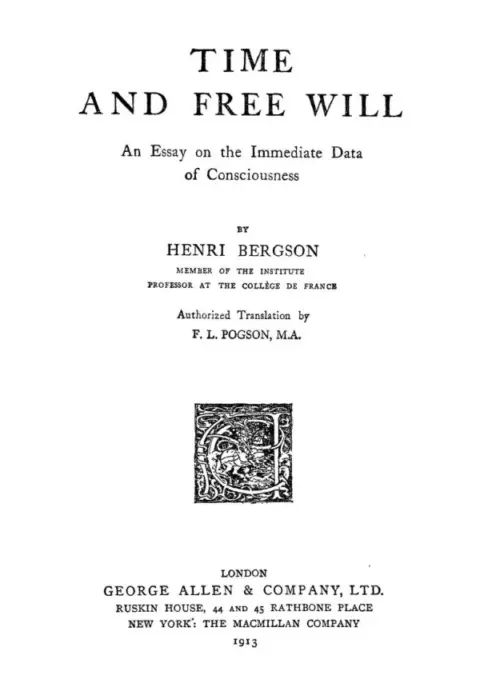
Time and Free Will: An Essay on the Immediate Data of Consciousness
Henri Bergson
THE CLASSIC COLLECTION · 1911
"Creative Evolution" by Henri Bergson is a philosophical work published in 1907. The book challenges Darwin's theory of natural selection, proposing instead that evolution is driven by élan vital—a vital creative impulse within life itself. Bergson explores concepts of subjective time and "duration," suggesting these can only be grasped through intuition rather than rational analysis. His ideas profoundly influenced modernist writers and thinkers, making the book enormously popular in the early twentieth century.
Introduction adapted from the source catalogue; source summaries may be automatically generated.
Free to read · English · 134,128 words · No account needed
MAKE TIME FOR A GOOD BOOK
On by default. Untick to stop anonymous reading totals. Each page counts after 10 seconds in view. How this works.
Anonymous counting is on unless you have switched it off.
[Footnote 11: In his fine work on Genius in Art (Le Génie dans l'art), M. Séailles develops this twofold thesis, that art is a continuation of nature and that life is creation. We should willingly accept the second formula; but by creation must we understand, as the author does, a synthesis of elements? Where the elements pre-exist, the synthesis that will be made is virtually given, being only one of the possible arrangements. This arrangement a superhuman intellect could have perceived in advance among all the possible ones that surround it. We hold, on the contrary, that in the domain of life the elements have no real and separate existence. They are manifold mental views of an indivisible process. And for that reason there is radical contingency in progress, incommensurability between what goes before and what follows--in short, duration.]
[Footnote 12: Bütschli, Untersuchungen über mikroskopische Schäume und das Protoplasma, Leipzig, 1892, First Part.]
[Footnote 13: Rhumbler, Versuch einer mechanischen Erklärung der indirekten Zell-und Kernteilung (Roux's Archiv, 1896).]
[Footnote 14: Berthold, Studien über Protoplasmamechanik, Leipzig, 1886, p. 102. Cf. the explanation proposed by Le Dantec, Théorie nouvelle de la vie, Paris, 1896, p. 60.]
[Footnote 15: Cope, The Primary Factors of Organic Evolution, Chicago,
1896, pp. 475-484.]
[Footnote 16: Maupas, "Etude des infusoires ciliés" (Arch. de zoologie expérimentale, 1883, pp. 47, 491, 518, 549, in particular). P. Vignon, Recherches de cytologie générale sur les épithéliums, Paris, 1902, p. 655. A profound study of the motions of the Infusoria and a very penetrating criticism of the idea of tropism have been made recently by Jennings (Contributions to the Study of the Behavior of Lower Organisms, Washington, 1904). The "type of behavior" of these lower organisms, as Jennings defines it (pp. 237-252), is unquestionably of the psychological order.]
[Footnote 17: E.B. Wilson, The Cell in Development and Inheritance,
New York, 1897, p. 330.]
[Footnote 18: Dastre, La Vie et la mort, p. 43.]
[Footnote 19: Laplace, Introduction à la théorie analytique des probabilités (OEuvres complètes, vol. vii., Paris, 1886, p. vi.).]
[Footnote 20: Du Bois-Reymond, Über die Grenzen des Naturerkennens,
Leipzig, 1892.]
[Footnote 21: There are really two lines to follow in contemporary neo-vitalism: on the one hand, the assertion that pure mechanism is insufficient, which assumes great authority when made by such scientists as Driesch or Reinke, for example; and, on the other hand, the hypotheses which this vitalism superposes on mechanism (the "entelechies" of Driesch, and the "dominants" of Reinke, etc.). Of these two parts, the former is perhaps the more interesting. See the admirable studies of Driesch--Die Lokalisation morphogenetischer Vorgänge, Leipzig, 1899; Die organischen Regulationen, Leipzig, 1901; Naturbegriffe und Natururteile, Leipzig, 1904; Der Vitalismus als Geschichte und als Lehre, Leipzig, 1905; and of Reinke--Die Welt als Tat, Berlin, 1899; Einleitung in die theoretische Biologie, Berlin, 1901; Philosophie der Botanik, Leipzig, 1905.]
Your reading position is saved on this browser. Take it to another device with a library code. Reading pages adapt to text, rather than matching a printed edition.
Henri Bergson
Henri Bergson
Henri Bergson
BEHIND THE BOOK
This eBook is for the use of anyone anywhere in the United States and most other parts of the world at no cost and with almost no restrictions whatsoever. You may copy it, give it away or re-use it under the terms of the Project Gutenberg License included with this eBook or online at www.gutenberg.org. If you are not located in the United States, you will have to check the laws of the country where you are located before using this eBook. Read the source licence.
The original source file, including credits and licence, is retained by this library. Request an original-format copy at no charge. Please include the book title and Project Gutenberg identifier #26163.
KEEP YOUR CURIOSITY GOING

David Patterson (Spirit) Hatch
Coulson Kernahan

Ralph Waldo Emerson
Frances Wright

Edwin Abbott Abbott

Joseph Droz