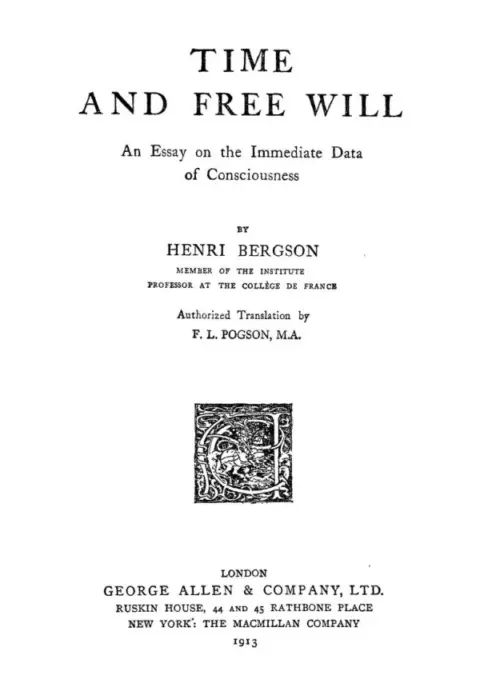
Time and Free Will: An Essay on the Immediate Data of Consciousness
Henri Bergson
THE CLASSIC COLLECTION · 1911
"Creative Evolution" by Henri Bergson is a philosophical work published in 1907. The book challenges Darwin's theory of natural selection, proposing instead that evolution is driven by élan vital—a vital creative impulse within life itself. Bergson explores concepts of subjective time and "duration," suggesting these can only be grasped through intuition rather than rational analysis. His ideas profoundly influenced modernist writers and thinkers, making the book enormously popular in the early twentieth century.
Introduction adapted from the source catalogue; source summaries may be automatically generated.
Free to read · English · 134,128 words · No account needed
MAKE TIME FOR A GOOD BOOK
On by default. Untick to stop anonymous reading totals. Each page counts after 10 seconds in view. How this works.
Anonymous counting is on unless you have switched it off.
After having been affirmed as a dogma, the transmissibility of acquired characters has been no less dogmatically denied, for reasons drawn a priori from the supposed nature of germinal cells. It is well known how Weismann was led, by his hypothesis of the continuity of the germ-plasm, to regard the germinal cells--ova and spermatozoa--as almost independent of the somatic cells. Starting from this, it has been claimed, and is still claimed by many, that the hereditary transmission of an acquired character is inconceivable. But if, perchance, experiment should show that acquired characters are transmissible, it would prove thereby that the germ-plasm is not so independent of the somatic envelope as has been contended, and the transmissibility of acquired characters would become ipso facto conceivable; which amounts to saying that conceivability and inconceivability have nothing to do with the case, and that experience alone must settle the matter. But it is just here that the difficulty begins. The acquired characters we are speaking of are generally habits or the effects of habit, and at the root of most habits there is a natural disposition. So that one can always ask whether it is really the habit acquired by the soma of the individual that is transmitted, or whether it is not rather a natural aptitude, which existed prior to the habit. This aptitude would have remained inherent in the germ-plasm which the individual bears within him, as it was in the individual himself and consequently in the germ whence he sprang. Thus, for instance, there is no proof that the mole has become blind because it has formed the habit of living underground; it is perhaps because its eyes were becoming atrophied that it condemned itself to a life underground.[40] If this is the case, the tendency to lose the power of vision has been transmitted from germ to germ without anything being acquired or lost by the soma of the mole itself. From the fact that the son of a fencing-master has become a good fencer much more quickly than his father, we cannot infer that the habit of the parent has been transmitted to the child; for certain natural dispositions in course of growth may have passed from the plasma engendering the father to the plasma engendering the son, may have grown on the way by the effect of the primitive impetus, and thus assured to the son a greater suppleness than the father had, without troubling, so to speak, about what the father did. So of many examples drawn from the progressive domestication of animals: it is hard to say whether it is the acquired habit that is transmitted or only a certain natural tendency--that, indeed, which has caused such and such a particular species or certain of its representatives to be specially chosen for domestication. The truth is, when every doubtful case, every fact open to more than one interpretation, has been eliminated, there remains hardly a single unquestionable example of acquired and transmitted peculiarities, beyond the famous experiments of Brown-Séquard, repeated and confirmed by other physiologists.[41] By cutting the spinal cord or the sciatic nerve of guinea-pigs, Brown-Séquard brought about an epileptic state which was transmitted to the descendants. Lesions of the same sciatic nerve, of the restiform body, etc., provoked various troubles in the guinea-pig which its progeny inherited sometimes in a quite different form: exophthalmia, loss of toes, etc. But it is not demonstrated that in these different cases of hereditary transmission there had been a real influence of the soma of the animal on its germ-plasm. Weismann at once objected that the operations of Brown-Séquard might have introduced certain special microbes into the body of the guinea-pig, which had found their means of nutrition in the nervous tissues and transmitted the malady by penetrating into the sexual elements.[42] This objection has been answered by Brown-Séquard himself;[43] but a more plausible one might be raised. Some experiments of Voisin and Peron have shown that fits of epilepsy are followed by the elimination of a toxic body which, when injected into animals,[44] is capable of producing convulsive symptoms. Perhaps the trophic disorders following the nerve lesions made by Brown-Séquard correspond to the formation of precisely this convulsion-causing poison. If so, the toxin passed from the guinea-pig to its spermatozoon or ovum, and caused in the development of the embryo a general disturbance, which, however, had no visible effects except at one point or another of the organism when developed. In that case, what occurred would have been somewhat the same as in the experiments of Charrin, Delamare, and Moussu, where guinea-pigs in gestation, whose liver or kidney was injured, transmitted the lesion to their progeny, simply because the injury to the mother's organ had given rise to specific "cytotoxins" which acted on the corresponding organ of the foetus.[45] It is true that, in these experiments, as in a former observation of the same physiologists,[46] it was the already formed foetus that was influenced by the toxins. But other researches of Charrin have resulted in showing that the same effect may be produced, by an analogous process, on the spermatozoa and the ova.[47] To conclude, then: the inheritance of an acquired peculiarity in the experiments of Brown-Séquard can be explained by the effect of a toxin on the germ. The lesion, however well localized it seems, is transmitted by the same process as, for instance, the taint of alcoholism. But may it not be the same in the case of every acquired peculiarity that has become hereditary?
Your reading position is saved on this browser. Take it to another device with a library code. Reading pages adapt to text, rather than matching a printed edition.
Henri Bergson
Henri Bergson
Henri Bergson
BEHIND THE BOOK
This eBook is for the use of anyone anywhere in the United States and most other parts of the world at no cost and with almost no restrictions whatsoever. You may copy it, give it away or re-use it under the terms of the Project Gutenberg License included with this eBook or online at www.gutenberg.org. If you are not located in the United States, you will have to check the laws of the country where you are located before using this eBook. Read the source licence.
The original source file, including credits and licence, is retained by this library. Request an original-format copy at no charge. Please include the book title and Project Gutenberg identifier #26163.
KEEP YOUR CURIOSITY GOING

David Patterson (Spirit) Hatch
Coulson Kernahan

Ralph Waldo Emerson
Frances Wright
Edwin Abbott Abbott
Joseph Droz