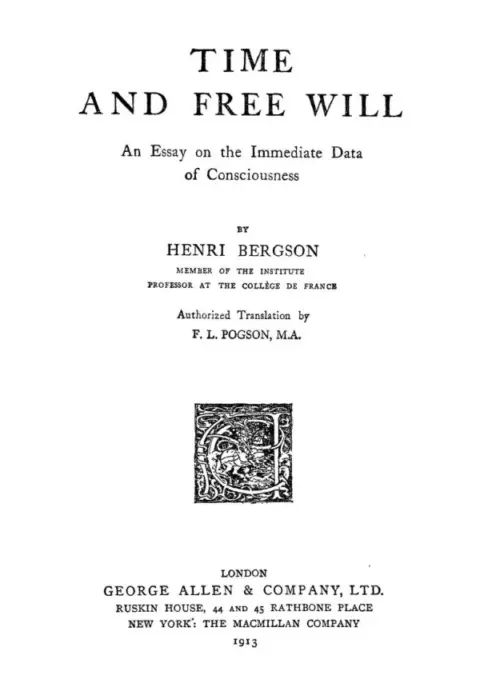
Time and Free Will: An Essay on the Immediate Data of Consciousness
Henri Bergson
THE CLASSIC COLLECTION · 1911
"Creative Evolution" by Henri Bergson is a philosophical work published in 1907. The book challenges Darwin's theory of natural selection, proposing instead that evolution is driven by élan vital—a vital creative impulse within life itself. Bergson explores concepts of subjective time and "duration," suggesting these can only be grasped through intuition rather than rational analysis. His ideas profoundly influenced modernist writers and thinkers, making the book enormously popular in the early twentieth century.
Introduction adapted from the source catalogue; source summaries may be automatically generated.
Free to read · English · 134,128 words · No account needed
MAKE TIME FOR A GOOD BOOK
On by default. Untick to stop anonymous reading totals. Each page counts after 10 seconds in view. How this works.
Anonymous counting is on unless you have switched it off.
It may be claimed that considerations of utility are out of place here; that the eye is not made to see, but that we see because we have eyes; that the organ is what it is, and "utility" is a word by which we designate the functional effects of the structure. But when I say that the eye "makes use of" light, I do not merely mean that the eye is capable of seeing; I allude to the very precise relations that exist between this organ and the apparatus of locomotion. The retina of vertebrates is prolonged in an optic nerve, which, again, is continued by cerebral centres connected with motor mechanisms. Our eye makes use of light in that it enables us to utilize, by movements of reaction, the objects that we see to be advantageous, and to avoid those which we see to be injurious. Now, of course, as light may have produced a pigment-spot by physical means, so it can physically determine the movements of certain organisms; ciliated Infusoria, for instance, react to light. But no one would hold that the influence of light has physically caused the formation of a nervous system, of a muscular system, of an osseous system, all things which are continuous with the apparatus of vision in vertebrate animals. The truth is, when one speaks of the gradual formation of the eye, and, still more, when one takes into account all that is inseparably connected with it, one brings in something entirely different from the direct action of light. One implicitly attributes to organized matter a certain capacity sui generis, the mysterious power of building up very complicated machines to utilize the simple excitation that it undergoes.
But this is just what is claimed to be unnecessary. Physics and chemistry are said to give us the key to everything. Eimer's great work is instructive in this respect. It is well known what persevering effort this biologist has devoted to demonstrating that transformation is brought about by the influence of the external on the internal, continuously exerted in the same direction, and not, as Darwin held, by accidental variations. His theory rests on observations of the highest interest, of which the starting-point was the study of the course followed by the color variation of the skin in certain lizards. Before this, the already old experiments of Dorfmeister had shown that the same chrysalis, according as it was submitted to cold or heat, gave rise to very different butterflies, which had long been regarded as independent species, Vanessa levana and Vanessa prorsa: an intermediate temperature produces an intermediate form. We might class with these facts the important transformations observed in a little crustacean, Artemia salina, when the salt of the water it lives in is increased or diminished.[32] In these various experiments the external agent seems to act as a cause of transformation. But what does the word "cause" mean here? Without undertaking an exhaustive analysis of the idea of causality, we will merely remark that three very different meanings of this term are commonly confused. A cause may act by impelling, releasing, or unwinding. The billiard-ball, that strikes another, determines its movement by impelling. The spark that explodes the powder acts by releasing. The gradual relaxing of the spring, that makes the phonograph turn, unwinds the melody inscribed on the cylinder: if the melody which is played be the effect, and the relaxing of the spring the cause, we must say that the cause acts by unwinding. What distinguishes these three cases from each other is the greater or less solidarity between the cause and the effect. In the first, the quantity and quality of the effect vary with the quantity and quality of the cause. In the second, neither quality nor quantity of the effect varies with quality and quantity of the cause: the effect is invariable. In the third, the quantity of the effect depends on the quantity of the cause, but the cause does not influence the quality of the effect: the longer the cylinder turns by the action of the spring, the more of the melody I shall hear, but the nature of the melody, or of the part heard, does not depend on the action of the spring. Only in the first case, really, does cause explain effect; in the others the effect is more or less given in advance, and the antecedent invoked is--in different degrees, of course--its occasion rather than its cause. Now, in saying that the saltness of the water is the cause of the transformations of Artemia, or that the degree of temperature determines the color and marks of the wings which a certain chrysalis will assume on becoming a butterfly, is the word "cause" used in the first sense? Obviously not: causality has here an intermediary sense between those of unwinding and releasing. Such, indeed, seems to be Eimer's own meaning when he speaks of the "kaleidoscopic" character of the variation,[33] or when he says that the variation of organized matter works in a definite way, just as inorganic matter crystallizes in definite directions.[34] And it may be granted, perhaps, that the process is a merely physical and chemical one in the case of the color-changes of the skin. But if this sort of explanation is extended to the case of the gradual formation of the eye of the vertebrate, for instance, it must be supposed that the physico-chemistry of living bodies is such that the influence of light has caused the organism to construct a progressive series of visual apparatus, all extremely complex, yet all capable of seeing, and of seeing better and better.[35] What more could the most confirmed finalist say, in order to mark out so exceptional a physico-chemistry? And will not the position of a mechanistic philosophy become still more difficult, when it is pointed out to it that the egg of a mollusc cannot have the same chemical composition as that of a vertebrate, that the organic substance which evolved toward the first of these two forms could not have been chemically identical with that of the substance which went in the other direction, and that, nevertheless, under the influence of light, the same organ has been constructed in the one case as in the other?
Your reading position is saved on this browser. Take it to another device with a library code. Reading pages adapt to text, rather than matching a printed edition.
Henri Bergson
Henri Bergson
Henri Bergson
BEHIND THE BOOK
This eBook is for the use of anyone anywhere in the United States and most other parts of the world at no cost and with almost no restrictions whatsoever. You may copy it, give it away or re-use it under the terms of the Project Gutenberg License included with this eBook or online at www.gutenberg.org. If you are not located in the United States, you will have to check the laws of the country where you are located before using this eBook. Read the source licence.
The original source file, including credits and licence, is retained by this library. Request an original-format copy at no charge. Please include the book title and Project Gutenberg identifier #26163.
KEEP YOUR CURIOSITY GOING

David Patterson (Spirit) Hatch
Coulson Kernahan

Ralph Waldo Emerson
Frances Wright

Edwin Abbott Abbott

Joseph Droz