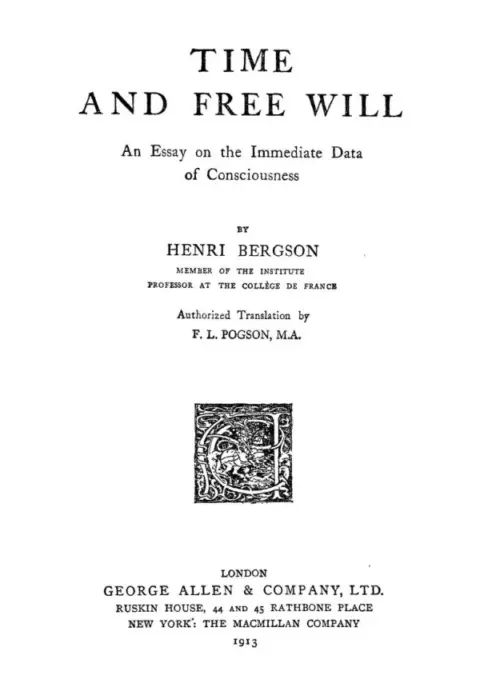
Time and Free Will: An Essay on the Immediate Data of Consciousness
Henri Bergson
THE CLASSIC COLLECTION · 1911
"Creative Evolution" by Henri Bergson is a philosophical work published in 1907. The book challenges Darwin's theory of natural selection, proposing instead that evolution is driven by élan vital—a vital creative impulse within life itself. Bergson explores concepts of subjective time and "duration," suggesting these can only be grasped through intuition rather than rational analysis. His ideas profoundly influenced modernist writers and thinkers, making the book enormously popular in the early twentieth century.
Introduction adapted from the source catalogue; source summaries may be automatically generated.
Free to read · English · 134,128 words · No account needed
MAKE TIME FOR A GOOD BOOK
On by default. Untick to stop anonymous reading totals. Each page counts after 10 seconds in view. How this works.
Anonymous counting is on unless you have switched it off.
Shaler, N.S., 133 note, 184 note
Sheath, calcareous, in illustration of animal tendency to mobility, 130-1
Signs, function of, 158, 159, 160
the instrument of science, 329-30
Sigwart, 287 note
Silurian epoch, failure of certain species to evolve since, 102
Similarity among individuals of same species the type of generality,
224-6, 228-9, 230-1
and mechanical causality, 44, 45
Simultaneity, to measure time is merely to count simultaneities, 9,
336, 337, 341
Sinuousness of evolution, 71, 98, 102, 212-3
Sitaris, unconscious knowledge of, 146, 147
Situation and magnitude, problems of, 211
Sketching movements, function of consciousness, 207-8
Sleep, 129-31, 135, 181
Snapshot, in illustration of intellectual representation of motion, 305, 306, 313, 315, 344 See View of reality, Cinematographical character, etc. form defined as a, of transition, 301-2, 317, 318, 321-2, 345
Social instinct, 101, 140, 158, 171-2
life, 138, 140, 158, 265
and pedagogical character of negation, 287-97
Societies, 101, 131-2, 158, 171-2, 259
Society and the individual, 260, 265
Solar energy stored by plants, released by animals, 246, 254
systems, 241-4, 246 note, 256, 270
systems, life in other, 256
Solid, concepts analogous to solids, ix
intellect as a solid nucleus, 193, 194
the material of construction and the object of the intellect, 153,
154, 161, 162, 251
Solidarity between brain and consciousness, 180, 262 of the parts of matter, 203, 207-8, 241, 271
Solidification operated by the understanding, 249
[Greek: sôma] in Aristotle, 350
Somnambulism and consciousness, 144, 145, 159
Soul and body, 350
and cell, 269
creation of, 270
Space and action, 203
in ancient philosophy, 318, 319
and concepts, 160-1, 163, 174-5, 176-7, 188-9, 257-9
geometrical, 203
homogeneity of, 156, 212
and induction, 216
in Kant's philosophy, 205, 206, 207, 244
in Leibniz's philosophy, 351
and matter, 189, 202-13, 244, 257, 264, 361-2, 368
and time in Kant's philosophy, 205-6
unity and multiplicity determinations of, 357-9
See Extension
Spatiality atmosphere of, bathing intelligence, 205
degradation of the extra-spatial, 207
and distinctness, 203, 207, 244, 250, 257-9
and geometrical space, 203, 211, 213, 218
and mathematical order, 208, 209
Special instincts and environment, 138, 168, 192-3, 194
and recollections, 167, 168, 180
as variations on a theme, 167, 172, 264
Species, articulate, 133
evolution of, 247, 255, 269
and external finality, 128-9, 130-1, 132, 266
fossil, 102
human, as goal of evolution, 266, 267
human, styled homo faber, 139
and instinct, 140, 167, 170-2, 264
and life, 167
similarity within, 223-6, 228-9, 230-1
Speculation, dead-locks in, xii, 155, 156, 312, 313-4 object of philosophy, 44, 152, 196, 198, 220, 225-6, 227, 251, 270-1, 273, 297-8, 306-7, 317, 347-8
Spencer, Herbert, xi, xiv, 78-9, 153, 188, 189, 190, 364, 365
Spencer's evolutionism, correspondence between mind and matter in, 368
cosmogony in, 188
imprint of relations and laws upon consciousness in, 188
matter in, 365, 367
mind in, 365, 367
Spheres, concentric, in Aristotle's philosophy, 328
Sphex, paralyzing instinct in, 172-5
Spiders and paralyzing hymenoptera, 172
Spinal cord, 110
Spinoza, the adequate and the inadequate, 353
cause, 277
dogmatism, 356, 357
eternity, 353
extension, 350
God, 351, 357
intuitionism, 347
mechanism, 348, 352, 355, 356
time, 362
Spirit, 251, 269, 270
Spirituality and materiality, 128-9, 201-3, 316-7, 208-9, 210-1, 212-3, 217, 218, 219, 222-3, 237, 238, 245, 247-8, 249, 251, 254, 256, 257, 259, 261, 267, 270-1, 272, 276, 343
Spontaneity of life, 86, 237. See Freedom
and mechanism, 40
in vegetables, 109
and the willed order, 224
Sport (biol.), 63
Starch, in the function of vegetable kingdom, 114
States of becoming, 1, 13, 163, 247-8, 299, 300, 307
Static character of the intellect, 155-6, 163, 274, 298
views of becoming, 273
Stehasny, 124 note
Steam-engine and bronze, parallel as epoch-marking, 138-9
Stentor and individuality, 260
Stoics, 316
Storing of solar energy by plants, 246, 253-6
Strain of bow and indivisibility of motion, 308
Stream, duration as a, 39, 338
Your reading position is saved on this browser. Take it to another device with a library code. Reading pages adapt to text, rather than matching a printed edition.
Henri Bergson
Henri Bergson
Henri Bergson
BEHIND THE BOOK
This eBook is for the use of anyone anywhere in the United States and most other parts of the world at no cost and with almost no restrictions whatsoever. You may copy it, give it away or re-use it under the terms of the Project Gutenberg License included with this eBook or online at www.gutenberg.org. If you are not located in the United States, you will have to check the laws of the country where you are located before using this eBook. Read the source licence.
The original source file, including credits and licence, is retained by this library. Request an original-format copy at no charge. Please include the book title and Project Gutenberg identifier #26163.
KEEP YOUR CURIOSITY GOING

David Patterson (Spirit) Hatch
Coulson Kernahan

Ralph Waldo Emerson
Frances Wright

Edwin Abbott Abbott

Joseph Droz