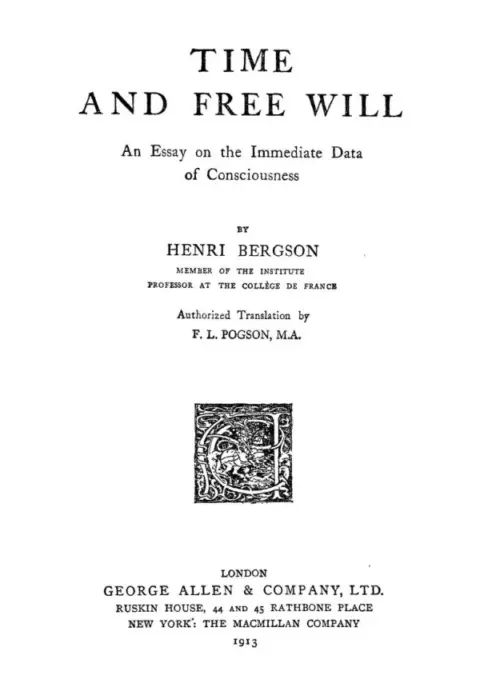
Time and Free Will: An Essay on the Immediate Data of Consciousness
Henri Bergson
THE CLASSIC COLLECTION · 1911
"Creative Evolution" by Henri Bergson is a philosophical work published in 1907. The book challenges Darwin's theory of natural selection, proposing instead that evolution is driven by élan vital—a vital creative impulse within life itself. Bergson explores concepts of subjective time and "duration," suggesting these can only be grasped through intuition rather than rational analysis. His ideas profoundly influenced modernist writers and thinkers, making the book enormously popular in the early twentieth century.
Introduction adapted from the source catalogue; source summaries may be automatically generated.
Free to read · English · 134,128 words · No account needed
MAKE TIME FOR A GOOD BOOK
On by default. Untick to stop anonymous reading totals. Each page counts after 10 seconds in view. How this works.
Anonymous counting is on unless you have switched it off.
Distinctness characteristic of the intellect, 160, 237, 251
characteristic of perception, 227, 251
as spatiality, 203, 207-8, 244, 250
Divergent lines of evolution, xii, 54, 55, 87, 97-101, 103-4, 106, 107, 109, 112, 113, 116, 119, 130, 132, 134-5, 142, 149, 150, 168, 173, 181, 254, 255, 266, 267. See Dissociation of tendencies, Complementarity, etc., Schisms in the primitive impulsion of life
Diversity, sensible, 205, 220-1, 231, 235, 236
Divination, instinct as, 176.
See Sympathy, etc.
Divisibility of extension, 154, 162
Division as function of intellect, 152, 154, 162-3, 189
of labor, 99, 110, 118, 157, 166, 260
of labor in cells, 166
Dog and man, consciousness in, 180
Dogmatism of the ancient epistemology contrasted with the relativism of
the modern, 230
of Leibniz and Spinoza, 356-7
skepticism, and relativism, 196-7, 230
Dogs and the law of correlation, 66
Domestication of animals and heredity, 80
Dominants of Reinke, 42 note
Dorfmeister, 72
Dream, 144, 180-1, 202, 209, 256.
See Interpenetration, Relaxation, Detention, Recollection
as relaxation, 202
Driesch, 42 note
Drosera, 107, 108, 109
Dufourt, 124 note
Duhem, 242 note
Dunan, Ch., xv note
Duration, xiv note, 2, 4-6, 8-11, 15, 17, 21, 22, 37, 39, 46, 51,
199, 201, 206, 213, 216, 240, 272, 273, 276, 298-9, 308-9, 317-8, 319
note, 324, 328, 332, 339, 342, 343, 345, 354, 361, 363-4
absoluteness of, 206
and deduction, 213
in Descartes's philosophy, 346
gnawing of, 4, 8, 46
indivisibility of, 6, 308-9
and induction, 216
and the inert, 343-4
in the philosophy of the Ideas, 316-7, 319 note, 324, 327, 328-9
rhythm of, 11, 128, 346.
See Creation, Evolution, Invention, Time, Unforeseeableness,
Uniqueness
Echinoderms in reference to animal mobility, 130, 131
Efficient cause in conception of chance, 234
Spinoza and, 269
Effort in evolution, 170
[Greek: Eidos], 314-5
Eimer, 55, 72, 73, 86
Elaborateness of the mathematical order, 208-10, 217, 251
Eleatic philosophy, 308, 314-5
Emanation, logical thought an, issue, aspect or deposit of life, ix, xii,
xiii, 49
Embroidering "something" on the canvas of "nothing," 297
Embroidery by descendants on the canvas handed down by ancestors, 23
Embryo, 18, 19, 26, 27, 75, 81, 89, 101, 166
Embryogeny, comparative, and transformism, 25
Embryonic life, 27, 166
Empirical study of evolution the centre of the theory of knowledge and of
the theory of life, 178
theories of knowledge, 205
Empty, thinking the full by means of the empty, 273-4
End in Eleatic philosophy, 314-5
of science is practical utility, 329
Energy, 115-7, 120-3, 242, 243, 245, 246, 252-5, 256, 257, 262
conservation of, 242
degradation of, 242, 243, 246
solar, stored by plants, released by animals, 245, 254
Enneadae of Plotinus, 210 note
Entelechy of Driesch, 42 note
Entropy, 243
Environment in evolution, 129, 133, 138, 140, 142, 150, 167, 168, 170,
192, 193, 252, 256, 257
and special instincts, 138, 168, 192, 193
Epiphenomenalism, 262
Essence and accidents in Aristotle's philosophy, 353
or form in Eleatic philosophy, 314-5
the meaning of, 302-3
Essences (or forms), qualities and acts, the three kinds of
representation, 303-4
Eternity, 39, 298, 314, 317, 320, 324, 328, 346, 352, 354
in the philosophy of Ideas, 316-7, 319, 324, 328
in Spinoza's philosophy, 353
Euglena, 116
Evellin, 311 note
Eventual actions, 11, 96.
See Possible activity
Your reading position is saved on this browser. Take it to another device with a library code. Reading pages adapt to text, rather than matching a printed edition.
Henri Bergson
Henri Bergson
Henri Bergson
BEHIND THE BOOK
This eBook is for the use of anyone anywhere in the United States and most other parts of the world at no cost and with almost no restrictions whatsoever. You may copy it, give it away or re-use it under the terms of the Project Gutenberg License included with this eBook or online at www.gutenberg.org. If you are not located in the United States, you will have to check the laws of the country where you are located before using this eBook. Read the source licence.
The original source file, including credits and licence, is retained by this library. Request an original-format copy at no charge. Please include the book title and Project Gutenberg identifier #26163.
KEEP YOUR CURIOSITY GOING

David Patterson (Spirit) Hatch
Coulson Kernahan

Ralph Waldo Emerson
Frances Wright

Edwin Abbott Abbott

Joseph Droz