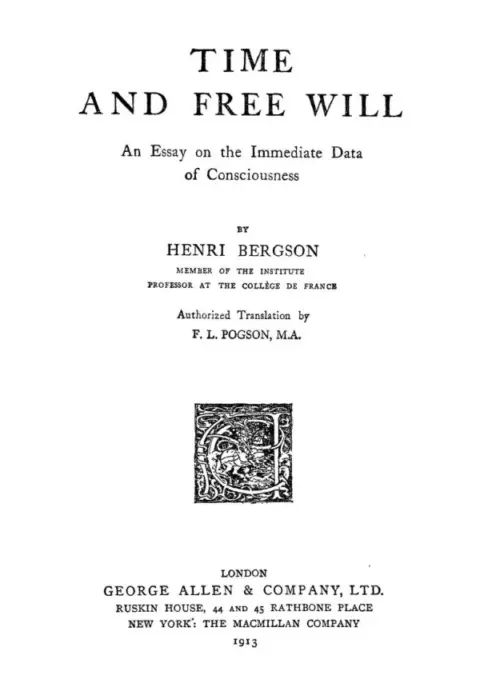
Time and Free Will: An Essay on the Immediate Data of Consciousness
Henri Bergson
THE CLASSIC COLLECTION · 1911
"Creative Evolution" by Henri Bergson is a philosophical work published in 1907. The book challenges Darwin's theory of natural selection, proposing instead that evolution is driven by élan vital—a vital creative impulse within life itself. Bergson explores concepts of subjective time and "duration," suggesting these can only be grasped through intuition rather than rational analysis. His ideas profoundly influenced modernist writers and thinkers, making the book enormously popular in the early twentieth century.
Introduction adapted from the source catalogue; source summaries may be automatically generated.
Free to read · English · 134,128 words · No account needed
MAKE TIME FOR A GOOD BOOK
On by default. Untick to stop anonymous reading totals. Each page counts after 10 seconds in view. How this works.
Anonymous counting is on unless you have switched it off.
[Footnote 104: De caelo, i. 279 a 12 [Greek: oude chronos hestin hexô tou ouranou]. Phys. viii. 251 b 27 [Greek: ho chronos pathos ti kinêseôs].]
[Footnote 105: Especially have we left almost entirely on one side those admirable but somewhat fugitive intuitions that Plotinus was later to seize, to study and to fix.]
[Footnote 106: See page 10.]
[Footnote 107: Descartes, Principes, ii. § 29.]
[Footnote 108: Descartes, Principes, ii. §§ 36 ff.]
[Footnote 109: In a course of lectures on Plotinus, given at the Collège de France in 1897-1898, we tried to bring out these resemblances. They are numerous and impressive. The analogy is continued even in the formulae employed on each side.]
[Footnote 110: "Le Paralogisme psycho-physiologique" (Revue de métaphysique et de morale, Nov. 1904, pp. 895-908). Cf. Matière et mémoire, Paris, 1896, chap. i.]
(Compiled by the Translator)
Abolition of everything a self-contradiction, 280, 283, 296, 298
idea of, 279, 282, 283, 295, 296.
See Nought
Absence of order, 231, 234, 274.
See Disorder
Absolute and freedom, 277
reality, 99, 228-9, 269, 358, 361
reality of the person, 269
time and the, 239, 240, 298, 340, 344
Absoluteness of duration, 206
of understanding, xi, 47, 152, 190, 197, 199
Abstract becoming, 304-7
multiplicity, 257-9
time, 9, 17, 20-2, 37, 39, 46, 51, 163, 318-9, 336, 352-3
Accident and essence in Aristotle's philosophy, 353
in evolution, 86-7, 104, 114-5, 127, 169, 170, 252, 254-5, 266, 267,
326-7
Accidental variations, 55, 63, 68, 69, 74, 85-6, 168
Accumulation of energy, function of vegetable organisms, 253, 255
Achilles and tortoise, in Zeno, 311, 312-3
Acquired characters, inheritance of, 76-9, 83-4, 87, 169, 170, 173, 231
Act, consciousness as inadequacy of, to representation, 144 form (or essence), quality, three classes of representation, 302-3
Action, creativeness of free, 192, 247
and concepts, 160, 297
and consciousness, xiii, 5, 143-4, 145, 179-80, 207, 262
discontinuity of, 154, 307
freedom of, in animals, 130
as function of nervous system, 262-3
indivisibility of, 94, 95, 308-9
and inert matter, 96, 136, 141-2, 156, 187, 198, 226, 366
instinct and, 136, 141
instrument of, consciousness, 180
instrument of, life, 162
instrument of matter, 161, 198-9
as instrument of consciousness, 180
and intellect. See Intellect and action
intensity of consciousness varies with ratio of possible, to real, 145
meaning of, 301-3
moves from want to fulness, 297, 298
organism a machine for, 252, 254, 300
and perception, 5, 11, 12, 93, 188, 189, 206, 227-30, 300, 307, 368
possible, 12, 13, 96, 144, 145, 146-7, 159, 165, 179-81, 188, 264
and science, 93, 195-6, 198-9, 329-30
and space, 203
sphere of the intellect, 155
tension in a free, 200, 207, 238, 240, 301-2
Activity, dissatisfaction the starting-point of, 297
of instinct, continuous with vital process, 139, 140
life as, 128-9, 247
mutually inverse factors in vital, 248
and nervous system, 110, 130, 132-3, 134-5, 180, 252, 261-3
organism as, 174
potential. See Action, possible
tension of free, 200, 202, 207-8, 223-4, 237, 239, 300-1
and torpor in evolution, 109, 111, 113, 114, 119-20, 129-30,
135-6, 181, 292
vital, has evolved divergently, 134
See Divergent lines of evolution
Adaptation, 50-1, 55, 57-8, 59, 70, 101, 129, 133, 192, 255, 270, 305-6
and causation, 102
mutual, between materiality and intellectuality, 187, 206-7
and progress, 101-2
Adequate and inadequate in Spinoza, 353
Adjectives, substantives and verbs, 303-4, 315
Aesthetics and philosophy, 177
Affection, Role of, in the idea of chance, 234
in the idea of nought, 281-3, 289, 293, 295, 296
in negation, 286-7
Affirmation and negation, 285-6, 293
Age and individuality, 15-6
Albuminoid substances, 121-2
Alciope, 96
Alexandrian philosophy, 322, 323
Algae in illustration of probable consciousness in vegetable forms, 112
Alimentation, 113-4, 117, 247
Allegory of the Cave, 191
Your reading position is saved on this browser. Take it to another device with a library code. Reading pages adapt to text, rather than matching a printed edition.
Henri Bergson
Henri Bergson
Henri Bergson
BEHIND THE BOOK
This eBook is for the use of anyone anywhere in the United States and most other parts of the world at no cost and with almost no restrictions whatsoever. You may copy it, give it away or re-use it under the terms of the Project Gutenberg License included with this eBook or online at www.gutenberg.org. If you are not located in the United States, you will have to check the laws of the country where you are located before using this eBook. Read the source licence.
The original source file, including credits and licence, is retained by this library. Request an original-format copy at no charge. Please include the book title and Project Gutenberg identifier #26163.
KEEP YOUR CURIOSITY GOING

David Patterson (Spirit) Hatch
Coulson Kernahan

Ralph Waldo Emerson
Frances Wright

Edwin Abbott Abbott

Joseph Droz