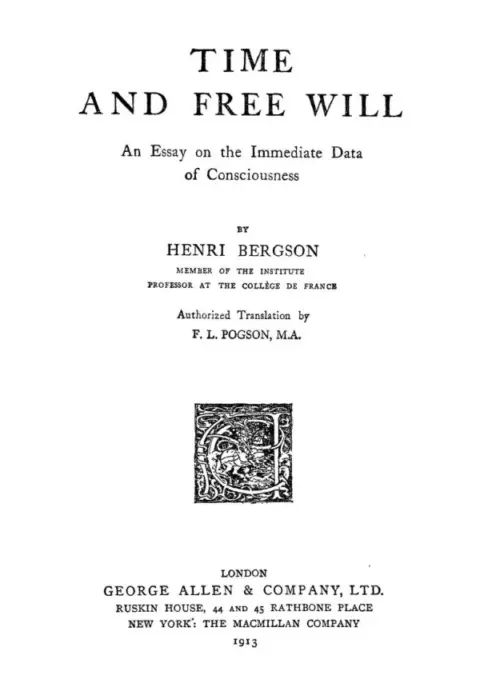
Time and Free Will: An Essay on the Immediate Data of Consciousness
Henri Bergson
THE CLASSIC COLLECTION · 1911
"Creative Evolution" by Henri Bergson is a philosophical work published in 1907. The book challenges Darwin's theory of natural selection, proposing instead that evolution is driven by élan vital—a vital creative impulse within life itself. Bergson explores concepts of subjective time and "duration," suggesting these can only be grasped through intuition rather than rational analysis. His ideas profoundly influenced modernist writers and thinkers, making the book enormously popular in the early twentieth century.
Introduction adapted from the source catalogue; source summaries may be automatically generated.
Free to read · English · 134,128 words · No account needed
MAKE TIME FOR A GOOD BOOK
On by default. Untick to stop anonymous reading totals. Each page counts after 10 seconds in view. How this works.
Anonymous counting is on unless you have switched it off.
Such is the last word of the Greek philosophy. We have not attempted to reconstruct it a priori. It has manifold origins. It is connected by many invisible threads to the soul of ancient Greece. Vain, therefore, the effort to deduce it from a simple principle.[105] But if everything that has come from poetry, religion, social life and a still rudimentary physics and biology be removed from it, if we take away all the light material that may have been used in the construction of the stately building, a solid framework remains, and this framework marks out the main lines of a metaphysic which is, we believe, the natural metaphysic of the human intellect. We come to a philosophy of this kind, indeed, whenever we follow to the end, the cinematographical tendency of perception and thought. Our perception and thought begin by substituting for the continuity of evolutionary change a series of unchangeable forms which are turn by turn, "caught on the wing," like the rings at a merry-go-round, which the children unhook with their little stick as they are passing. Now, how can the forms be passing, and on what "stick" are they strung? As the stable forms have been obtained by extracting from change everything that is definite, there is nothing left, to characterize the instability on which the forms are laid, but a negative attribute, which must be indetermination itself. Such is the first proceeding of our thought: it dissociates each change into two elements--the one stable, definable for each particular case, to wit, the Form; the other indefinable and always the same, Change in general. And such, also, is the essential operation of language. Forms are all that it is capable of expressing. It is reduced to taking as understood or is limited to suggesting a mobility which, just because it is always unexpressed, is thought to remain in all cases the same.--Then comes in a philosophy that holds the dissociation thus effected by thought and language to be legitimate. What can it do, except objectify the distinction with more force, push it to its extreme consequences, reduce it into a system? It will therefore construct the real, on the one hand, with definite Forms or immutable elements, and, on the other, with a principle of mobility which, being the negation of the form, will, by the hypothesis, escape all definition and be the purely indeterminate. The more it directs its attention to the forms delineated by thought and expressed by language, the more it will see them rise above the sensible and become subtilized into pure concepts, capable of entering one within the other, and even of being at last massed together into a single concept, the synthesis of all reality, the achievement of all perfection. The more, on the contrary, it descends toward the invisible source of the universal mobility, the more it will feel this mobility sink beneath it and at the same time become void, vanish into what it will call the "non-being." Finally, it will have on the one hand the system of ideas, logically coördinated together or concentrated into one only, on the other a quasi-nought, the Platonic "non-being" or the Aristotelian "matter."--But, having cut your cloth, you must sew it. With supra-sensible Ideas and an infra-sensible non-being, you now have to reconstruct the sensible world. You can do so only if you postulate a kind of metaphysical necessity in virtue of which the confronting of this All with this Zero is equivalent to the affirmation of all the degrees of reality that measure the interval between them--just as an undivided number, when regarded as a difference between itself and zero, is revealed as a certain sum of units, and with its own affirmation affirms all the lower numbers. That is the natural postulate. It is that also that we perceive as the base of the Greek philosophy. In order then to explain the specific characters of each of these degrees of intermediate reality, nothing more is necessary than to measure the distance that separates it from the integral reality. Each lower degree consists in a diminution of the higher, and the sensible newness that we perceive in it is resolved, from the point of view of the intelligible, into a new quantity of negation which is superadded to it. The smallest possible quantity of negation, that which is found already in the highest forms of sensible reality, and consequently a fortiori in the lower forms, is that which is expressed by the most general attributes of sensible reality, extension and duration. By increasing degradations we will obtain attributes more and more special. Here the philosopher's fancy will have free scope, for it is by an arbitrary decree, or at least a debatable one, that a particular aspect of the sensible world will be equated with a particular diminution of being. We shall not necessarily end, as Aristotle did, in a world consisting of concentric spheres turning on themselves. But we shall be led to an analogous cosmology--I mean, to a construction whose pieces, though all different, will have none the less the same relations between them. And this cosmology will be ruled by the same principle. The physical will be defined by the logical. Beneath the changing phenomena will appear to us, by transparence, a closed system of concepts subordinated to and coördinated with each other. Science, understood as the system of concepts, will be more real than the sensible reality. It will be prior to human knowledge, which is only able to spell it letter by letter; prior also to things, which awkwardly try to imitate it. It would only have to be diverted an instant from itself in order to step out of its eternity and thereby coincide with all this knowledge and all these things. Its immutability is therefore, indeed, the cause of the universal becoming.
Your reading position is saved on this browser. Take it to another device with a library code. Reading pages adapt to text, rather than matching a printed edition.
Henri Bergson
Henri Bergson
Henri Bergson
BEHIND THE BOOK
This eBook is for the use of anyone anywhere in the United States and most other parts of the world at no cost and with almost no restrictions whatsoever. You may copy it, give it away or re-use it under the terms of the Project Gutenberg License included with this eBook or online at www.gutenberg.org. If you are not located in the United States, you will have to check the laws of the country where you are located before using this eBook. Read the source licence.
The original source file, including credits and licence, is retained by this library. Request an original-format copy at no charge. Please include the book title and Project Gutenberg identifier #26163.
KEEP YOUR CURIOSITY GOING

David Patterson (Spirit) Hatch
Coulson Kernahan

Ralph Waldo Emerson
Frances Wright

Edwin Abbott Abbott

Joseph Droz