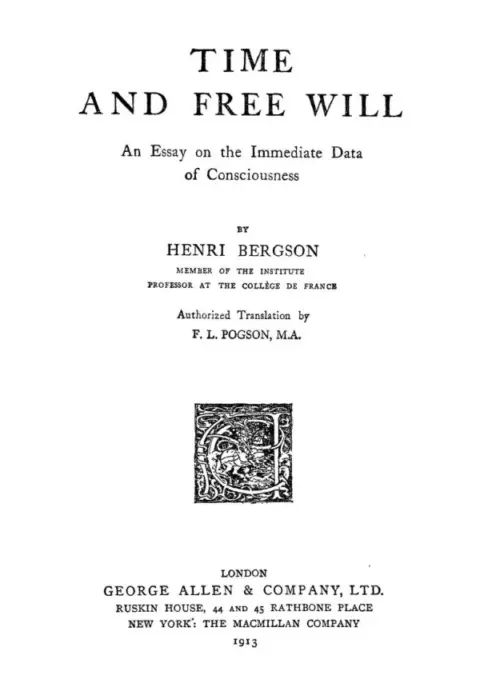
Time and Free Will: An Essay on the Immediate Data of Consciousness
Henri Bergson
THE CLASSIC COLLECTION · 1911
"Creative Evolution" by Henri Bergson is a philosophical work published in 1907. The book challenges Darwin's theory of natural selection, proposing instead that evolution is driven by élan vital—a vital creative impulse within life itself. Bergson explores concepts of subjective time and "duration," suggesting these can only be grasped through intuition rather than rational analysis. His ideas profoundly influenced modernist writers and thinkers, making the book enormously popular in the early twentieth century.
Introduction adapted from the source catalogue; source summaries may be automatically generated.
Free to read · English · 134,128 words · No account needed
MAKE TIME FOR A GOOD BOOK
On by default. Untick to stop anonymous reading totals. Each page counts after 10 seconds in view. How this works.
Anonymous counting is on unless you have switched it off.
These fleeting intuitions, which light up their object only at distant intervals, philosophy ought to seize, first to sustain them, then to expand them and so unite them together. The more it advances in this work, the more will it perceive that intuition is mind itself, and, in a certain sense, life itself: the intellect has been cut out of it by a process resembling that which has generated matter. Thus is revealed the unity of the spiritual life. We recognize it only when we place ourselves in intuition in order to go from intuition to the intellect, for from the intellect we shall never pass to intuition.
Philosophy introduces us thus into the spiritual life. And it shows us at the same time the relation of the life of the spirit to that of the body. The great error of the doctrines on the spirit has been the idea that by isolating the spiritual life from all the rest, by suspending it in space as high as possible above the earth, they were placing it beyond attack, as if they were not thereby simply exposing it to be taken as an effect of mirage! Certainly they are right to listen to conscience when conscience affirms human freedom; but the intellect is there, which says that the cause determines its effect, that like conditions like, that all is repeated and that all is given. They are right to believe in the absolute reality of the person and in his independence toward matter; but science is there, which shows the interdependence of conscious life and cerebral activity. They are right to attribute to man a privileged place in nature, to hold that the distance is infinite between the animal and man; but the history of life is there, which makes us witness the genesis of species by gradual transformation, and seems thus to reintegrate man in animality. When a strong instinct assures the probability of personal survival, they are right not to close their ears to its voice; but if there exist "souls" capable of an independent life, whence do they come? When, how and why do they enter into this body which we see arise, quite naturally, from a mixed cell derived from the bodies of its two parents? All these questions will remain unanswered, a philosophy of intuition will be a negation of science, will be sooner or later swept away by science, if it does not resolve to see the life of the body just where it really is, on the road that leads to the life of the spirit. But it will then no longer have to do with definite living beings. Life as a whole, from the initial impulsion that thrust it into the world, will appear as a wave which rises, and which is opposed by the descending movement of matter. On the greater part of its surface, at different heights, the current is converted by matter into a vortex. At one point alone it passes freely, dragging with it the obstacle which will weigh on its progress but will not stop it. At this point is humanity; it is our privileged situation. On the other hand, this rising wave is consciousness, and, like all consciousness, it includes potentialities without number which interpenetrate and to which consequently neither the category of unity nor that of multiplicity is appropriate, made as they both are for inert matter. The matter that it bears along with it, and in the interstices of which it inserts itself, alone can divide it into distinct individualities. On flows the current, running through human generations, subdividing itself into individuals. This subdivision was vaguely indicated in it, but could not have been made clear without matter. Thus souls are continually being created, which, nevertheless, in a certain sense pre-existed. They are nothing else than the little rills into which the great river of life divides itself, flowing through the body of humanity. The movement of the stream is distinct from the river bed, although it must adopt its winding course. Consciousness is distinct from the organism it animates, although it must undergo its vicissitudes. As the possible actions which a state of consciousness indicates are at every instant beginning to be carried out in the nervous centres, the brain underlines at every instant the motor indications of the state of consciousness; but the interdependency of consciousness and brain is limited to this; the destiny of consciousness is not bound up on that account with the destiny of cerebral matter. Finally, consciousness is essentially free; it is freedom itself; but it cannot pass through matter without settling on it, without adapting itself to it: this adaptation is what we call intellectuality; and the intellect, turning itself back toward active, that is to say free, consciousness, naturally makes it enter into the conceptual forms into which it is accustomed to see matter fit. It will therefore always perceive freedom in the form of necessity; it will always neglect the part of novelty or of creation inherent in the free act; it will always substitute for action itself an imitation artificial, approximative, obtained by compounding the old with the old and the same with the same. Thus, to the eyes of a philosophy that attempts to reabsorb intellect in intuition, many difficulties vanish or become light. But such a doctrine does not only facilitate speculation; it gives us also more power to act and to live. For, with it, we feel ourselves no longer isolated in humanity, humanity no longer seems isolated in the nature that it dominates. As the smallest grain of dust is bound up with our entire solar system, drawn along with it in that undivided movement of descent which is materiality itself, so all organized beings, from the humblest to the highest, from the first origins of life to the time in which we are, and in all places as in all times, do but evidence a single impulsion, the inverse of the movement of matter, and in itself indivisible. All the living hold together, and all yield to the same tremendous push. The animal takes its stand on the plant, man bestrides animality, and the whole of humanity, in space and in time, is one immense army galloping beside and before and behind each of us in an overwhelming charge able to beat down every resistance and clear the most formidable obstacles, perhaps even death.
Your reading position is saved on this browser. Take it to another device with a library code. Reading pages adapt to text, rather than matching a printed edition.
Henri Bergson
Henri Bergson
Henri Bergson
BEHIND THE BOOK
This eBook is for the use of anyone anywhere in the United States and most other parts of the world at no cost and with almost no restrictions whatsoever. You may copy it, give it away or re-use it under the terms of the Project Gutenberg License included with this eBook or online at www.gutenberg.org. If you are not located in the United States, you will have to check the laws of the country where you are located before using this eBook. Read the source licence.
The original source file, including credits and licence, is retained by this library. Request an original-format copy at no charge. Please include the book title and Project Gutenberg identifier #26163.
KEEP YOUR CURIOSITY GOING

David Patterson (Spirit) Hatch
Coulson Kernahan

Ralph Waldo Emerson
Frances Wright
Edwin Abbott Abbott
Joseph Droz