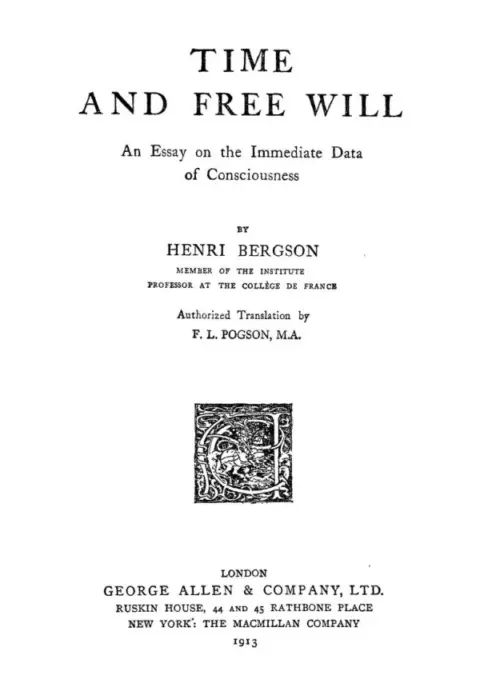
Time and Free Will: An Essay on the Immediate Data of Consciousness
Henri Bergson
THE CLASSIC COLLECTION · 1911
"Creative Evolution" by Henri Bergson is a philosophical work published in 1907. The book challenges Darwin's theory of natural selection, proposing instead that evolution is driven by élan vital—a vital creative impulse within life itself. Bergson explores concepts of subjective time and "duration," suggesting these can only be grasped through intuition rather than rational analysis. His ideas profoundly influenced modernist writers and thinkers, making the book enormously popular in the early twentieth century.
Introduction adapted from the source catalogue; source summaries may be automatically generated.
Free to read · English · 134,128 words · No account needed
MAKE TIME FOR A GOOD BOOK
On by default. Untick to stop anonymous reading totals. Each page counts after 10 seconds in view. How this works.
Anonymous counting is on unless you have switched it off.
It is precisely because a cerebral state expresses simply what there is of nascent action in the corresponding psychical state, that the psychical state tells us more than the cerebral state. The consciousness of a living being, as we have tried to prove elsewhere, is inseparable from its brain in the sense in which a sharp knife is inseparable from its edge: the brain is the sharp edge by which consciousness cuts into the compact tissue of events, but the brain is no more coextensive with consciousness than the edge is with the knife. Thus, from the fact that two brains, like that of the ape and that of the man, are very much alike, we cannot conclude that the corresponding consciousnesses are comparable or commensurable.
But the two brains may perhaps be less alike than we suppose. How can we help being struck by the fact that, while man is capable of learning any sort of exercise, of constructing any sort of object, in short of acquiring any kind of motor habit whatsoever, the faculty of combining new movements is strictly limited in the best-endowed animal, even in the ape? The cerebral characteristic of man is there. The human brain is made, like every brain, to set up motor mechanisms and to enable us to choose among them, at any instant, the one we shall put in motion by the pull of a trigger. But it differs from other brains in this, that the number of mechanisms it can set up, and consequently the choice that it gives as to which among them shall be released, is unlimited. Now, from the limited to the unlimited there is all the distance between the closed and the open. It is not a difference of degree, but of kind.
Radical therefore, also, is the difference between animal consciousness, even the most intelligent, and human consciousness. For consciousness corresponds exactly to the living being's power of choice; it is coextensive with the fringe of possible action that surrounds the real action: consciousness is synonymous with invention and with freedom. Now, in the animal, invention is never anything but a variation on the theme of routine. Shut up in the habits of the species, it succeeds, no doubt, in enlarging them by its individual initiative; but it escapes automatism only for an instant, for just the time to create a new automatism. The gates of its prison close as soon as they are opened; by pulling at its chain it succeeds only in stretching it. With man, consciousness breaks the chain. In man, and in man alone, it sets itself free. The whole history of life until man has been that of the effort of consciousness to raise matter, and of the more or less complete overwhelming of consciousness by the matter which has fallen back on it. The enterprise was paradoxical, if, indeed, we may speak here otherwise than by metaphor of enterprise and of effort. It was to create with matter, which is necessity itself, an instrument of freedom, to make a machine which should triumph over mechanism, and to use the determinism of nature to pass through the meshes of the net which this very determinism had spread. But, everywhere except in man, consciousness has let itself be caught in the net whose meshes it tried to pass through: it has remained the captive of the mechanisms it has set up. Automatism, which it tries to draw in the direction of freedom, winds about it and drags it down. It has not the power to escape, because the energy it has provided for acts is almost all employed in maintaining the infinitely subtle and essentially unstable equilibrium into which it has brought matter. But man not only maintains his machine, he succeeds in using it as he pleases. Doubtless he owes this to the superiority of his brain, which enables him to build an unlimited number of motor mechanisms, to oppose new habits to the old ones unceasingly, and, by dividing automatism against itself, to rule it. He owes it to his language, which furnishes consciousness with an immaterial body in which to incarnate itself and thus exempts it from dwelling exclusively on material bodies, whose flux would soon drag it along and finally swallow it up. He owes it to social life, which stores and preserves efforts as language stores thought, fixes thereby a mean level to which individuals must raise themselves at the outset, and by this initial stimulation prevents the average man from slumbering and drives the superior man to mount still higher. But our brain, our society, and our language are only the external and various signs of one and the same internal superiority. They tell, each after its manner, the unique, exceptional success which life has won at a given moment of its evolution. They express the difference of kind, and not only of degree, which separates man from the rest of the animal world. They let us guess that, while at the end of the vast spring-board from which life has taken its leap, all the others have stepped down, finding the cord stretched too high, man alone has cleared the obstacle.
Your reading position is saved on this browser. Take it to another device with a library code. Reading pages adapt to text, rather than matching a printed edition.
Henri Bergson
Henri Bergson
Henri Bergson
BEHIND THE BOOK
This eBook is for the use of anyone anywhere in the United States and most other parts of the world at no cost and with almost no restrictions whatsoever. You may copy it, give it away or re-use it under the terms of the Project Gutenberg License included with this eBook or online at www.gutenberg.org. If you are not located in the United States, you will have to check the laws of the country where you are located before using this eBook. Read the source licence.
The original source file, including credits and licence, is retained by this library. Request an original-format copy at no charge. Please include the book title and Project Gutenberg identifier #26163.
KEEP YOUR CURIOSITY GOING

David Patterson (Spirit) Hatch
Coulson Kernahan

Ralph Waldo Emerson
Frances Wright
Edwin Abbott Abbott
Joseph Droz