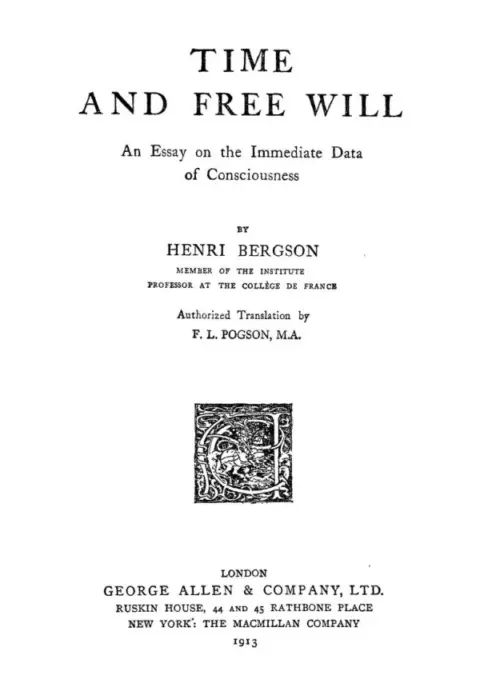
Time and Free Will: An Essay on the Immediate Data of Consciousness
Henri Bergson
THE CLASSIC COLLECTION · 1911
"Creative Evolution" by Henri Bergson is a philosophical work published in 1907. The book challenges Darwin's theory of natural selection, proposing instead that evolution is driven by élan vital—a vital creative impulse within life itself. Bergson explores concepts of subjective time and "duration," suggesting these can only be grasped through intuition rather than rational analysis. His ideas profoundly influenced modernist writers and thinkers, making the book enormously popular in the early twentieth century.
Introduction adapted from the source catalogue; source summaries may be automatically generated.
Free to read · English · 134,128 words · No account needed
MAKE TIME FOR A GOOD BOOK
On by default. Untick to stop anonymous reading totals. Each page counts after 10 seconds in view. How this works.
Anonymous counting is on unless you have switched it off.
The main problem of the theory of knowledge is to know how science is possible, that is to say, in effect, why there is order and not disorder in things. That order exists is a fact. But, on the other hand, disorder, which appears to us to be less than order, is, it seems, of right. The existence of order is then a mystery to be cleared up, at any rate a problem to be solved. More simply, when we undertake to found order, we regard it as contingent, if not in things, at least as viewed by the mind: of a thing that we do not judge to be contingent we do not require an explanation. If order did not appear to us as a conquest over something, or as an addition to something (which something is thought to be the "absence of order"), ancient realism would not have spoken of a "matter" to which the Idea superadded itself, nor would modern idealism have supposed a "sensuous manifold" that the understanding organizes into nature. Now, it is unquestionable that all order is contingent, and conceived as such. But contingent in relation to what?
The reply, to our thinking, is not doubtful. An order is contingent, and seems so, in relation to the inverse order, as verse is contingent in relation to prose and prose in relation to verse. But, just as all speech which is not prose is verse and necessarily conceived as verse, just as all speech which is not verse is prose and necessarily conceived as prose, so any state of things that is not one of the two orders is the other and is necessarily conceived as the other. But it may happen that we do not realize what we are actually thinking of, and perceive the idea really present to our mind only through a mist of affective states. Any one can be convinced of this by considering the use we make of the idea of disorder in daily life. When I enter a room and pronounce it to be "in disorder," what do I mean? The position of each object is explained by the automatic movements of the person who has slept in the room, or by the efficient causes, whatever they may be, that have caused each article of furniture, clothing, etc., to be where it is: the order, in the second sense of the word, is perfect. But it is order of the first kind that I am expecting, the order that a methodical person consciously puts into his life, the willed order and not the automatic: so I call the absence of this order "disorder." At bottom, all there is that is real, perceived and even conceived, in this absence of one of the two kinds of order, is the presence of the other. But the second is indifferent to me, I am interested only in the first, and I express the presence of the second as a function of the first, instead of expressing it, so to speak, as a function of itself, by saying it is disorder. Inversely, when we affirm that we are imagining a chaos, that is to say a state of things in which the physical world no longer obeys laws, what are we thinking of? We imagine facts that appear and disappear capriciously. First we think of the physical universe as we know it, with effects and causes well proportioned to each other; then, by a series of arbitrary decrees, we augment, diminish, suppress, so as to obtain what we call disorder. In reality we have substituted will for the mechanism of nature; we have replaced the "automatic order" by a multitude of elementary wills, just to the extent that we imagine the apparition or vanishing of phenomena. No doubt, for all these little wills to constitute a "willed order," they must have accepted the direction of a higher will. But, on looking closely at them, we see that that is just what they do: our own will is there, which objectifies itself in each of these capricious wills in turn, and takes good care not to connect the same with the same, nor to permit the effect to be proportional to the cause--in fact makes one simple intention hover over the whole of the elementary volitions. Thus, here again, the absence of one of the two orders consists in the presence of the other. In analyzing the idea of chance, which is closely akin to the idea of disorder, we find the same elements. When the wholly mechanical play of the causes which stop the wheel on a number makes me win, and consequently acts like a good genius, careful of my interests, or when the wholly mechanical force of the wind tears a tile off the roof and throws it on to my head, that is to say acts like a bad genius, conspiring against my person: in both cases I find a mechanism where I should have looked for, where, indeed, it seems as if I ought to have found, an intention. That is what I express in speaking of chance. And of an anarchical world, in which phenomena succeed each other capriciously, I should say again that it is a realm of chance, meaning that I find before me wills, or rather decrees, when what I am expecting is mechanism. Thus is explained the singular vacillation of the mind when it tries to define chance. Neither efficient cause nor final cause can furnish the definition sought. The mind swings to and fro, unable to rest, between the idea of an absence of final cause and that of an absence of efficient cause, each of these definitions sending it back to the other. The problem remains insoluble, in fact, so long as the idea of chance is regarded as a pure idea, without mixture of feeling. But, in reality, chance merely objectifies the state of mind of one who, expecting one of the two kinds of order, finds himself confronted with the other. Chance and disorder are therefore necessarily conceived as relative. So if we wish to represent them to ourselves as absolute, we perceive that we are going to and fro like a shuttle between the two kinds of order, passing into the one just at the moment at which we might catch ourself in the other, and that the supposed absence of all order is really the presence of both, with, besides, the swaying of a mind that cannot rest finally in either. Neither in things nor in our idea of things can there be any question of presenting this disorder as the substratum of order, since it implies the two kinds of order and is made of their combination.
Your reading position is saved on this browser. Take it to another device with a library code. Reading pages adapt to text, rather than matching a printed edition.
Henri Bergson
Henri Bergson
Henri Bergson
BEHIND THE BOOK
This eBook is for the use of anyone anywhere in the United States and most other parts of the world at no cost and with almost no restrictions whatsoever. You may copy it, give it away or re-use it under the terms of the Project Gutenberg License included with this eBook or online at www.gutenberg.org. If you are not located in the United States, you will have to check the laws of the country where you are located before using this eBook. Read the source licence.
The original source file, including credits and licence, is retained by this library. Request an original-format copy at no charge. Please include the book title and Project Gutenberg identifier #26163.
KEEP YOUR CURIOSITY GOING

David Patterson (Spirit) Hatch
Coulson Kernahan

Ralph Waldo Emerson
Frances Wright

Edwin Abbott Abbott

Joseph Droz