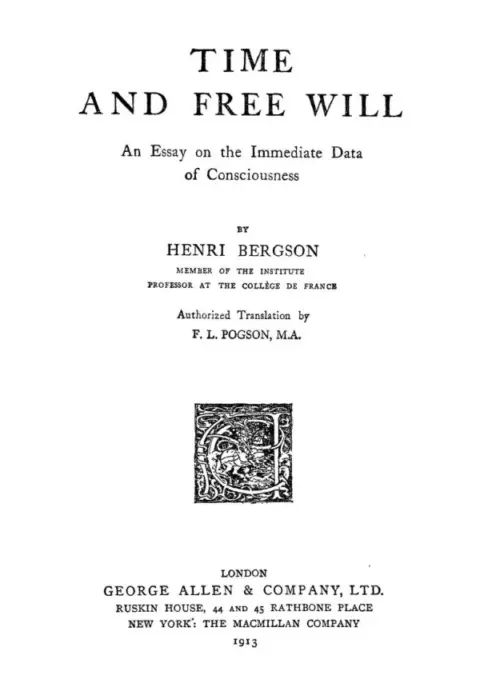
Time and Free Will: An Essay on the Immediate Data of Consciousness
Henri Bergson
THE CLASSIC COLLECTION · 1911
"Creative Evolution" by Henri Bergson is a philosophical work published in 1907. The book challenges Darwin's theory of natural selection, proposing instead that evolution is driven by élan vital—a vital creative impulse within life itself. Bergson explores concepts of subjective time and "duration," suggesting these can only be grasped through intuition rather than rational analysis. His ideas profoundly influenced modernist writers and thinkers, making the book enormously popular in the early twentieth century.
Introduction adapted from the source catalogue; source summaries may be automatically generated.
Free to read · English · 134,128 words · No account needed
MAKE TIME FOR A GOOD BOOK
On by default. Untick to stop anonymous reading totals. Each page counts after 10 seconds in view. How this works.
Anonymous counting is on unless you have switched it off.
Deduction, then, does not work unless there be spatial intuition behind it. But we may say the same of induction. It is not necessary indeed to think geometrically, nor even to think at all, in order to expect from the same conditions a repetition of the same fact. The consciousness of the animal already does this work, and indeed, independently of all consciousness, the living body itself is so constructed that it can extract from the successive situations in which it finds itself the similarities which interest it, and so respond to the stimuli by appropriate reactions. But it is a far cry from a mechanical expectation and reaction of the body, to induction properly so called, which is an intellectual operation. Induction rests on the belief that there are causes and effects, and that the same effects follow the same causes. Now, if we examine this double belief, this is what we find. It implies, in the first place, that reality is decomposable into groups, which can be practically regarded as isolated and independent. If I boil water in a kettle on a stove, the operation and the objects that support it are, in reality, bound up with a multitude of other objects and a multitude of other operations; in the end, I should find that our entire solar system is concerned in what is being done at this particular point of space. But, in a certain measure, and for the special end I am pursuing, I may admit that things happen as if the group water-kettle-stove were an independent microcosm. That is my first affirmation. Now, when I say that this microcosm will always behave in the same way, that the heat will necessarily, at the end of a certain time, cause the boiling of the water, I admit that it is sufficient that a certain number of elements of the system be given in order that the system should be complete; it completes itself automatically, I am not free to complete it in thought as I please. The stove, the kettle and the water being given, with a certain interval of duration, it seems to me that the boiling, which experience showed me yesterday to be the only thing wanting to complete the system, will complete it to-morrow, no matter when to-morrow may be. What is there at the base of this belief? Notice that the belief is more or less assured, according as the case may be, but that it is forced upon the mind as an absolute necessity when the microcosm considered contains only magnitudes. If two numbers be given, I am not free to choose their difference. If two sides of a triangle and the contained angle are given, the third side arises of itself and the triangle completes itself automatically. I can, it matters not where and it matters not when, trace the same two sides containing the same angle: it is evident that the new triangles so formed can be superposed on the first, and that consequently the same third side will come to complete the system. Now, if my certitude is perfect in the case in which I reason on pure space determinations, must I not suppose that, in the other cases, the certitude is greater the nearer it approaches this extreme case? Indeed, may it not be the limiting case which is seen through all the others and which colors them, accordingly as they are more or less transparent, with a more or less pronounced tinge of geometrical necessity?[82] In fact, when I say that the water on the fire will boil to-day as it did yesterday, and that this is an absolute necessity, I feel vaguely that my imagination is placing the stove of yesterday on that of to-day, kettle on kettle, water on water, duration on duration, and it seems then that the rest must coincide also, for the same reason that, when two triangles are superposed and two of their sides coincide, their third sides coincide also. But my imagination acts thus only because it shuts its eyes to two essential points. For the system of to-day actually to be superimposed on that of yesterday, the latter must have waited for the former, time must have halted, and everything become simultaneous: that happens in geometry, but in geometry alone. Induction therefore implies first that, in the world of the physicist as in that of the geometrician, time does not count. But it implies also that qualities can be superposed on each other like magnitudes. If, in imagination, I place the stove and fire of to-day on that of yesterday, I find indeed that the form has remained the same; it suffices, for that, that the surfaces and edges coincide; but what is the coincidence of two qualities, and how can they be superposed one on another in order to ensure that they are identical? Yet I extend to the second order of reality all that applies to the first. The physicist legitimates this operation later on by reducing, as far as possible, differences of quality to differences of magnitude; but, prior to all science, I incline to liken qualities to quantities, as if I perceived behind the qualities, as through a transparency, a geometrical mechanism.[83] The more complete this transparency, the more it seems to me that in the same conditions there must be a repetition of the same fact. Our inductions are certain, to our eyes, in the exact degree in which we make the qualitative differences melt into the homogeneity of the space which subtends them, so that geometry is the ideal limit of our inductions as well as of our deductions. The movement at the end of which is spatiality lays down along its course the faculty of induction as well as that of deduction, in fact, intellectuality entire.
Your reading position is saved on this browser. Take it to another device with a library code. Reading pages adapt to text, rather than matching a printed edition.
Henri Bergson
Henri Bergson
Henri Bergson
BEHIND THE BOOK
This eBook is for the use of anyone anywhere in the United States and most other parts of the world at no cost and with almost no restrictions whatsoever. You may copy it, give it away or re-use it under the terms of the Project Gutenberg License included with this eBook or online at www.gutenberg.org. If you are not located in the United States, you will have to check the laws of the country where you are located before using this eBook. Read the source licence.
The original source file, including credits and licence, is retained by this library. Request an original-format copy at no charge. Please include the book title and Project Gutenberg identifier #26163.
KEEP YOUR CURIOSITY GOING

David Patterson (Spirit) Hatch
Coulson Kernahan

Ralph Waldo Emerson
Frances Wright

Edwin Abbott Abbott

Joseph Droz