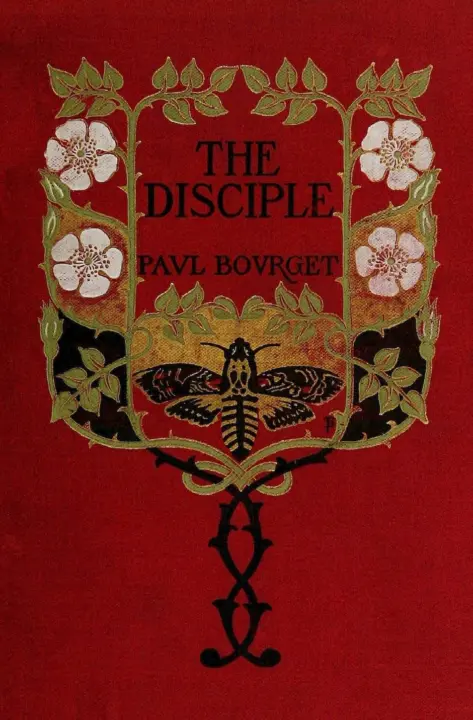
The disciple
Paul Bourget
THE CLASSIC COLLECTION · 1908
"Cosmopolis — Complete" by Paul Bourget is a novel written in the late 19th century. The story explores the intricacies of cosmopolitan life through its depiction of cultural interactions across a backdrop of European cities, with a particular focus on characters who embody modern dilemmas intertwined with traditional values. The narrative begins in Rome and introduces us to a variety of characters, spotlighting their connections to the themes of identity, belonging, and the impacts of financial and social upheaval. The opening of the novel presents a vivid scene in an old bookseller's shop, where regular customers interact with the eccentric merchant, Ribalta. Among them is Marquis de Montfanon, who engages with Ribalta in witty repartees while searching for valuable documents. This meeting sets the stage for a deeper exploration of the characters, including old political sentiments from the past, as Montfanon grapples with his feelings toward Baron Hafner's daughter, Fanny. The dialogue reveals Montfanon’s strong opinions about modernity and mixed heritage, hinting at underlying tensions related to relationships, social standing, and individual identity that permeate the cosmopolitan context of the story.
Introduction adapted from the source catalogue; source summaries may be automatically generated.
Free to read · English · 101,477 words · No account needed
MAKE TIME FOR A GOOD BOOK
On by default. Untick to stop anonymous reading totals. Each page counts after 10 seconds in view. How this works.
Anonymous counting is on unless you have switched it off.
To be sure, the drama of passion which this book depicts has no particularly Roman features, and nothing was farther from my thoughts than to trace a picture of the society so local, so traditional, which exists between the Quirinal and the Vatican. The drama is not even Italian, for the scene might have been laid, with as much truth, at Venice, Florence, Nice, St. Moritz, even Paris or London, the various cities which are like quarters scattered over Europe of the fluctuating 'Cosmopolis,' christened by Beyle: 'Vengo adesso da Cosmopoli'. It is the contrast between the rather incoherent ways of the rovers of high life and the character of perennity impressed everywhere in the great city of the Caesars and of the Popes which has caused me to choose the spot where even the corners speak of a secular past, there to evoke some representatives of the most modern, as well as the most arbitrary and the most momentary, life. You, who know better than any one the motley world of cosmopolites, understand why I have confined myself to painting here only a fragment of it. That world, indeed, does not exist, it can have neither defined customs nor a general character. It is composed of exceptions and of singularities. We are so naturally creatures of custom, our continual mobility has such a need of gravitating around one fixed axis, that motives of a personal order alone can determine us upon an habitual and voluntary exile from our native land. It is so, now in the case of an artist, a person seeking for instruction and change; now in the case of a business man who desires to escape the consequences of some scandalous error; now in the case of a man of pleasure in search of new adventures; in the case of another, who cherishes prejudices from birth, it is the longing to find the "happy mean;" in the case of another, flight from distasteful memories. The life of the cosmopolite can conceal all beneath the vulgarity of its whims, from snobbery in quest of higher connections to swindling in quest of easier prey, submitting to the brilliant frivolities of the sport, the sombre intrigues of policy, or the sadness of a life which has been a failure. Such a variety of causes renders at once very attractive and almost impracticable the task of the author who takes as a model that ever-changing society so like unto itself in the exterior rites and fashions, so really, so intimately complex and composite in its fundamental elements. The writer is compelled to take from it a series of leading facts, as I have done, essaying to deduce a law which governs them. That law, in the present instance, is the permanence of race. Contradictory as may appear this result, the more one studies the cosmopolites, the more one ascertains that the most irreducible idea within them is that special strength of heredity which slumbers beneath the monotonous uniform of superficial relations, ready to reawaken as soon as love stirs the depths of the temperament. But there again a difficulty, almost insurmountable, is met with. Obliged to concentrate his action to a limited number of personages, the novelist can not pretend to incarnate in them the confused whole of characters which the vague word race sums up. Again, taking this book as an example, you and I, my dear Primoli, know a number of Venetians and of English women, of Poles and of Romans, of Americans and of French who have nothing in common with Madame Steno, Maud and Boleslas Gorka, Prince d'Ardea, Marquis Cibo, Lincoln Maitland, his brother-in-law, and the Marquis de Montfanon, while Justus Hafner only represents one phase out of twenty of the European adventurer, of whom one knows neither his religion, his family, his education, his point of setting out, nor his point of arriving, for he has been through various ways and means. My ambition would be satisfied were I to succeed in creating here a group of individuals not representative of the entire race to which they belong, but only as possibly existing in that race--or those races. For several of them, Justus Hafner and his daughter Fanny, Alba Steno, Florent Chapron, Lydia Maitland, have mixed blood in their veins. May these personages interest you, my dear friend, and become to you as real as they have been to me for some time, and may you receive them in your palace of Tor di Nona as faithful messengers of the grateful affection felt for you by your companion of last winter.
Your reading position is saved on this browser. Take it to another device with a library code. Reading pages adapt to text, rather than matching a printed edition.
Paul Bourget
Paul Bourget
Paul Bourget
Paul Bourget
BEHIND THE BOOK
This eBook is for the use of anyone anywhere in the United States and most other parts of the world at no cost and with almost no restrictions whatsoever. You may copy it, give it away or re-use it under the terms of the Project Gutenberg License included with this eBook or online at www.gutenberg.org. If you are not located in the United States, you will have to check the laws of the country where you are located before using this eBook. Read the source licence.
The original source file, including credits and licence, is retained by this library. Request an original-format copy at no charge. Please include the book title and Project Gutenberg identifier #3967.
KEEP YOUR CURIOSITY GOING
Coulson Kernahan

Maurice Baring
Frances Wright
Cécile Tormay

Frederic Jesup Stimson

W. H. P. (William Henry Pope) Jarvis