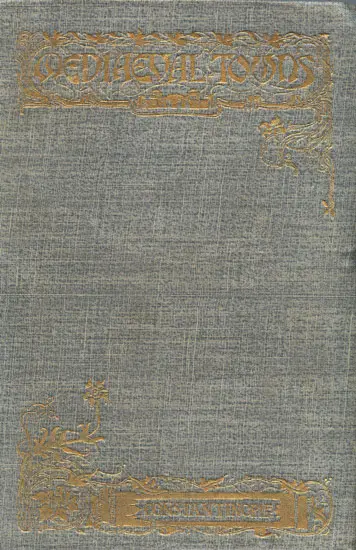
The Church and the Barbarians Being an Outline of the History of the Church from A.D. 461 to A.D. 1003
William Holden Hutton

THE CLASSIC COLLECTION · 1900
"Constantinople: The Story of the Old Capital of the Empire" by William Holden Hutton is a historical account written in the late 19th century. The work explores the rich and complex history of Constantinople, from its foundation as Byzantium through its transformation into the capital of the Eastern Roman Empire under Constantine the Great. It delves into the city's geographical significance, its architectural marvels, and its pivotal role in the history of Christianity and the Byzantine Empire. The opening of the book sets the tone for Hutton's exploration, evoking the awe inspired by Constantinople's stunning landscape and historical importance. Hutton expresses his adoration for the city, referring to it as the “home of the Cæsars of the East.” He notes the beauty of its strategic location, nestled between Asia and Europe, with a flourishing harbor that has historically been a nexus for trade and culture. The author outlines the early history of the site, from its founding by the Greeks to its eventual establishment as the Roman Empire’s new seat of power by Constantine. Through vivid descriptions and references to classical authors, Hutton aims to provide readers with an understanding of both the magnificence of Constantinople and its significance throughout centuries of tumultuous change.
Introduction adapted from the source catalogue; source summaries may be automatically generated.
Free to read · English · 94,133 words · No account needed
MAKE TIME FOR A GOOD BOOK
On by default. Untick to stop anonymous reading totals. Each page counts after 10 seconds in view. How this works.
Anonymous counting is on unless you have switched it off.
The body of Constantine, recognised by the purple buskins, was found in a heap of dead. His head was cut off and borne to the Sultan. It was exposed on a column in front of the palace. The body was buried with respect, and over its grave, not far from where the mosque of Suleiman now stands, a lamp has always been kept burning, but the Ottoman government has sternly repressed the attempt of the faithful Greeks to turn it into a place of pilgrimage and prayer.
So ended the Roman empire of the East. Its fall was an undying disgrace to Christendom, which stood by and would not help. But it fell chiefly through its own weakness. Military power and religion had been the strength of the Empire; corruption had eaten away the first, and the luxury and vice of the imperial court had shown that the Christian faith had failed to hold its own. In the hour of their despair the Emperors turned again to Christ, but it was too late to save the Empire which their defiance of His laws had brought to desolation. The Church of Constantinople must pass through the fires of persecution, and recover in its isolation, if it might be, the strength of the first days.
When Mohammed passed from the great church, he rode along the Hippodrome, and when he came to the serpent column from Delphi he struck off one of the three heads. He had done, he might have said, with the old world. It was the day of the new peoples: a day which began with the destruction of the old. As he walked through the deserted halls of the great palace he repeated the words of Firdusi:
Now the spider draws the curtain in the Cæsar's palace hall, And the owl is made the sentinel on Afrasiab's tower of watch.
[1] This was close to where is now the Kutchuk Aya Sofia (church of S.
Sergius and S. Bacchus).
[2] Van Millingen, "Walls of Constantinople," p. 41.
[3] Themistius, Oratio xviii., quoted by Van Millingen, p. 42.
[4] Van Millingen, pp. 44, 45.
[5] Van Millingen, p. 46.
[6] The very interesting little book of M. Antonin Debidour, L'Impératrice Théodora (1885), should be read by all who are attracted by the wonderful career of this extraordinary Empress.
[7] Church of the Sixth Century, pp. 259, 260.
[8] Byzant. Zeitschrift, i. 69.
[9] See Curtis, Broken Bits of Byzantium, ii. 54, 56.
[10] Later Roman Empire, ii. 352.
[11] Vol. ii., p. 423.
[12] The Church and the Eastern Empire, pp. 106-108.
[13] Vol. ii., p. 446.
[14] Vol. ii., pp. 497-498.
[15] Van Millingen, p. 168.
[16] History of Greece, vol. ii., p. 191.
[17] Gibbon, vol. v., pp. 525, appendix II., a most important and thorough investigation of a very interesting period of legal history.
Your reading position is saved on this browser. Take it to another device with a library code. Reading pages adapt to text, rather than matching a printed edition.
BEHIND THE BOOK
This eBook is for the use of anyone anywhere in the United States and most other parts of the world at no cost and with almost no restrictions whatsoever. You may copy it, give it away or re-use it under the terms of the Project Gutenberg License included with this eBook or online at www.gutenberg.org. If you are not located in the United States, you will have to check the laws of the country where you are located before using this eBook. Read the source licence.
The original source file, including credits and licence, is retained by this library. Request an original-format copy at no charge. Please include the book title and Project Gutenberg identifier #41391.
KEEP YOUR CURIOSITY GOING
Cécile Tormay

Moritz Busch
John L. Ransom
Frances Wright
Cécile Tormay

Mabel Potter Daggett

