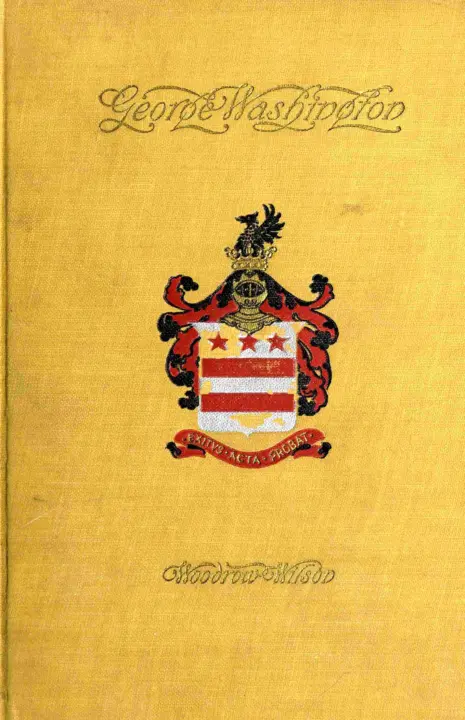
George Washington
Woodrow Wilson

THE CLASSIC COLLECTION · 1885
"Congresional Government: A Study in American Politics" by Woodrow Wilson is an academic publication written in the late 19th century. The work examines the distinctive characteristics of the federal system in the United States, focusing particularly on the centrality of Congress and how its structure and functions differ from other governing bodies around the world. Wilson intends to highlight the peculiarities of American Congressional governance, shedding light on its historical development and its practical implications. The opening of the text serves as a preface where Wilson reflects on the evolution of the United States' governmental structure since the Constitution's adoption. He emphasizes that while the Constitution was intended to establish a system of checks and balances, in practice, Congress has become the predominant force in American governance, often overshadowing the executive branch. Wilson notes the challenges in fully understanding the functioning of Congress due to its complex committee system, which often leads to a considerable amount of business being managed behind closed doors, limiting public insight. He argues for a critical assessment of the congressional system, exploring how it has deviated from its original design and what that means for the future of American politics.
Introduction adapted from the source catalogue; source summaries may be automatically generated.
Free to read · English · 80,327 words · No account needed
MAKE TIME FOR A GOOD BOOK
On by default. Untick to stop anonymous reading totals. Each page counts after 10 seconds in view. How this works.
Anonymous counting is on unless you have switched it off.
It is only in the exercise of those functions of public and formal consultation and cooperation with the President which are the peculiar offices of the Senate, that the power of Congress has made itself offensive to popular conceptions of constitutional propriety, because it is only in the exercise of such functions that Congress is compelled to be overt and demonstrative in its claims of over-lordship. The House of Representatives has made very few noisy demonstrations of its usurped right of ascendency; not because it was diffident or unambitious, but because it could maintain and extend its prerogatives quite as satisfactorily without noise; whereas the aggressive policy of the Senate has, in the acts of its "executive sessions," necessarily been overt, in spite of the closing of the doors, because when acting as the President's council in the ratification of treaties and in appointments to office its competition for power has been more formally and directly a contest with the executive than were those really more significant legislative acts by which, in conjunction with the House, it has habitually forced the heads of the executive departments to observe the will of Congress at every important turn of policy. Hence it is that to the superficial view it appears that only the Senate has been outrageous in its encroachments upon executive privilege. It is not often easy to see the true constitutional bearing of strictly legislative action; but it is patent even to the least observant that in the matter of appointments to office, for instance, senators have often outrun their legal right to give or withhold their assent to appointments, by insisting upon being first consulted concerning nominations as well, and have thus made their constitutional assent to appointments dependent upon an unconstitutional control of nominations.
This particular usurpation has been put upon a very solid basis of law by that Tenure-of-Office Act, which took away from President Johnson, in an hour of party heat and passion, that independent power of removal from office with which the Constitution had invested him, but which he had used in a way that exasperated a Senate not of his own way of thinking. But though this teasing power of the Senate's in the matter of the federal patronage is repugnant enough to the original theory of the Constitution, it is likely to be quite nullified by that policy of civil-service reform which has gained so firm, and mayhap so lasting, a footing in our national legislation; and in no event would the control of the patronage by the Senate have unbalanced the federal system more seriously than it may some day be unbalanced by an irresponsible exertion of that body's semi-executive powers in regard to the foreign policy of the government. More than one passage in the history of our foreign relations illustrates the danger. During the single congressional session of 1868-9, for example, the treaty-marring power of the Senate was exerted in a way that made the comparative weakness of the executive very conspicuous, and was ominous of very serious results. It showed the executive in the right, but feeble and irresolute; the Senate masterful, though in the wrong. Denmark had been asked to part with the island of St. Thomas to the United States, and had at first refused all terms, not only because she cared little for the price, but also and principally because such a sale as that proposed was opposed to the established policy of the powers of Western Europe, in whose favor Denmark wished to stand; but finally, by stress of persistent and importunate negotiation, she had been induced to yield; a treaty had been signed and sent to the Senate; the people of St. Thomas had signified their consent to the cession by a formal vote; and the island had been actually transferred to an authorized agent of our government, upon the faith, on the part of the Danish ministers, that our representatives would not have trifled with them by entering upon an important business transaction which they were not assured of their ability to conclude. But the Senate let the treaty lie neglected in its committee-room; the limit of time agreed upon for confirmation passed; the Danish government, at last bent upon escaping the ridiculous humiliation that would follow a failure of the business at that stage, extended the time and even sent over one of its most eminent ministers of state to urge the negotiation by all dignified means; but the Senate cared nothing for Danish feelings and could afford, it thought, to despise President Grant and Mr. Fish, and at the next session rejected the treaty, and left the Danes to repossess themselves of the island, which we had concluded not to buy after all.
Your reading position is saved on this browser. Take it to another device with a library code. Reading pages adapt to text, rather than matching a printed edition.
Woodrow Wilson
Woodrow Wilson
Woodrow Wilson
Woodrow Wilson
BEHIND THE BOOK
This eBook is for the use of anyone anywhere in the United States and most other parts of the world at no cost and with almost no restrictions whatsoever. You may copy it, give it away or re-use it under the terms of the Project Gutenberg License included with this eBook or online at www.gutenberg.org. If you are not located in the United States, you will have to check the laws of the country where you are located before using this eBook. Read the source licence.
The original source file, including credits and licence, is retained by this library. Request an original-format copy at no charge. Please include the book title and Project Gutenberg identifier #35861.
KEEP YOUR CURIOSITY GOING
Cécile Tormay

Moritz Busch
John L. Ransom
Frances Wright
Cécile Tormay

Mabel Potter Daggett